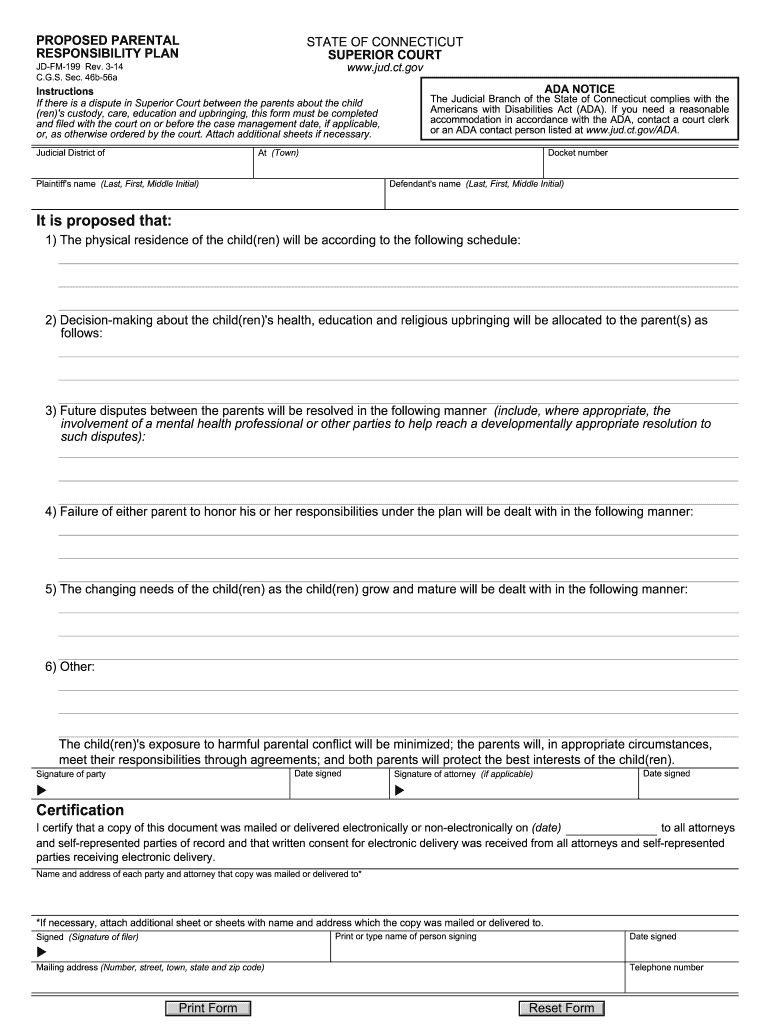
PROPOSED PARENTAL RESPONSIBILITY PLAN STATE OF CONNECTICUT SUPERIOR COURT www. jud. ct. gov JD-FM-199 Rev. 3-14 C. G*S* Sec* 46b-56a ADA NOTICE Instructions If there is a dispute in Superior Court between the parents about the child ren s custody care education and upbringing this form must be completed and filed with the court on or before the case management date if applicable or as otherwise ordered by the court. Attach additional sheets if necessary. Judicial District of The Judicial Branch .
Loading

Open form follow the instructions

Easily sign the form with your finger

Send filled & signed form or save
How to fill out the CT JD-FM-199 online
The CT JD-FM-199 is a vital document used in Connecticut's Superior Court for outlining parental responsibility plans. This guide will provide clear and supportive instructions to assist users in filling out the form online with confidence.
Follow the steps to complete the CT JD-FM-199 online.
- Press the ‘Get Form’ button to access the CT JD-FM-199 document and open it in your preferred online editor.
- Begin by entering the Judicial District where your case will be handled, followed by the docket number if applicable.
- Fill in the names of the parties involved. For the plaintiff, provide the last name, first name, and middle initial. Repeat this process for the defendant.
- In section one, clearly state the proposed physical residence schedule for the child or children. This should detail where the children will stay and the visitation times.
- For section two, allocate decision-making responsibilities regarding the children's health, education, and religious upbringing between the parents.
- Outline how future disputes between the parents will be resolved. Include options for the involvement of mental health professionals if needed.
- In section four, describe the consequences if either parent fails to meet their responsibilities under the proposed plan.
- In section five, explain how you plan to address the changing needs of the children as they grow.
- Finally, use section six to include any additional information or conditions that are pertinent to the parental responsibility plan.
- Review all sections for accuracy and completeness. Once finished, save your changes, download the document, print it, or share it as required.
Take action now and complete your CT JD-FM-199 online!
Experience a faster way to fill out and sign forms on the web. Access the most extensive library of templates available.
Related content
JD-FM-199 Rev. 1-25. C.G.S. § 46b-56a. 1) The physical residence of the child(ren) will...
by I Ayres · 2021 · Cited by 1 — Temporary Restraining Orders ("TROs") provide victims...
This is a list of academic articles related to the coverage of health and medical topics...
Get answers to your most pressing questions about US Legal Forms API.
How to look up divorce records in CT?
To look up divorce records in Connecticut, you can visit the Connecticut Judicial Branch website or contact the local court where the divorce was filed. This process typically involves providing basic information about the case. Understanding how to access these records can help you manage any necessary legal documentation, including forms like the CT JD-FM-199.
Can you file for divorce online in CT?
Yes, you can file for divorce online in Connecticut, streamlining the process for both parties. Many forms, including the CT JD-FM-199, can be submitted through various online platforms that handle divorce filings. This makes it easier for individuals to navigate the legal requirements without needing to visit the courthouse.
What does a 70/30 split look like?
A 70/30 split in custody means one parent has the child 70% of the time, while the other has 30%. This arrangement often reflects the parents' work schedules or living situations, ensuring that the child's best interests are met. The CT JD-FM-199 form can assist in formalizing such custody arrangements, making the terms clear for both parents.
What does joint legal custody mean in CT?
Joint legal custody in Connecticut allows both parents to make significant decisions about their child's life, including education, health care, and religious upbringing. This type of custody emphasizes cooperation between parents to benefit the child’s needs. Using the CT JD-FM-199 form can help facilitate the establishment of joint legal custody, clarifying each parent's role.
What does joint custody mean in CT?
In Connecticut, joint custody refers to both parents sharing legal and physical custody of their child. This means that both parents have equal rights and responsibilities when it comes to making decisions regarding the child's upbringing. The CT JD-FM-199 form is often used to outline joint custody agreements, ensuring a clear structure for both parents.
How to file Connecticut taxes online?
Filing your Connecticut taxes online can be done easily through the state's Department of Revenue Services website or through trusted third-party platforms. You will need your CT JD-FM-199 and other supporting documentation handy to ensure accurate reporting. Many online services offer guidance and resources, ensuring you complete your tax filing correctly and efficiently.
What forms do I need to file for divorce in CT?
To file for divorce in Connecticut, you will generally need to complete several forms, including the CT JD-FM-199. This form outlines the grounds for your divorce and requests essential information. You may also need to provide financial affidavits and custody agreements, depending on your situation. Using a service like uslegalforms can help you find the correct documents.
What is the first step in filing for divorce in CT?
The first step in filing for divorce in Connecticut involves completing the necessary forms, including the CT JD-FM-199, which is crucial for initiating the process. You must first gather information about your marriage and assets. Once you prepare the forms, you can file them at your local Superior Court. It’s important to ensure all details are accurate to avoid delays.
What age can a child refuse to see a parent in CT?
While there is no legal age when a child can refuse to see a parent in Connecticut, their preferences become more significant around age 12. Judges evaluate various aspects, including the child's emotional and psychological well-being, when making visitation decisions. To ensure you understand these laws, consider reviewing the CT JD-FM-199.
At what age can a child refuse visitation in Connecticut?
In Connecticut, there is no specific age when a child can outright refuse visitation; however, children's preferences are taken into account as they mature. Courts often recognize the wishes of children around the age of 12 or older. If you're unsure about your rights regarding visitation, investigating options through the CT JD-FM-199 is advisable.
Use professional pre-built templates to fill in and sign documents online faster. Get access to thousands of forms.
If you believe that this page should be taken down, please follow our DMCA take down process here.