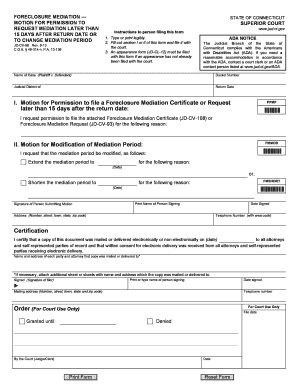
NECTICUT SUPERIOR COURT www.jud.ct.gov Instructions to person filing this form 1. Type or print legibly. 2. Fill out section I or II of this form and file it with the court. 3. An appearance form (JD-CL-12) must be filed with this form if an appearance has not already been filed with the court. ADA NOTICE The Judicial Branch of the State of Connecticut complies with the Americans with Disabilities Act (ADA). If you need a reasonable accommodation in accordance with the ADA, contact a court c.

How it works
  • Open form

    Open form follow the instructions

  • Easily sign form

    Easily sign the form with your finger

  • Share form

    Send filled & signed form or save

How to fill out the CT JD-CV-96 online

The CT JD-CV-96 form is used to request permission to file a foreclosure mediation certificate or to modify the mediation period in the state of Connecticut. This guide provides clear, step-by-step instructions to help users fill out the form accurately and efficiently, ensuring a smooth process.

Follow the steps to complete the CT JD-CV-96 online accurately.

  1. Click the ‘Get Form’ button to access the CT JD-CV-96 online form and open it in the editor.
  2. Begin by entering the name of the case in the format 'Plaintiff v. Defendant'. This is essential for identifying the legal proceeding.
  3. Fill out the 'Return Date' section with the date when the original complaint was filed. This may also be found in your court documents.
  4. Choose between Section I or II to specify the nature of your request. For Section I, indicate whether you are requesting permission to file a mediation certificate or request after the deadline and provide the reason for this request.
  5. If opting for Section II, indicate if you are requesting an extension or shortening of the mediation period, and clearly state the new date and reason for modification.
  6. Sign and date the form in the designated section. Ensure your name and contact information are printed legibly to facilitate communication.
  7. Lastly, review all information for accuracy. Once verified, you can save your changes, download the completed form, print it, or share it as needed.

Begin filling out your CT JD-CV-96 online now for efficient document management.

Get form

Experience a faster way to fill out and sign forms on the web. Access the most extensive library of templates available.

Related content

FORECLOSURE MEDIATION - Connecticut Judicial...

JD-CV-96 Rev. 2-24. C.G.S. § 49-31k-n. Instructions to person filing this form. 1. Fill...

Learn more
The Jerome N. Frank Legal Services Organization

Feb 9, 2024 — This guide may be used by law students (with supervision) and practicing...

Learn more
O Novo Padrão

Design Circumaural Supra-auricular de Costas. Fechadas • Curva de EQ para Música e...

Learn more
Questions & Answers

Get answers to your most pressing questions about US Legal Forms API.

Contact support

What is the 120-day rule for foreclosure?

The 120-day rule for foreclosure is a guideline that often ensures homeowners receive ample time to explore alternatives before facing foreclosure proceedings. This period allows for mediation, negotiations, or other strategies to keep the home while avoiding the stress of foreclosure. It's important to understand this timeframe and how it impacts your rights as a homeowner. Using documents like CT JD-CV-96 can assist in protecting your interests during this critical time.

Foreclosure mediation involves discussions where homeowners and lenders collaborate to explore possibilities to avert foreclosure. Mediators guide these conversations to ensure fair communication. This is a crucial step for homeowners seeking relief from their current situation. Understanding the role of legal documents, including CT JD-CV-96, is essential for properly addressing any issues that arise during mediation.

At the conclusion of successful mediation, a settlement agreement is created that outlines the terms both parties have agreed upon. This agreement often aims to find a compromise to keep the homeowner in their property or alleviate their financial burden. The process is facilitated by mediators who ensure that both sides understand the implications. Utilizing resources such as CT JD-CV-96 can help in drafting and finalizing the mediation results effectively.

Foreclosure typically involves six distinct phases: pre-foreclosure, notice of default, auction, redemption, eviction, and property ownership transfer. During pre-foreclosure, the homeowner becomes aware of the impending foreclosure and can explore options. The notice of default serves as a formal alert, while the auction marks the sale of the home. Understanding these phases is crucial, especially when dealing with forms like CT JD-CV-96 to navigate rights or file necessary documents.

Foreclosure mediation typically begins with the homeowner submitting a request using the CT JD-CV-96 form. Once accepted, a mediation session is scheduled, where both parties present their case. The mediator's goal is to foster a collaborative environment, allowing homeowners and lenders to negotiate terms that could lead to a resolution and prevent foreclosure from proceeding.

The 120 day rule for foreclosure in CT requires lenders to wait at least 120 days after a borrower defaults on a mortgage before filing for foreclosure. This rule provides homeowners with a critical window to seek assistance and negotiate alternatives like mediation. Utilizing the CT JD-CV-96 form can be advantageous during this timeframe, as it opens doors to potential solutions.

Yes, Connecticut has a statute of limitations on foreclosure actions, generally allowing lenders to initiate foreclosure proceedings within six years of the default. This time frame emphasizes the necessity for homeowners to be proactive in addressing potential foreclosure situations. Knowing your rights and timelines, especially in relation to the CT JD-CV-96, can be beneficial in navigating these circumstances.

In CT, a motion to dismiss can be granted for various legal reasons, including lack of jurisdiction, failure to state a claim, or issues related to the statute of limitations. These grounds serve to protect defendants from baseless claims that do not meet legal standards. Understanding the legal framework surrounding these motions is important, especially for those involved in foreclosure cases related to the CT JD-CV-96 form.

The foreclosure mediation statute in CT provides guidelines to facilitate mediation sessions between homeowners and lenders. This law ensures that both parties have the opportunity to discuss options to avoid foreclosure, emphasizing the importance of a collaborative approach. The implementation of the CT JD-CV-96 form is crucial in this process, as it formalizes the request for mediation under the established statute.

Foreclosure mediation in CT is a process designed to help homeowners and lenders reach an agreement before proceeding with property foreclosure. This program aims to encourage communication and negotiation between both parties, fostering resolutions that can help keep families in their homes. With the CT JD-CV-96 form, homeowners can officially request mediation, making it an essential step in the process.

Get This Form Now!

Use professional pre-built templates to fill in and sign documents online faster. Get access to thousands of forms.

If you believe that this page should be taken down, please follow our DMCA take down process here.

Get CT JD-CV-96