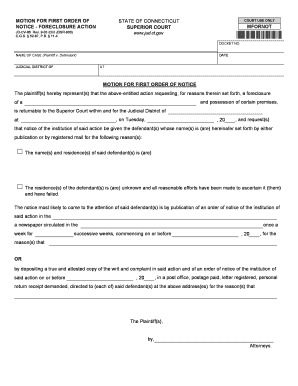
DOCKET NO. NAME OF CASE (Plaintiff v. Defendant) JUDICIAL DISTRICT OF DATE AT MOTION FOR FIRST ORDER OF NOTICE The plaintiff(s) hereby represent(s) that the above-entitled action requesting, for reasons therein set forth, a foreclosure and possession of certain premises, of a is returnable to the Superior Court within and for the Judicial District of , on Tuesday, at , 20 , and request(s) that notice of the institution of said action be given the defendant(s) whose name(s) is (are) here.
Open form follow the instructions
Easily sign the form with your finger
Send filled & signed form or save
How to fill out the CT JD-CV-86 online
The CT JD-CV-86 form is essential for initiating foreclosure actions and notifying defendants of legal proceedings. This guide will walk you through each section of the form, ensuring that you can fill it out accurately and efficiently online.
Follow the steps to complete the CT JD-CV-86 accurately.
- Click ‘Get Form’ button to obtain the form and open it in the editor.
- Begin by filling in the court use only section, leaving the docket number and court identifiers blank as they will be assigned by the court during processing.
- In the 'Name of Case' field, clearly state the names of the plaintiff and defendant in the format 'Plaintiff v. Defendant'.
- Fill in the 'Judicial District' field with the appropriate district where the action is being filed.
- Enter the date when the action is set to be heard at the court.
- In the 'Description of Motion' section, explain the reasons for the foreclosure and possession request. Be specific about what you are seeking from the court.
- Provide names and addresses of the defendants in the designated area. If any addresses are unknown, indicate that reasonable efforts have been made to ascertain them.
- Choose whether the notice will be given by publication or by mail. If opting for publication, specify the newspaper and the duration of the notice. If choosing registered mail, detail the method and ensure that return receipt is demanded.
- Finally, include the plaintiff's signature and print the name of the attorney representing them, if applicable.
- Once all sections are filled out, review the form for accuracy. Users can then save changes, download, print, or share the form as needed.
Complete your documents online today for a smoother filing process.
Experience a faster way to fill out and sign forms on the web. Access the most extensive library of templates available.
Related content
JD-CV-86 Rev. 1-20. C.G.S. § 52-87, P.B. § 11-4. MFORNOT. COURT USE ONLY. Docket number...
Global and contingent self-esteem and moderators in the relations between adolescent...
Design Circumaural Supra-auricular de Costas. Fechadas • Curva de EQ para Música e...
Get answers to your most pressing questions about US Legal Forms API.
Who pays lawyer fees in small claims court?
In small claims court, each party generally pays their own legal fees. This setup encourages individuals to represent themselves, which aligns with the court's goal of simplifying the legal process. If you choose to use professional legal services, be mindful of this aspect, and utilize resources like the CT JD-CV-86 to bolster your arguments and focus on your claim.
Is it worth taking someone to small claims court?
Taking someone to small claims court can be worthwhile if you feel wronged and deserve compensation. The process is simpler and typically faster than regular court, making it accessible for many. Before proceeding, consider using the CT JD-CV-86 to outline your case effectively, as a well-prepared claim can increase your chances of success.
What is the maximum I can claim in the small claims court?
In small claims court, you can seek compensation up to $5,000. This limit allows individuals to resolve disputes without the need for extensive legal representation. When preparing your claim, you may find the CT JD-CV-86 form useful for accurately presenting your case and ensuring all necessary details are included.
How do I retire from the practice of law in CT?
To retire from the practice of law in Connecticut, you must follow specific steps. First, inform the Connecticut Bar Association of your intention to retire. Then, ensure you settle any outstanding professional obligations, including any pending cases or fees. Finally, consider filing the CT JD-CV-86 form to formalize your retirement status.
What is the statute of limitations in CT for small claims court?
In Connecticut, the statute of limitations for small claims court varies depending on the type of claim but generally ranges from two to six years. It’s crucial to be aware of these timelines to protect your rights effectively. If you're dealing with CT JD-CV-86, understanding these limits can help you take timely legal action.
How to serve a small claims writ and notice of suit in CT?
To serve a small claims writ and notice of suit in Connecticut, you must deliver these documents to the defendant personally or through a legally approved method. Ensuring proper service is essential for your case's validity. If you're unsure about the procedures, using resources from USLegalForms to help you navigate serving documents related to CT JD-CV-86 can be extremely beneficial.
What is Section 10 35 of the CT practice book?
Section 10-35 of the Connecticut Practice Book outlines the rules and procedures for motions related to pleadings. This section is pivotal for understanding how and when to challenge or amend pleadings in your case. Familiarity with this section, especially in connection with CT JD-CV-86, helps you navigate the legal landscape more effectively.
What does a certificate of closed pleadings mean?
A certificate of closed pleadings serves as a formal declaration that all necessary legal documents have been filed and no further pleadings will be submitted. Essentially, it locks in the current state of the case, allowing it to move forward. If you're working with CT JD-CV-86, this certificate plays a crucial role in your legal journey.
When to file certificate of closed pleadings CT?
You should file the certificate of closed pleadings in Connecticut after all parties have completed their pleadings and before moving on to trial or other legal proceedings. This document signifies that you are ready to advance your case legally. Using the CT JD-CV-86 form can streamline this process, ensuring that you meet the court's requirements efficiently.
What does it mean when pleadings are closed?
When pleadings are closed, it means that both parties in a legal case have submitted all necessary documents to the court. This stage indicates that the court will no longer accept new pleadings unless there are compelling reasons. For those dealing with forms related to CT JD-CV-86, understanding this concept is key to preparing for the next steps in their case.
Use professional pre-built templates to fill in and sign documents online faster. Get access to thousands of forms.
If you believe that this page should be taken down, please follow our DMCA take down process here.
This form is available in several versions. Select the version you need from the drop-down list below.