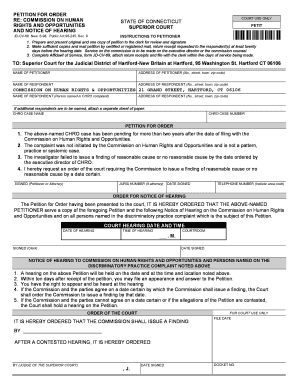
TIONS TO PETITIONER 1. Prepare and present original and one copy of petition to the clerk for review and signature 2. Make sufficient copies and mail petition by certified or registered mail, return receipt requested to the respondent(s) at least twenty days before the hearing date. Service on the commission is to be made on the executive director or the commission counsel. 3. Complete Affidavit of Service, form JD-CV-69, attach return receipts and file with the clerk within five days of service.
Open form follow the instructions
Easily sign the form with your finger
Send filled & signed form or save
How to fill out the CT JD-CV-68 online
Filling out the CT JD-CV-68 form is an essential step in addressing human rights and opportunities concerns. This guide provides a step-by-step approach to ensure that users can successfully complete the form online.
Follow the steps to properly complete the CT JD-CV-68 form
- Click ‘Get Form’ button to access the form online and open it in your browser.
- Begin by entering your name as the petitioner in the designated 'NAME OF PETITIONER' field. Ensure that you provide your full legal name.
- Fill in your address in the 'ADDRESS OF PETITIONER' section, including the street number, street name, town, and zip code.
- Next, input the name of the respondent in the 'NAME OF RESPONDENT' field, as well as their corresponding address in the 'ADDRESS OF RESPONDENT' section.
- If there are multiple respondents, attach an additional sheet of paper with their names and addresses.
- Provide the CHRO case name and case number in the appropriate fields, ensuring accurate details to support your petition.
- Complete the section stating the reasons for your petition by affirmatively checking the provided statements regarding the status of your CHRO case.
- Sign the form in the 'SIGNED' section. If you are an attorney, include your jurisdiction number in the 'JURIS NUMBER' field.
- Input the date you are signing the form and your contact telephone number in the respective fields.
- After filling in all necessary information, review the form for any errors or omissions before submitting.
- Once satisfied that all fields are completed accurately, you can save changes, download, print, or share the form as needed.
Complete your CT JD-CV-68 form online today for a smoother filing process.
Experience a faster way to fill out and sign forms on the web. Access the most extensive library of templates available.
Related content
JD-CV-68 Rev 12-23. C.G.S. § 46a-82e. TO: Superior Court for the Judicial District of...
Here as well any injury resulting from the State's decision to cross-reference the...
Design Circumaural Supra-auricular de Costas. Fechadas • Curva de EQ para Música e...
Get answers to your most pressing questions about US Legal Forms API.
What does a certificate of closed pleadings mean?
A certificate of closed pleadings indicates that all involved parties have finalized their pleadings and there are no outstanding issues to be addressed. This certificate plays a key role in moving a case forward in the court system, affirming that the matter is ready for the next steps. Utilizing the CT JD-CV-68 helps ensure compliance and strong communication with the court.
What does it mean when pleadings are closed?
When pleadings are closed, it means that all parties have submitted their written arguments, and no further changes can be made to those documents. This closure is a significant step in the legal process, as it prepares the case for trial or resolution. Submitting the CT JD-CV-68 confirms this closure and informs the court that the case is ready to progress.
What is Section 10 35 of the CT practice book?
Section 10-35 of the CT practice book pertains to the requirements for pleadings, specifically addressing the closure of pleadings. Understanding this section is crucial when dealing with civil cases, as it outlines when a party can no longer amend their pleading. The CT JD-CV-68 form ties into this process, ensuring you meet all requirements and deadlines.
Is it worth taking someone to small claims court?
Taking someone to small claims court may be worthwhile if the amount in dispute is significant and you have a solid case. It allows you to resolve disputes efficiently without the need for a lengthy trial. Utilizing the CT JD-CV-68 certificate may streamline your experience in small claims court, boosting your confidence and clarity moving forward.
When to file certificate of closed pleadings CT?
You should file the certificate of closed pleadings CT after all parties have submitted their written claims and defenses. This document serves to notify the court that there are no outstanding pleadings. Filing the CT JD-CV-68 is essential for moving your case forward in the legal process. Make sure to check the specific court’s rules regarding the timing of this filing.
What is the maximum for small claims court in CT?
What is Small Claims Court? Small Claims Court is a part of Connecticut's court system where a person can sue for money damages only up to $5,000.00 or in the case of a home improvement contract, money damages are limited up to $15,000. That amount is set by state law and may change from time to time.
What is the limitations for Small Claims Court in Connecticut?
The “Small Claims Court” is a part of Connecticut's court system where a person may sue for up to $5,000.00 in money damages only. This amount is set by state law and may change from time to time. To find out the current amount, you may contact any court clerk's office.
Do judgments expire in Connecticut?
Keep in mind, judgments issued by Connecticut Superior Courts are enforceable for up to 20 years and can possibly be revived for an additional period of time if proper procedure is followed before the expiration date.
What is the statute of limitations of judgment in CT?
How long does a judgment lien last in Connecticut? A judgment lien in Connecticut will remain attached to the debtor's property (even if the property changes hands) for 20 years (for liens on real estate) or five years (liens on personal property).
How long do you have to file a lawsuit in CT?
Generally, you have two years to file a case but there are circumstances where you have much less time to notify the parties that you are intending to sue. For a quasi-governmental agency, you might have notice periods as short as 90 days.
Use professional pre-built templates to fill in and sign documents online faster. Get access to thousands of forms.
If you believe that this page should be taken down, please follow our DMCA take down process here.