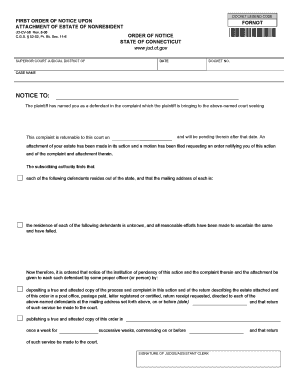
Ov SUPERIOR COURT JUDICIAL DISTRICT OF DATE DOCKET NO. CASE NAME NOTICE TO: The plaintiff has named you as a defendant in the complaint which the plaintiff is bringing to the above-named court seeking and will be pending therein after that date. An This complaint is returnable to this court on attachment of your estate has been made in its action and a motion has been filed requesting an order notifying you of this action and of the complaint and attachment therein. The subscribing autho.

How it works
  • Open form

    Open form follow the instructions

  • Easily sign form

    Easily sign the form with your finger

  • Share form

    Send filled & signed form or save

How to fill out the CT JD-CV-58 online

Filling out the CT JD-CV-58 form can seem daunting, but this guide aims to simplify the process. By following these clear steps, you can complete the form accurately and efficiently.

Follow the steps to successfully fill out the form.

  1. Press the ‘Get Form’ button to access the document. This will allow you to open the form in the editor.
  2. Begin by entering the date at the top of the form where indicated. This date should reflect the current date or the date relevant to your case.
  3. Fill in the docket number where prompted. Ensure that this number corresponds to the case associated with your complaint.
  4. In the ‘Case Name’ section, provide the full name of the case as it appears in the court documents. This identifies the matter you are addressing.
  5. Specify the names and addresses of the defendants. It is essential to ensure this information is accurate and complete for the court's records.
  6. Indicate whether the defendants reside out of state or if their residence is unknown. This information is crucial for the court to determine the next steps for notification.
  7. Provide details about how the notice will be served, including whether it will be mailed or published. Include the date by which this action should occur.
  8. Finally, the form must be signed by the judge or assistant clerk. Make sure to leave space for their signature before finalizing your document.
  9. After completing the form, you can save any changes you made. Depending on your needs, you may choose to download, print, or share the form.

Take the next step and complete your CT JD-CV-58 form online today.

Get form

Experience a faster way to fill out and sign forms on the web. Access the most extensive library of templates available.

Related content

FIRST ORDER OF NOTICE UPON ATTACHMENT OF ...

JD-CV-58 Rev. 1-20. C.G.S. § 52-52, P.B. § 11-6. Notice to: This complaint is returnable...

Learn more
Efeito da aplicação de nitrogênio e de...

by EG Martinazzo · 2016 · Cited by 5 — Este trabalho teve como objetivo verificar o...

Learn more
O Novo Padrão

Design Circumaural Supra-auricular de Costas. Fechadas • Curva de EQ para Música e...

Learn more
Questions & Answers

Get answers to your most pressing questions about US Legal Forms API.

Contact support

What does it mean when pleadings are closed?

When pleadings are closed, it means that all parties have submitted their necessary documents, and no further amendments or additions will be accepted. This closure allows the court to set a timeline for the case proceedings. Knowing this stage is critical, especially when filing important documents like the CT JD-CV-58, as it signifies readiness to proceed with the trial or next steps.

You should file a certificate of closed pleadings in Connecticut once all necessary pleadings have been completed and submitted. This filing is essential to move your case forward, often making it a prerequisite for scheduling further hearings. Referencing the CT JD-CV-58, ensure you file this certificate promptly to avoid any procedural hindrances.

Section 10 35 of the Connecticut Practice Book pertains to closed pleadings and the related requirements in civil cases. This section specifies the process for closing pleadings, which is crucial for moving forward with litigation. Understanding this section helps parties involved in a case to correctly follow the necessary steps, including the filing of CT JD-CV-58.

To serve a small claims writ and notice of suit in Connecticut, you must follow the guidelines outlined in the CT JD-CV-58 form. Typically, you can serve the notice through a state marshal or by any method that complies with Connecticut law. Ensure that you provide proper documentation to the court, confirming service has been completed to avoid any delays in your case.

A certificate of closed pleadings indicates that all necessary pleadings have been submitted and filed in a case. This document, often related to the CT JD-CV-58, signifies that the parties involved have completed their filings, allowing the case to proceed to the next stage. By obtaining this certificate, you confirm that the matter is ready for scheduling hearings or other judicial actions.

You have two years from the date of the incident to file a small claims suit in Connecticut. This timeline emphasizes the importance of acting swiftly if you wish to pursue a claim. By using the CT JD-CV-58 form, you can ensure that all paperwork is completed accurately and submitted on time.

The statute of limitations for small claims in Connecticut is generally two years for most civil actions. This means you must file your claim within this period to seek legal recourse. Utilizing the CT JD-CV-58 can assist you in understanding filing processes and compliance with local laws.

In Connecticut, small claims court limits the amount you can sue for to $5,000 per case. This limit encourages individuals to resolve minor disputes without the complexities of larger court processes. If you plan to file a small claim, obtaining the CT JD-CV-58 form can simplify and streamline your filing process.

In Connecticut, the timeframe to initiate a lawsuit depends on the type of case. For most civil actions, including breach of contract, you typically have six years to file. The CT JD-CV-58 form can provide you with the essential guidelines you need to ensure your claim is filed within the appropriate period.

In Connecticut, court recording monitors earn varying salaries based on their experience and location. Generally, courthouse monitors can expect to make between $40,000 and $55,000 annually. If you are considering a career in this field, the CT JD-CV-58 form may be beneficial for understanding related legal proceedings and requirements.

Get This Form Now!

Use professional pre-built templates to fill in and sign documents online faster. Get access to thousands of forms.

If you believe that this page should be taken down, please follow our DMCA take down process here.

CT JD-CV-58 Form

This form is available in several versions. Select the version you need from the drop-down list below.

Get CT JD-CV-58