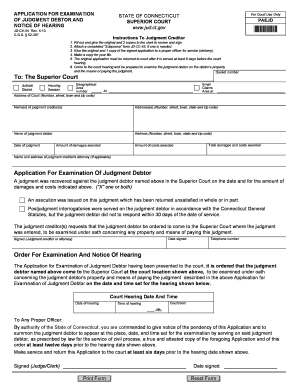
Tructions To Judgment Creditor 1. Fill out and give the original and 2 copies to the clerk to review and sign. 2. Attach a completed "Subpoena" form JD-CL-43, if one is needed. 3. Give the original and 1 copy of the signed application to a proper officer for service (delivery). 4. Make a copy for your file. 5. The original application must be returned to court after it is served at least 6 days before the court hearing. 6. Come to the court hearing and be prepared to examine the judgment debtor.

How it works
  • Open form

    Open form follow the instructions

  • Easily sign form

    Easily sign the form with your finger

  • Share form

    Send filled & signed form or save

How to fill out the CT JD-CV-54 online

This guide provides step-by-step instructions on completing the CT JD-CV-54 Application for Examination of Judgment Debtor online. Whether you are a judgment creditor seeking to assess a debtor's financial situation or simply navigating the legal process, this guide will assist you in effectively using the form.

Follow the steps to complete the form accurately.

  1. Select the ‘Get Form’ button to obtain the document and open it in the editor.
  2. Fill in the 'Docket number' field accurately with the relevant case number assigned by the court.
  3. Enter the 'Address of Court' using the complete address, including number, street, town, and zip code.
  4. Specify the 'Judicial District' and any applicable 'Housing Session' or 'Small Claims Area'.
  5. Provide the names and addresses of all judgment creditors in the designated sections.
  6. Fill in the name and address of the judgment debtor, ensuring all information is correct.
  7. Record the 'Date of judgment' and the amounts for 'Damages awarded', 'Costs awarded', and the 'Total damages and costs awarded'.
  8. If applicable, include the name and address of the judgment creditor's attorney.
  9. In the application section, check the boxes for the reasons prompting the examination request.
  10. Date the application, and secure the signature of the judgment creditor or their attorney, along with their telephone number.
  11. Complete the 'Court Hearing Date and Time' by entering the relevant hearing details including courtroom and time.
  12. Once the form is filled out, review all entries for accuracy. You can then save your changes, download, print, or share the form as needed.

Get started now by completing the CT JD-CV-54 form online.

Get form

Experience a faster way to fill out and sign forms on the web. Access the most extensive library of templates available.

Related content

CV054CO.pdf - Connecticut Judicial Branch - CT.gov

1. Fill out and give the original and 2 copies to the clerk to review and sign. 2. Attach...

Learn more
Case 3:20-cv-05151-JD Document 54 Filed 11/23/21...

Apr 21, 2022 — The final rule also prohibits any “may be” labeling, despite the...

Learn more
Renal Cell Carcinoma - Cloudfront.net

EPIDEMIOLOGY, AETIOLOGY AND PATHOLOGY. 11. 3.1. Epidemiology. 11. 3.2. Aetiology. 11...

Learn more
Questions & Answers

Get answers to your most pressing questions about US Legal Forms API.

Contact support

How long do you have to sue someone in CT?

In Connecticut, the time limit to file a lawsuit, known as the statute of limitations, varies depending on the nature of your claim. For most personal injury cases, you generally have two years from the date of the incident to file. However, for contract disputes, this period can be up to six years. Make sure to review available resources like CT JD-CV-54 and seek guidance through platforms like UsLegalForms to ensure you meet all deadlines.

In Connecticut, a motion to dismiss can be filed for several reasons, including lack of jurisdiction, failure to state a claim, or if the case is barred by law. These grounds help ensure that only valid cases proceed through the court system. If you find yourself needing to file a motion, consulting with legal forms, such as the CT JD-CV-54, can help clarify your compliance with procedural requirements. UsLegalForms can assist you in preparing the necessary documents.

To file for workers' compensation in Connecticut, you must first report your injury to your employer as soon as possible. Next, fill out the necessary forms, including the CT JD-CV-54 if necessary. It’s crucial to understand your rights and the deadlines involved, as timely submission can significantly impact your claim. UsLegalForms offers various resources to help you navigate this process smoothly.

Taking someone to small claims court can be beneficial if you have a valid claim and can present solid evidence. The process is often faster and less expensive than traditional court proceedings. However, you should weigh the potential outcomes and costs of filing forms like CT JD-CV-54 against the amount you wish to recover. Consider using resources like UsLegalForms to streamline your claim process effectively.

That's why most small claims cases are local. However, sometimes you may need to file a small claims lawsuit against a defendant who lives in another state. ... If that person never comes to the state, you may not be able to sue them in small claims court.

Small claims court is designed to be a way for people to recover money in cases that are too small to be worth going through regular litigation, which can be costly and time-consuming. There's not a minimum amount you can sue for in small claims court, but most courts have a filing fee that will be between $25 and $50.

Try to settle the dispute outside of court. ... Contact the county clerk in the small claims court district closest to the residence or business of the person you are suing. ... Fill out a complaint form, otherwise known as a "Statement of Claim" at the clerk's office, and pay the filing fee.

Only an individual can sue in Small Claims Court. Corporations, partnerships, associations, or assignees cannot sue in Small Claims Court. However, they can be sued in Small Claims Court. If you are a corporation, partnership, association or assignee, you can bring a Commercial Claim or Consumer Transaction.

If you are younger than 18, your parent or guardian may file the claim for you. Corporations, partnerships, association or assignees cannot sue in Small Claims Court, but they can be sued. If you sue in Small Claims Court, you are the claimant (plaintiff); if you have been sued, you are the defendant.

Generally, claims involving a relatively small amount of money (up to $10,000 depending on the state) should be filed in small claims court. A separate court will hear cases involving medium-sized claims (usually up to $25,000) and another court will hear most claims that exceed that amount.

Get This Form Now!

Use professional pre-built templates to fill in and sign documents online faster. Get access to thousands of forms.

If you believe that this page should be taken down, please follow our DMCA take down process here.

Get CT JD-CV-54