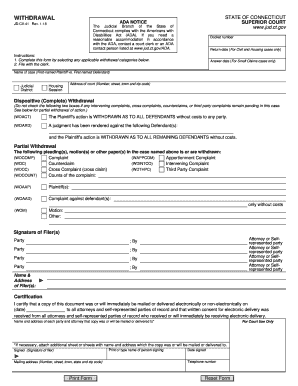
WITHDRAWAL STATE OF CONNECTICUT SUPERIOR COURT www. jud. ct. gov ADA NOTICE JD-CV-41 Rev. 1-18 The Judicial Branch of the State of Connecticut complies with the Americans with Disabilities Act ADA. If you need a reasonable accommodation in accordance with the ADA contact a court clerk or an ADA contact person listed at www. jud. ct. gov/ADA. Docket number Return date For Civil and Housing cases only Instructions 1. Complete this form by selecting any applicable withdrawal categories below. 2. Fi.
Open form follow the instructions
Easily sign the form with your finger
Send filled & signed form or save
How to fill out the CT JD-CV-41 online
The CT JD-CV-41 form is used for the withdrawal of a case in Connecticut Superior Court. This guide will provide you with clear and supportive instructions on how to complete this form online, ensuring that you can efficiently manage your document needs.
Follow the steps to successfully complete the CT JD-CV-41 online.
- Click the ‘Get Form’ button to obtain the form and open it in the editing interface.
- Fill in the docket number and return date. Ensure accuracy as these details link your form to a specific case.
- Enter the name of the case, listing the first-named plaintiff against the first-named defendant.
- Select the appropriate judicial district and provide the address of the court, including number, street, town, and zip code.
- Choose the relevant category for withdrawal. Indicate whether it is a dispositive (complete) withdrawal or a partial withdrawal by checking the appropriate boxes.
- If it is a dispositive withdrawal, select if the action is withdrawn as to all defendants or if a judgment has been rendered against certain defendants.
- For partial withdrawal, specify the pleadings, motions, or other papers being withdrawn by checking the relevant boxes.
- Sign the form in the designated area for the filer(s). If there are multiple filers, include their signatures.
- Complete the certification section by filling in the date and providing details on how a copy of the document will be delivered to all parties.
- Finalize your form by reviewing all entries for accuracy. You can then save changes, download, print, or share the completed form as needed.
Complete your CT JD-CV-41 form online today to efficiently manage your legal actions.
Experience a faster way to fill out and sign forms on the web. Access the most extensive library of templates available.
Related content
JD-CV-41 Rev. 1-18. (WOARD). ; By. ; By. ; By. ; By. Attorney or Self- represented ... If...
ADS Classic is now deprecated. It will be completely retired in October 2019. This page...
Design Circumaural Supra-auricular de Costas. Fechadas • Curva de EQ para Música e...
Get answers to your most pressing questions about US Legal Forms API.
How long after an injury can you sue in CT?
After an injury in Connecticut, you typically have two years to file a lawsuit, as dictated by state law. However, certain exceptions may apply, which could alter this timeline. Understanding these nuances related to CT JD-CV-41 is vital. For thorough assistance, explore uslegalforms for document preparation and legal advice tailored to your situation.
How long do you have to sue someone in CT?
In Connecticut, the time frame to sue someone can vary, but common civil claims must generally be filed within two to six years from the event that caused the dispute. The specific deadline hinges on the nature of the lawsuit, including personal injury and contract issues. Be sure to refer to the CT JD-CV-41 for clarity on related processes. To navigate these timelines effectively, uslegalforms can provide crucial resources.
What is the longest you can wait to sue someone?
The longest you can wait to file a lawsuit in Connecticut can be up to six years for certain types of cases, depending on the specific claims. However, waiting too long risks losing your rights to seek compensation. Therefore, understanding the relevant statutes related to CT JD-CV-41 is essential. Consult uslegalforms for precise guidelines and document templates to help you file your claim timely.
How do you withdraw an action by plaintiff in CT?
To withdraw an action as a plaintiff in Connecticut, you typically need to file a motion with the court. This motion should outline your reasons for withdrawal and may require court approval. Utilizing CT JD-CV-41 simplifies this process, as it provides the necessary forms and guidance. For comprehensive support, consider uslegalforms to ensure all paperwork is correctly submitted.
How long do you have to file a lawsuit in CT?
In Connecticut, the time limits for filing a lawsuit vary depending on the nature of the claim. Generally, most civil lawsuits must be filed within two years from the date of the injury or incident. It is crucial to act promptly, especially if your case involves specific statutes like the CT JD-CV-41. You can rely on resources like uslegalforms to access necessary documents and information.
When to file certificate of closed pleadings CT?
You should file a certificate of closed pleadings in Connecticut when all parties have finished filing their pleadings and ready for trial. This document helps the court understand that the case is prepared to move forward. Utilizing the CT JD-CV-41 ensures that you have all necessary documentation to support progression in the legal process.
Is it worth taking someone to small claims court?
Taking someone to small claims court can be worthwhile if the amount you are owed falls within the court's limits and if you believe you have a strong case. Many individuals find the process accessible and efficient, especially with the right forms, such as the CT JD-CV-41. Always evaluate your situation carefully to decide if pursuing legal action is the best route.
How long do you have to file small claims in CT?
In Connecticut, the time frame for filing a small claims case generally mirrors the statute of limitations for the underlying claim, which is usually six years. Hence, it’s vital to act promptly if you feel you have a valid claim. Remember, the CT JD-CV-41 form is essential for formalizing your small claims process.
How much can you sue for in Connecticut?
In Connecticut, you can sue for damages up to $5,000 in small claims court. This limit allows individuals to resolve disputes efficiently without engaging in complex legal processes. It's important to use the correct forms, like the CT JD-CV-41, to ensure your claim meets all necessary requirements.
How can I avoid paying a judgement?
To avoid paying a judgment, you may explore options such as negotiating a settlement or filing for bankruptcy. Understanding your legal rights is vital, and you may want to consult with a legal expert. Additionally, using the CT JD-CV-41 form can help you communicate your position effectively in court, potentially leading to a more favorable outcome. Active engagement in this process is key.
Use professional pre-built templates to fill in and sign documents online faster. Get access to thousands of forms.
If you believe that this page should be taken down, please follow our DMCA take down process here.