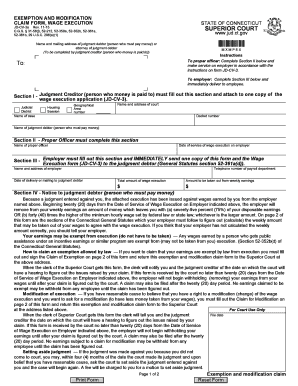
On on Employer indicated above, the employer will not begin withholding (removing) your earnings from your wages until after your claim is figured out by the court. A claim may also be filed after the twenty (20) day period. No earnings claimed to be exempt may be withheld from any employee until the claim has been figured out. Modification of execution If you have reasonable cause to believe that you have a right to a modification (change) of the wage execution and you want to ask for a mod.
Open form follow the instructions
Easily sign the form with your finger
Send filled & signed form or save
How to fill out the CT JD-CV-3a online
The CT JD-CV-3a form is essential for individuals seeking to claim an exemption or modification from wage execution in Connecticut. This guide provides a clear, step-by-step approach to help you complete the form efficiently and accurately.
Follow the steps to successfully complete the CT JD-CV-3a form online.
- Press the 'Get Form' button to access the CT JD-CV-3a document online.
- Fill out Section I, providing the name and mailing address of the judgment debtor. Be sure to include the court's details and the names of relevant parties.
- In Section II, the proper officer must complete their section based on service information provided. Provide the name of the proper officer and the date the wage execution was served on the employer.
- In Section III, the employer must provide their name, address, and telephone number. It is crucial to also indicate the date of delivery or mailing to the judgment debtor and the total amount of the wage execution.
- Section IV contains the notice to the judgment debtor. Ensure to fill out the amount to be deducted from weekly earnings based on the calculation guidelines provided.
- Complete Section V to claim exemption, certifying the reason your earnings are exempt from execution. Sign and date this section.
- If seeking a modification of the wage execution, fill out Section VI, stating the new amount requested and the reasoning for the modification. Provide your signature and date.
- In Section VII, if applicable, the judgment creditor must agree to the modification by signing their name along with the date.
- Complete Section VIII if there is a scheduled hearing regarding the exemption or modification claim, indicating the date, time, and courtroom.
- Finalize the form with Section IX, where the court will outline its order. Sign as directed.
- Once all sections are completed, save any changes made online, then download, print, or share the completed form as needed.
Ensure to file your documents online and take the necessary steps to protect your rights effectively.
Experience a faster way to fill out and sign forms on the web. Access the most extensive library of templates available.
Related content
This form is for claiming exemption from wage execution, especially for those with public...
Thus, in Planned Parenthood, the court held the plaintiff could challenge certain federal...
Design Circumaural Supra-auricular de Costas. Fechadas • Curva de EQ para Música e...
Get answers to your most pressing questions about US Legal Forms API.
What happens if you don't go to court for a judgement?
If you fail to appear in court for a judgment case, the court may issue a default judgment against you. This means the other party wins automatically, potentially resulting in wage garnishment, bank levies, or property liens. To avoid such outcomes, you may want to consult resources like the CT JD-CV-3a form through US Legal Forms, which provides essential information on handling legal issues related to judgments.
How long does a judgement lien last in CT?
A judgment lien in Connecticut lasts for five years from the date the judgment is recorded. If the lien holder does not take further action to enforce the lien, it will expire at the end of this period. It’s important to note that you may need to file a notice of the lien periodically, and utilizing the CT JD-CV-3a form can help streamline processes related to managing judgment liens effectively.
How is wage garnishment calculated in CT?
In Connecticut, wage garnishment is calculated based on your disposable earnings, which is the amount remaining after legally required deductions. The maximum amount that can be garnished is 25% of your disposable earnings or the amount by which your weekly income exceeds 40 times the federal minimum wage, whichever is less. To ensure you understand your rights and responsibilities regarding wage garnishment, consider using the CT JD-CV-3a form available on the US Legal Forms platform.
Is there a way around wage garnishment?
While it can be challenging, there are strategies to evade wage garnishment. Seeking legal counsel can provide a clearer path, as some exemptions might apply based on individual circumstances. Filing necessary documents, such as the CT JD-CV-3a, can also offer protection. Overall, staying informed about your rights is crucial to combating unwarranted garnishments.
What is the most they can garnish from your paycheck?
Typically, creditors can garnish a portion of your paycheck, generally up to 25% of your disposable earnings. However, the exact amount may vary depending on the type of debt and state laws. Knowing the limit on garnishments can help you manage your finances effectively. Utilize resources like the CT JD-CV-3a to better understand the specifics that apply to your situation.
What wages are exempt from garnishment?
Certain wages are exempt from garnishment, including social security benefits, unemployment benefits, and retirement benefits. The law protects a portion of your earnings to ensure you can still support yourself. Familiarizing yourself with these exemptions can be beneficial, especially in managing debt. Reference the CT JD-CV-3a for further clarification on protected wages.
How do you calculate disposable earnings for employees?
Calculating disposable earnings involves determining an employee's gross income and subtracting mandatory deductions like taxes and social security. It is crucial for employers to follow guidelines accurately under the law. For employees facing garnishment, understanding this calculation can help protect part of their wages. Tools such as the CT JD-CV-3a offer helpful insights regarding these calculations.
How do you get around wage garnishment?
To navigate around wage garnishment, it's essential to understand your rights and options. You might consider negotiating with your creditor, possibly leading to a settlement or reduced payment plan. Additionally, using tools like the CT JD-CV-3a can help you file a claim for exemption if applicable. Always explore legal advice for the most informed decisions.
How do you calculate employee earnings?
To calculate employee earnings, begin with the employee's hourly wage or salary and multiply by the hours worked or period of employment. Next, consider any overtime, bonuses, or commissions earned during that time. When considering employment guidelines related to CT JD-CV-3a, accurate calculation of earnings ensures fair compensation and adherence to legal requirements. Solid documentation of these calculations is key for both employers and employees.
What is the formula for disposable income?
The formula for disposable income is straightforward: Disposable Income = Gross Income - Taxes - Other Deductions. By following this formula, individuals can ensure they have a clear understanding of their financial situation. This calculation is especially relevant when considering debts and obligations in reference to CT JD-CV-3a. Accurate calculations can lead to more informed financial decisions.
Use professional pre-built templates to fill in and sign documents online faster. Get access to thousands of forms.
If you believe that this page should be taken down, please follow our DMCA take down process here.