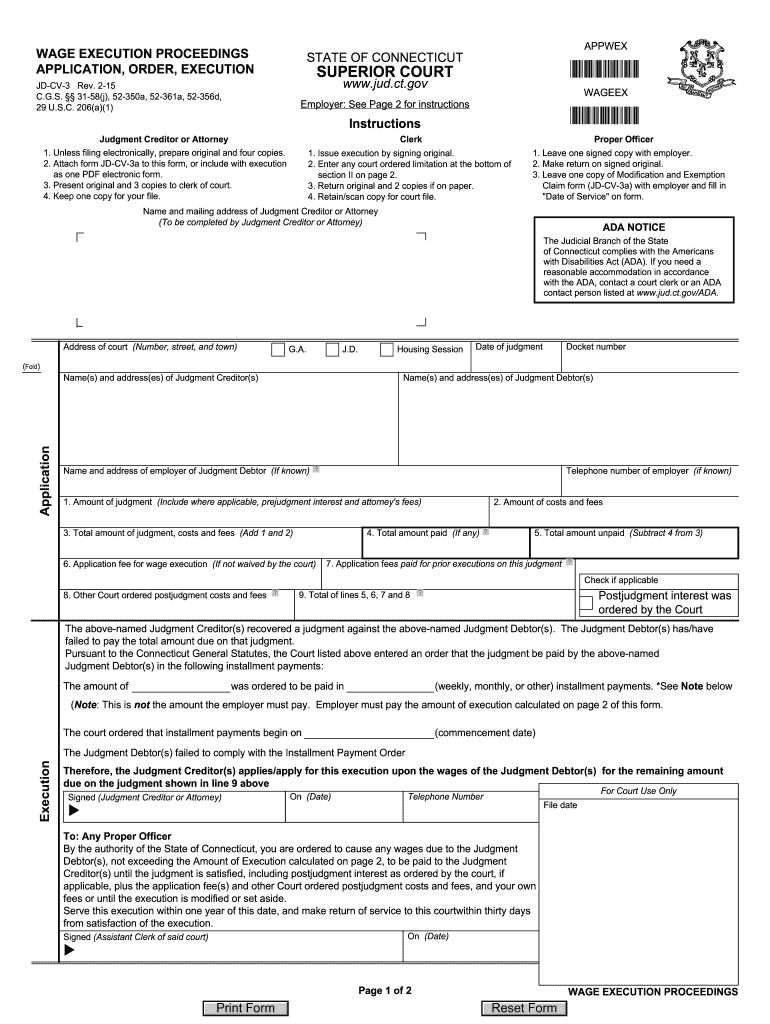
Ne year of this date, and make return of service to this courtwithin thirty days from satisfaction of the execution. On (Date) Signed (Assistant Clerk of said court) u Page 1 of 2 Print Form WAGE EXECUTION PROCEEDINGS Reset Form Important Notice To Employer You are being served with a wage execution, a court order requiring you to withhold non-exempt wages from a person employed by you. This execution is being served on you because your employee, the Judgment Debtor (on page 1), has had.
Loading

Open form follow the instructions

Easily sign the form with your finger

Send filled & signed form or save
How to fill out the CT JD-CV-3 online
The CT JD-CV-3 form is essential for initiating wage execution proceedings in Connecticut. This guide provides clear, step-by-step instructions on how to complete the form online, ensuring that all necessary information is accurately submitted.
Follow the steps to fill out the CT JD-CV-3 form with ease.
- Press the ‘Get Form’ button to access the CT JD-CV-3 form and open it for editing.
- Begin by providing the name and mailing address of the Judgment Creditor or Attorney. This section ensures that the court and involved parties can be properly identified for correspondence.
- Next, fill in the address of the court, including the number, street, and town, ensuring that it matches the venue specified for your case.
- Enter the date of judgment and the docket number associated with the case. This information is critical for the court to trace the specific execution request.
- Complete the sections for the Judgment Creditor(s) and Judgment Debtor(s), listing all names and addresses as applicable.
- If known, provide the employer's name and address, along with their telephone number. This step is important for facilitating communication regarding wage execution.
- Calculate the amounts owed, including the total judgment, costs, fees, and any payments already made. Ensure accuracy to avoid delays in processing.
- In the Execution section, detail the installment payments ordered by the court and when they must begin. This establishes the payment plan for the Judgment Debtor.
- Finally, review all entered information for accuracy and completeness. After confirming that everything is correct, save the changes and prepare to download, print, or share the completed form.
Complete your CT JD-CV-3 form online to streamline your filing process.
Experience a faster way to fill out and sign forms on the web. Access the most extensive library of templates available.
Related content
Instructions to Judgment Creditor or Attorney. 1. Complete this form, an Exemption and...
This is to certify that at a session of the Superior Court, within and for said Judicial...
The U.S. Environmental Protection Agency through its Office of Research and Development...
Get answers to your most pressing questions about US Legal Forms API.
What is the maximum amount you can be garnished?
The maximum amount you can be garnished varies by state and type of debt, but under federal law, it is typically capped at 25% of disposable earnings. For specific debts like student loans or taxes, different limits might apply. Knowing the exact figures and regulations in your state, especially regarding CT JD-CV-3, can help you be better prepared. Resources from US Legal Forms can provide clarity and support in understanding these laws.
What are the garnishment laws in CT?
In Connecticut, wage garnishment is subject to specific regulations that protect certain amounts of your income. Typically, CT law allows creditors to garnish up to 25% of disposable earnings after mandatory deductions. Additionally, certain types of income may be exempt from garnishment altogether. For a comprehensive understanding of garnishment laws and how CT JD-CV-3 relates, US Legal Forms offers valuable resources.
Is there a way around wage garnishment?
If you are facing wage garnishment, there are a few ways to potentially avoid it. You might negotiate a payment plan with your creditor or even seek bankruptcy protection, which can halt garnishments. Understanding your rights is crucial, and the CT JD-CV-3 form can provide essential information on your legal standing. Using resources like US Legal Forms can help you explore your options effectively.
What is the most wages can be garnished?
The maximum amount of wages that can be garnished is generally governed by federal law, which allows up to 25% of disposable earnings to be withheld. However, if you earn below a specific minimum income level, you might not face any garnishment at all. Each state may also impose additional restrictions, so it’s vital to review the laws that apply in your area. US Legal Forms can help find the specific guidelines related to CT JD-CV-3.
What are the rules for wage garnishment in New Jersey?
In New Jersey, wage garnishment typically requires a court order, and it usually limits the percentage that can be taken from an employee's earnings. New Jersey follows federal guidelines, allowing up to 25% of disposable income to be garnished. Additionally, certain types of income, such as Social Security or pensions, are usually protected. For further clarity on your rights under CT JD-CV-3 and state regulations, refer to resources like US Legal Forms.
What is the most someone can garnish from your paycheck?
In general, the maximum amount that can be garnished from your paycheck depends on the type of debt. Under federal law, up to 25% of your disposable income may be garnished. However, if you earn less than a certain amount, you may qualify for exemptions. To navigate issues surrounding wage garnishment, including CT JD-CV-3 forms, consider using the US Legal Forms platform for guidance.
What is disposable income for payroll?
Disposable income for payroll refers to the amount remaining after all mandatory deductions have been made from an employee's earnings. This is the portion of income eligible for garnishment or payment towards debts. Knowing how to interpret the CT JD-CV-3 helps employers manage these deductions accurately. For additional support in payroll management, consider exploring resources at UsLegalForms.
How to calculate disposable income from salary?
To calculate disposable income from salary, begin by tallying your gross salary before any deductions. Subtract all mandatory taxes and necessary living expenses, which will give you your disposable income. The CT JD-CV-3 can help clarify what qualifies as mandatory deductions in your case. If you need assistance, UsLegalForms can guide you through the calculations.
What is the formula for disposable income?
Disposable income is found by subtracting all necessary taxes and mandatory expenses from gross income. This includes federal and state taxes and other essential deductions. Familiarizing yourself with the CT JD-CV-3 can enhance your understanding of these deductions. If you're seeking clarity, UsLegalForms offers valuable resources to guide you.
How do you calculate disposable earnings for employees?
To determine disposable earnings, start by calculating the employee's total wages. Then, subtract any legally mandated deductions, such as federal and state taxes, Social Security, and health insurance premiums. Understanding the CT JD-CV-3 forms is essential, as they clarify how to treat various deductions. Using tools from UsLegalForms can simplify this process for employers.
Use professional pre-built templates to fill in and sign documents online faster. Get access to thousands of forms.
If you believe that this page should be taken down, please follow our DMCA take down process here.