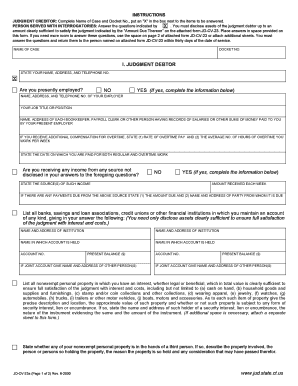
Must disclose assets of the judgment debtor up to an amount clearly sufficient to satisfy the judgment indicated by the "Amount Due Thereon" on the attached form JD-CV-23. Place answers in space provided on this form. If you need more room to answer these questions, use the space on page 2 of attached form JD-CV-23 or attach additional sheets. You must answer the questions and return them to the person named on attached form JD-CV-23 within thirty days of the date of service. NAME OF C.
Open form follow the instructions
Easily sign the form with your finger
Send filled & signed form or save
How to fill out the CT JD-CV-23a online
This guide provides step-by-step instructions for completing the CT JD-CV-23a form online. Designed for individuals with little legal experience, this resource aims to simplify the process and ensure accurate submissions.
Follow the steps to effectively complete the CT JD-CV-23a form.
- Click ‘Get Form’ button to obtain the CT JD-CV-23a form and open it in your preferred online editor.
- Fill in the name of the case and docket number at the top of the form. This identifies your specific case.
- In section I, provide the judgment debtor’s complete name, address, and telephone number. Ensure that all provided information is accurate.
- Indicate whether the judgment debtor is presently employed by checking the appropriate box. If employed, enter the name, address, and telephone number of the employer along with the debtor's job title.
- If applicable, disclose additional compensation for overtime. Include the overtime pay rate and average hours worked weekly.
- State any income received from undisclosed sources, including the weekly amount and sources of that income.
- List all financial institutions where the debtor holds accounts, providing the name, address, and account details, including balances.
- Detail all nonexempt personal property owned by the debtor, describing each item and providing its approximate value and any encumbrances.
- Specify any real estate owned by the debtor, ensuring the total value is sufficient to satisfy the judgment.
- Complete the employer information if the judgment debtor is employed, including gross salary and payment dates.
- If you are in possession of the debtor's property, provide the necessary details and description of the property.
- Once all sections are completed, review the form for accuracy and completeness. Save your changes, and if needed, download, print, or share the completed form.
Complete your CT JD-CV-23a form online today for a streamlined filing experience.
Experience a faster way to fill out and sign forms on the web. Access the most extensive library of templates available.
Related content
You must answer the questions and return them to the person named on attached form...
by K O'Laughlin · 2013 · Cited by 6 — The objectives of this study were to (1)...
EPIDEMIOLOGY, AETIOLOGY AND PATHOLOGY. 11. 3.1. Epidemiology. 11. 3.2. Aetiology. 11...
Get answers to your most pressing questions about US Legal Forms API.
How long does a judgement lien last in CT?
In Connecticut, a judgment lien remains effective for 20 years from the date of the judgment. During this time, the lien secures the creditor's claim to your property, impacting your financial standing. Be proactive in understanding how CT JD-CV-23a relates to your case to better manage the implications of a judgment lien. If you are concerned about the duration or effects of a lien, consulting with legal experts can provide clarity.
How to fill out a financial affidavit for divorce in Connecticut?
Filling out a financial affidavit for divorce in Connecticut requires you to accurately detail your income, expenses, assets, and debts. You can find helpful resources, including templates for CT JD-CV-23a, on platforms like uslegalforms that simplify the process. When completing this document, ensure that you provide thorough and honest information to avoid complications later. Seeking assistance from a legal professional can also enhance your understanding of the form.
What happens if you don't go to court for a judgement?
If you fail to appear in court for a judgment hearing, the court may rule in favor of the plaintiff by default. Consequently, you may face additional financial burdens, including garnished wages or liens against your property. Remember, understanding the implications of CT JD-CV-23a can help you navigate these situations. Routine communication with the court can also provide options to address missed appearances.
How can I avoid paying a judgement?
To avoid paying a judgment, consider negotiating a settlement with the creditor. They may accept a lower amount to resolve the outstanding debt. Make sure to reference CT JD-CV-23a when discussing specifics regarding your case. Establishing a payment plan can also provide a manageable solution without incurring further legal complications.
How long do you have to sue someone in CT?
In Connecticut, you generally have six years to sue someone for breach of contract or negligence. This timeline can vary based on the specifics of your case and the type of action taken. Utilizing the CT JD-CV-23a form can help streamline your filing process. Make sure to track the deadlines closely to ensure you do not miss your opportunity to pursue your claim.
Is it worth taking someone to small claims court?
Taking someone to small claims court can be a worthwhile option when you seek justice for a financial dispute. By using the CT JD-CV-23a form, you simplify the legal process and make it easier to present your case. This court is designed for resolving smaller amounts, which can lead to quicker resolutions. However, consider the costs and the likelihood of collecting any judgment before proceeding.
What does motion to release judgement mean?
A motion to release judgment is a request made to the court to remove or modify a judgment that has already been issued. This can happen if new evidence comes to light or if there's been a change in circumstances. Understanding the CT JD-CV-23a can guide you through filing this motion. For assistance with this process, consider using uslegalforms to access the necessary tools and templates.
What are post-judgment interrogatories?
Post-judgment interrogatories are written questions that one party can send to another after a judgment has been issued. They aim to uncover information about the debtor's financial situation and assets. Knowing how to properly respond to or utilize these in relation to the CT JD-CV-23a can significantly influence your legal strategy. Uslegalforms offers support in drafting and responding to these interrogatories effectively.
What does release of judgement mean?
The release of judgment refers to the formal process in which a court judgment is cleared or dismissed. This can happen for various reasons, including when the debt is satisfied or if the judgment is found to be unjust. Understanding the CT JD-CV-23a form can help you navigate this process effectively. Utilizing resources from uslegalforms can simplify obtaining the necessary documentation for releasing a judgment.
What is a debtor exam?
A judgment debtor examination is a court proceeding created by law where the party who has obtained a judgment in court is entitled to ask questions of the person who owes that judgment. What do the questions cover? The questions are limited to inquiries about your property, assets, debts, and income.
Use professional pre-built templates to fill in and sign documents online faster. Get access to thousands of forms.
If you believe that this page should be taken down, please follow our DMCA take down process here.