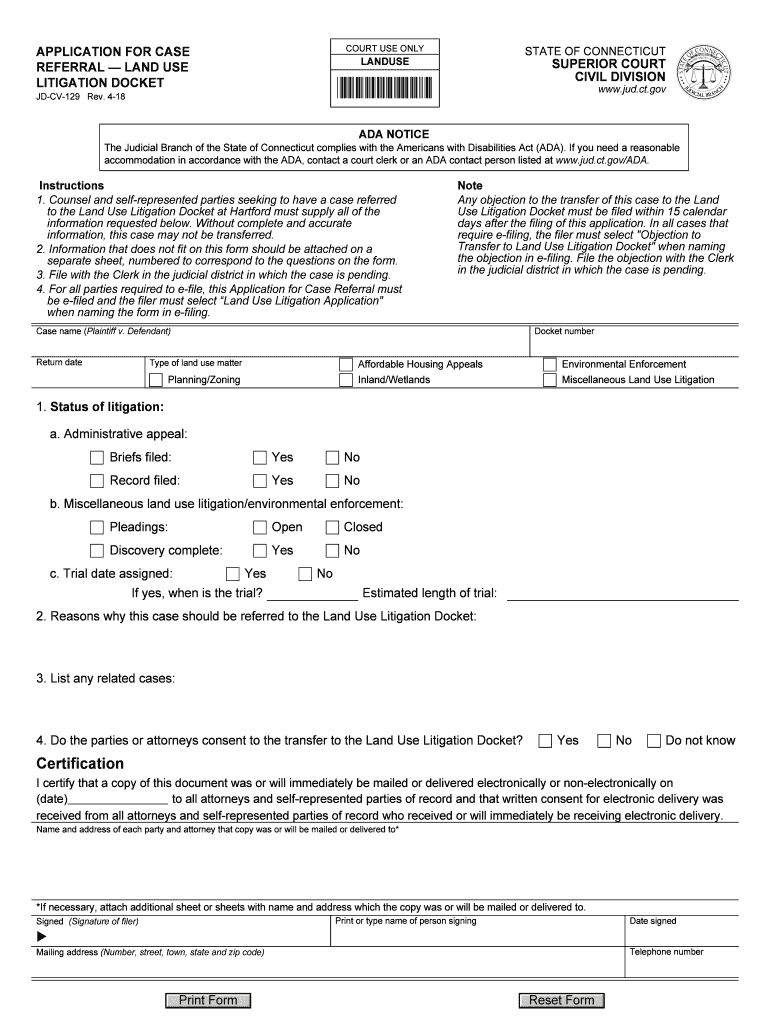
COURT USE ONLYAPPLICATION FOR CASE REFERRAL LAND USE LITIGATION DOCKETSTATE OF CONNECTICUTLANDUSESUPERIOR COURT CIVIL DIVISION*LANDUSE*JDCV129 Rev. 418www.jud.ct.govADA NOTICEThe Judicial Branch of.
Loading

Open form follow the instructions

Easily sign the form with your finger

Send filled & signed form or save
How to fill out the CT JD-CV-129 online
The CT JD-CV-129 form is essential for parties seeking referral of their case to the Land Use Litigation Docket in Connecticut. This guide provides clear, step-by-step instructions to assist you in completing the form accurately and efficiently, ensuring a smooth submission process.
Follow the steps to complete the CT JD-CV-129 online.
- Press the ‘Get Form’ button to access the form and open it in your preferred online editor.
- Begin by filling in the docket number of your case at the top of the form.
- In the 'Case name' field, please enter the names of the parties involved in the format 'Plaintiff v. Defendant'.
- Indicate the return date, which is crucial for the schedule of your case.
- Choose the type of land use matter you are addressing by selecting one of the following options: Planning/Zoning, Affordable Housing Appeals, Environmental Enforcement, Inland/Wetlands, or Miscellaneous Land Use Litigation.
- For the status of litigation section, specify if it is an administrative appeal by checking 'Yes' or 'No' for briefs and record filed.
- If applicable, indicate whether the miscellaneous land use litigation/environmental enforcement pleadings are open or closed and if discovery is complete.
- Provide information regarding the trial date, including whether a date has been assigned and the estimated length of the trial.
- Explain your reasons for referring the case to the Land Use Litigation Docket in the dedicated section.
- List any related cases that may be relevant to your application.
- In the section regarding consent, indicate whether the parties or attorneys consent to the transfer with a 'Yes', 'No', or 'Do not know' selection.
- Complete the certification section by entering the date you will mail or deliver copies of the document to all concerned parties.
- Input the names and addresses of each party and attorney who received or will receive the document.
- Lastly, print or type your name, provide your signature, fill in the date signed, your telephone number, and your complete mailing address.
- After reviewing the completed form, you can save, download, or print it, and prepare for submission.
Complete your CT JD-CV-129 form online today for efficient case management.
Experience a faster way to fill out and sign forms on the web. Access the most extensive library of templates available.
Related content
JD-CV-129, Application For Case Referral - Land Use Litigation Docket, Rev. 04 ... CT.gov...
Use of modern CT simulation and 3-D radiation therapy planning system to develop and...
Design Circumaural Supra-auricular de Costas. Fechadas • Curva de EQ para Música e...
Get answers to your most pressing questions about US Legal Forms API.
How to file a civil lawsuit in CT?
Filing a civil lawsuit in Connecticut involves several essential steps, which begin with determining the appropriate court and preparing your complaint. You will need to fill out the necessary forms, including the CT JD-CV-129, and submit them along with the appropriate filing fees. Additionally, you must serve the other party with the lawsuit documents to ensure they are properly notified of the proceedings.
When to file certificate of closed pleadings CT?
You should file a certificate of closed pleadings in Connecticut once all parties involved in a case have submitted their final documents, and the court has received necessary filings. This ensures that the case can proceed to the next stage, whether that be a trial or other proceedings. Utilizing CT JD-CV-129 appropriately during this process can help you maintain compliance with court requirements.
What does open Judgment mean?
Open Judgment refers to a legal status where a judgment remains active and may be subject to modification or reconsideration. In the context of CT JD-CV-129, an open Judgment allows parties to present new information that may alter the outcome of the case. This status provides a means for fair resolution as circumstances change over time.
What is a motion to open judgment in CT?
A motion to open judgment in CT is a formal request to the court to reconsider a verdict or judgment that has already been issued. This can occur when new evidence emerges or if there were issues that affected the fairness of the original trial. Understanding how to properly file such a motion can be crucial, and using CT JD-CV-129 can guide you through the filing process.
How long does a judge have to rule on a motion in Connecticut?
In Connecticut, judges typically have a reasonable timeframe to rule on motions, including those related to CT JD-CV-129. While there isn't a strict deadline, it is common for judges to issue rulings within several weeks to a few months, depending on the case's complexity and court schedule. Staying informed about your case through court filings can help you anticipate the decision timeline.
What is the purpose of a motion for Judgement?
A motion for Judgment in the context of the CT JD-CV-129 is a request made to the court to decide the outcome of a case without going to trial. This motion essentially asks the judge to evaluate the evidence presented and make a determination based on that evidence. Filing a motion for Judgment can streamline the legal process and save time for all parties involved.
When to file a certificate of closed pleadings CT?
You should file a certificate of closed pleadings in Connecticut once all parties have finished submitting their pleadings and you are ready to move forward. This document signals that you have completed the necessary steps before the court considers your case. Properly completing the CT JD-CV-129 helps pave the way for this filing, so make sure you stay organized throughout the process.
Who pays for a civil lawsuit?
In a civil lawsuit, the party who initiates the case typically pays for the court fees and related costs. However, if you win your lawsuit, the court may order the losing party to reimburse you for certain expenses. This situation emphasizes the importance of properly completing your CT JD-CV-129, as it establishes your claim and can influence potential outcomes regarding costs.
How long do you have to file a lawsuit in CT?
In Connecticut, the timeframe to file a lawsuit generally depends on the type of case. Most civil lawsuits, for instance, must be filed within two years from the date of the incident. Missing this deadline can result in losing your right to file. Therefore, if you are considering legal action, it is wise to prepare your CT JD-CV-129 as soon as possible.
How do I file a civil lawsuit without a lawyer?
To file a civil lawsuit without a lawyer, you can start by gathering all necessary documents related to your case. You will need to complete the CT JD-CV-129 form, which is essential for initiating a civil lawsuit in Connecticut. Make sure to understand the format and procedures required by the court. USLegalForms offers templates and guides that simplify this process, ensuring you submit everything correctly.
Use professional pre-built templates to fill in and sign documents online faster. Get access to thousands of forms.
If you believe that this page should be taken down, please follow our DMCA take down process here.