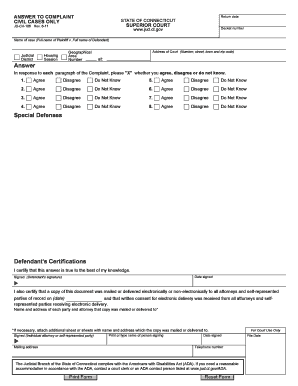
Docket number www.jud.ct.gov Name of case (Full name of Plaintiff v. Full name of Defendant) Judicial District Answer Housing Session Geographical Area Number Address of Court (Number, street, town and zip code) at: In response to each paragraph of the Complaint, please "X" whether you agree, disagree or do not know. 1. Agree Disagree Do Not Know 5. Agree Disagree Do Not Know 2. Agree Disagree Do Not Know 6. Agree Disagree Do Not Know 3. Agree Disagree Do Not Know 7.
Open form follow the instructions
Easily sign the form with your finger
Send filled & signed form or save
How to fill out the CT JD-CV-106 online
Filling out the CT JD-CV-106, also known as the answer to complaint form, is an essential step in responding to a civil case in Connecticut. This guide provides clear instructions to assist you in completing the form accurately online.
Follow the steps to complete the CT JD-CV-106 form.
- Click 'Get Form' button to obtain the form and open it in the editor.
- Enter the docket number at the designated field to identify your case. This number is unique to your court case.
- Provide the full name of the plaintiff and defendant in the name of case section. Ensure the names are entered correctly.
- Select the relevant judicial district and geographical area number from the options provided. This information helps in the proper filing of your form.
- Fill in the address of the court, including the number, street, town, and zip code. Accurate court addresses are critical for the document's validity.
- Review each paragraph of the complaint and indicate your response by marking 'X' in the appropriate column for agree, disagree, or do not know for each statement.
- If applicable, list any special defenses you wish to present in the provided section. Clearly outline your defenses to ensure they are considered.
- Complete the defendant's certifications section by signing and dating the form. This confirms that your answers are true to the best of your knowledge.
- Certify that a copy of the document has been sent to all relevant parties by filling in their names and addresses in the space provided. If necessary, attach an additional sheet.
- After ensuring all information is accurate, save your changes, download, or print the form as needed. Ensure to keep copies for your records.
Complete your documents online today and ensure your response is filed correctly.
Experience a faster way to fill out and sign forms on the web. Access the most extensive library of templates available.
Related content
JD-CV-106 Rev. 1-24. P.B. §§ 10-46 through 10-54. Signed (Defendant's signature). ▷...
May 6, 2022 — Former President Donald J. Trump, the American Conservative Union, and...
Design Circumaural Supra-auricular de Costas. Fechadas • Curva de EQ para Música e...
Get answers to your most pressing questions about US Legal Forms API.
How to plead not guilty to a ticket in CT?
To plead not guilty to a ticket in CT, you must file the appropriate paperwork with the court where the ticket was issued, ensuring you comply with the deadlines provided. Using CT JD-CV-106 can help simplify this process by providing you with the necessary forms and information. It's crucial to clearly express your intention in your filing to avoid misunderstandings. Successfully pleading not guilty allows you to contest the ticket effectively.
What does it mean when pleadings are closed?
When pleadings are closed, it means that all written submissions by the parties are complete, and no further amendments or answers can be made. This is an important phase in any CT JD-CV-106 case, as it defines the issues for trial and streamlines the judicial process. Closed pleadings reflect a commitment by all parties to the arguments presented. It sets the stage for the court to consider the case based on the established facts.
When to file a certificate of closed pleadings CT?
You should file a certificate of closed pleadings in CT once all parties have completed their pleadings, and there are no outstanding motions or changes. In relation to CT JD-CV-106, this step is crucial for advancing your case to trial or other resolutions. Filing this certificate signals that you are ready for the court to take the next steps. Delaying this filing could impede your legal progress.
What does a certificate of closed pleadings mean?
A certificate of closed pleadings indicates that all parties have submitted their pleadings and that the issues for the case are now defined. In the context of CT JD-CV-106, this certificate is vital for moving forward with your legal strategy. This document ensures that the court can proceed to the next stages without further modifications to pleadings. It provides clarity and finality in the litigation process.
What is Section 10 35 of the CT practice book?
Section 10 35 of the CT practice book outlines the rules regarding pleadings, specifically addressing how parties can move to strike or amend a pleading. Understanding this section is crucial when using CT JD-CV-106 in your legal proceedings. It provides a framework for properly handling pleadings, ensuring they meet legal standards. This can lead to a more efficient resolution of your case.
What are the three most common types of civil cases?
The three most common types of civil cases include contract disputes, personal injury claims, and property disputes. Each type varies in legal procedures and required documentation. For those involved in such cases, CT JD-CV-106 offers valuable tools and forms to manage these proceedings efficiently. Understanding the type of civil case you face is vital for determining your next steps.
Is a civil summons serious?
Yes, a civil summons is a serious legal document that compels you to respond to a lawsuit. Ignoring a summons can lead to automatic judgment against you. It’s crucial to take this document seriously and respond promptly. Resources like CT JD-CV-106 provide essential information on how to handle a civil summons properly, ensuring you understand your rights and obligations.
How hard is it to win a civil lawsuit?
Winning a civil lawsuit can be challenging because the burden of proof often lies with the plaintiff. You must present clear and compelling evidence to support your defense. By using CT JD-CV-106 for guidance, you can navigate the complexities of civil litigation more effectively. Success may require careful strategy and legal expertise.
What happens when a civil suit is filed against you?
When a civil suit is filed against you, it typically starts a legal process that requires your immediate attention. You'll receive a summons and must respond within a specified timeframe to avoid default judgment. Utilizing CT JD-CV-106 can benefit you as it includes instructions on how to properly respond to a lawsuit. Acting quickly and seeking legal advice can significantly improve your chances of a favorable outcome.
What percentage of civil suits settle?
Approximately 90% of civil suits settle before reaching trial. This is largely due to the desire of both parties to avoid the costs and uncertainties associated with a courtroom battle. Utilizing resources like CT JD-CV-106 can help streamline the settlement process by providing clearer guidelines. It's essential to understand that settling often leads to a more efficient resolution.
Use professional pre-built templates to fill in and sign documents online faster. Get access to thousands of forms.
If you believe that this page should be taken down, please follow our DMCA take down process here.
This form is available in several versions. Select the version you need from the drop-down list below.