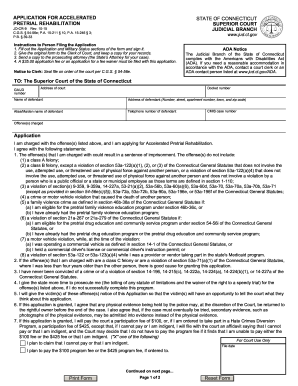
Rcial vehicle as defined in section 14-1 of the Connecticut General Statutes, or (b) I held a commercial driver's license or commercial driver's instruction permit; or (8) a violation of section 53a-122 or 53a-123(a)(4) while I was a provider or vendor taking part in the state's Medicaid program. 2. If the offense(s) that I am charged with are a class C felony or are a violation of section 53a-71(a)(1) of the Connecticut General Statutes, where I was less than four years older than the other per.
Loading
Open form follow the instructions
Easily sign the form with your finger
Send filled & signed form or save
How to fill out the CT JD-CR-9 online
The CT JD-CR-9 form is an application for Accelerated Pretrial Rehabilitation in Connecticut. This guide provides user-friendly instructions to help individuals fill out the form accurately and efficiently, ensuring compliance with legal requirements.
Follow the steps to complete the CT JD-CR-9 form online.
- Press the ‘Get Form’ button to obtain the CT JD-CR-9 form and open it for editing.
- Provide the docket number in the designated field, which is required for the court's reference.
- Fill in the address of the court where the application will be filed, ensuring accuracy to avoid delays.
- Enter the defendant's name, including any alias or maiden name, in the respective sections to identify the applicant.
- Complete the defendant's contact information, including their address and telephone number, to facilitate any necessary communication.
- List the offense(s) charged against the defendant in the appropriate section, making sure they align with the eligibility criteria.
- In the Application section, confirm that the defendant agrees with the statements presented, checking all applicable boxes.
- Indicate whether the defendant has served in the U.S. Armed Forces by selecting the appropriate option in the Military Status section.
- Have the form signed by the defendant. If necessary, include a signature from a duly authorized person or a parent/guardian.
- Once all sections are filled, review the information for accuracy, and then save changes to the form.
- After saving, options to download, print, or share the filled-out form will be available for submission to the court.
Complete your CT JD-CR-9 application online for a smoother filing process.
Experience a faster way to fill out and sign forms on the web. Access the most extensive library of templates available.
Related content
Have you ever served in the U.S. Armed Forces, including the Connecticut National Guard?...
by R Iannaccone · 2003 · Cited by 209 — PURPOSE: To compare the performance of...
by S Campbell · 2017 · Cited by 1430 — Purpose. This AUA Guidelines focuses primarily...
Get answers to your most pressing questions about US Legal Forms API.
How to get excused from jury duty CT?
To be excused from jury duty in Connecticut, you must submit a written request to the court explaining your reason for the exemption. Common acceptable reasons include medical issues or pre-existing obligations. It is essential to refer to CT JD-CR-9 to ensure you meet all requirements for your request.
What is the first time offenders program in CT?
The first time offenders program in Connecticut is designed to provide an alternative to traditional prosecution for eligible individuals who commit minor offenses. Successfully completing this program often results in a dismissal of charges. If you're exploring your options, the CT JD-CR-9 forms might be beneficial to understand the application process.
What is the process of warrant of removal?
The warrant of removal in Connecticut is typically issued in eviction cases. It allows for the removal of a tenant from a rental property. To handle such a case correctly, you'll want to refer to the CT JD-CR-9 forms, which outline the legal procedures involved in the eviction process.
What is the best thing to do if you have a warrant?
If you discover that you have a warrant, the best course of action is to consult with a legal professional. They can guide you on the steps to resolve the situation effectively. Additionally, reviewing the CT JD-CR-9 forms may provide you with helpful insights on how to handle the warrant properly.
How do you get a warrant lifted?
To get a warrant lifted, you may need to file a motion in court requesting that the warrant be removed. This process often involves demonstrating that you have resolved the issue that led to the warrant’s issuance. Utilizing CT JD-CR-9 can simplify this process by providing the necessary legal framework for your case.
How long does a warrant stay active in Connecticut?
In Connecticut, a warrant remains active until it is executed or recalled by the court. This means that a warrant does not expire, and it can continue to affect your legal standing indefinitely. Therefore, it is important to address any outstanding warrants promptly, possibly using CT JD-CR-9 for effective guidance.
How to vacate a warrant in CT?
To vacate a warrant in Connecticut, you typically need to file a motion with the court that issued the warrant. The motion should include reasons why the warrant should be vacated, and it can be beneficial to provide documentation or evidence. Consider using CT JD-CR-9 forms to ensure your submission is complete and follows the necessary procedures.
What happens at a pre-trial in CT?
During a pre-trial in Connecticut, the court will review the case details and address any motions filed by the parties involved. This phase may include discussions about plea agreements, evidence exchange, and setting timelines for the trial. It is a vital step in the legal process, where strategies are developed. Using CT JD-CR-9 can aid in ensuring that all necessary paperwork is submitted properly.
What are the grounds for a motion to dismiss in CT?
A motion to dismiss in Connecticut can be grounded on several factors, such as lack of jurisdiction, failure to state a claim, or procedural defects. When filing this motion, it's essential to present strong legal arguments backed by evidence. Properly formatted documents, like those referenced in CT JD-CR-9, can enhance the chances of a favorable outcome.
How long do you have to sue someone in CT?
In Connecticut, the time limit to sue someone generally ranges from two to six years, depending on the nature of the case. It's crucial to determine the correct statute of limitations for your specific situation. If you're planning to file a lawsuit, consider consulting the CT JD-CR-9 resources to ensure you adhere to all legal timelines.
Use professional pre-built templates to fill in and sign documents online faster. Get access to thousands of forms.
If you believe that this page should be taken down, please follow our DMCA take down process here.
This form is available in several versions. Select the version you need from the drop-down list below.