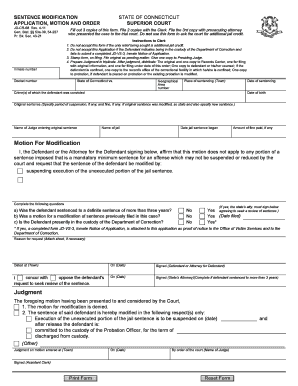
Is form. File 2 copies with the Clerk. File the 3rd copy with prosecuting attorney who presented the case to the trial court. Do not use this form to ask the court for additional jail credit. Instructions to Clerk 1. Do not accept this form if the only relief being sought is additional jail credit. 2. Do not accept this Application if the Defendant indicates being in the custody of the Department of Correction and fails to submit a completed JD-VS-3, Inmate Notice of Application. 3. Stamp form,.
Open form follow the instructions
Easily sign the form with your finger
Send filled & signed form or save
How to fill out the CT JD-CR-68 online
The CT JD-CR-68 form is essential for individuals seeking to modify their sentencing in the state of Connecticut. This guide provides clear, step-by-step instructions to assist users in accurately completing the form online, ensuring a better understanding of each section and field.
Follow the steps to complete the form effectively.
- Press the ‘Get Form’ button to access the document and open it in your browser.
- Begin by entering the inmate number and the docket number at the top of the form. Ensure that all numbers are entered correctly to avoid processing delays.
- Fill in the state, geographical area number, date of sentencing, place of sentencing (town), and date of birth in the designated fields. This information is crucial for identifying the case accurately.
- List the crime or crimes for which the defendant was convicted. Make sure to include any relevant details about the original sentence, such as the period of suspension and any fines imposed.
- Indicate the name of the judge who entered the original sentence, as well as the name of the jail where the individual is incarcerated and the date the jail sentence began.
- If applicable, enter the amount of any fine that has been paid. This information can impact the modification of the sentence.
- In the motion for modification section, affirm that the motion does not pertain to any mandatory minimum sentences by checking the appropriate box. Then, request the modification by indicating your intention, such as suspending the execution of the unexecuted portion of the jail sentence.
- Answer the questions about the defendant's sentence length, previous modification motions, and current custody status accurately. If certain conditions apply, bring attention to these as indicated on the form.
- Provide any reasons for the request for modification. If extra space is needed, you may attach a separate sheet with your detailed explanation.
- After filling out the necessary information, sign and date the form where indicated, whether you are the defendant or their attorney.
- Make sure to have the state's attorney sign as required, especially if the defendant's sentence was for more than three years.
- Finally, review all entries for accuracy. Save your changes, download, print, or choose to share the completed form as necessary.
Complete your CT JD-CR-68 form online today to seek your sentence modification.
Experience a faster way to fill out and sign forms on the web. Access the most extensive library of templates available.
Related content
Instructions to Defendant. 1. Complete this form and the Notice of Application Filed...
Feb 9, 2024 — JD-CR-68 Rev. 12-23 · C.G.S. §§ 53a-39, 54-227; P.B. § 43-21; P.A...
by MC Cabarrus · 2017 · Cited by 24 — Multiparametric magnetic resonance imaging...
Get answers to your most pressing questions about US Legal Forms API.
How to write a letter to judge to reduce a sentence?
When writing a letter to a judge to reduce a sentence, it’s essential to be respectful and clear. State your request directly, followed by a brief explanation of why you believe a reduction is warranted. Provide any supporting evidence, such as character references or proof of rehabilitation. Utilizing the CT JD-CR-68 can ensure that your request follows proper legal channels, enhancing its effectiveness.
How to write a strong motion to dismiss?
Writing a strong motion to dismiss demands clarity and precision in your argument. Begin with a concise statement of the facts, followed by a detailed outline of the legal reasons for dismissal. Ensure you cite relevant laws, like those outlined in CT JD-CR-68, to bolster your claims. A structured and persuasive motion can significantly influence the court's decision.
What is an example of a sentence modification?
A sentence modification may involve changing the terms of probation, altering the length of incarceration, or changing a fine amount. Such modifications aim to better suit a defendant's current situation or reflect personal growth. The CT JD-CR-68 form can be instrumental in filing a proper request for modification. It's crucial to support your request with relevant reasoning and documentation.
What is the rule 12 motion to dismiss?
The rule 12 motion to dismiss focuses on the sufficiency of the plaintiff's complaint. It allows the defendant to argue that even if all allegations are true, there is no legal basis for a lawsuit. This motion frequently employs procedural arguments to seek dismissal. Utilizing the CT JD-CR-68 can assist in formatting and presenting your arguments effectively.
What are the grounds for a motion to dismiss in CT?
In Connecticut, grounds for a motion to dismiss can vary but often include insufficient service of process, lack of personal jurisdiction, or failure to state a claim. Each ground can fundamentally challenge the legality of the case. It's crucial to carefully evaluate these factors when filing your motion. The CT JD-CR-68 form helps ensure that you address all necessary elements.
What goes into a motion to dismiss?
A motion to dismiss generally includes a written statement that identifies the legal grounds for dismissal. You should also provide supporting facts and perhaps references to applicable laws or rules, such as CT JD-CR-68. This structure not only enhances clarity but also strengthens your argument. Your motion must clearly articulate why the case lacks merit.
How to convince a judge to reduce a sentence?
Convincing a judge to reduce a sentence involves demonstrating compelling reasons for leniency. Support your request with evidence of rehabilitation, positive community contributions, or mitigating circumstances. Utilizing the CT JD-CR-68 form for your motion adds credibility to your petition. It is essential to present a clear, respectful argument while adhering to court protocols.
How to ask for a reduced sentence?
To ask for a reduced sentence, one typically files a motion with the court that outlines the reasons for the request. It is helpful to include any changes in circumstances or good behavior since the original sentencing. Using the CT JD-CR-68 form can ensure you follow the correct procedures. This approach not only formalizes your request but also highlights your intention to improve.
What is the rule 19 motion to dismiss?
The rule 19 motion to dismiss is a legal request made to terminate a case based on specific procedural grounds. In Connecticut, this motion typically argues that the plaintiff has not included all necessary parties to the case. These required parties, if absent, could significantly impact the case's outcome. Using the CT JD-CR-68 form can help streamline your motion.
How to write a letter to a judge to reduce a sentence?
When writing a letter to a judge requesting a reduced sentence, start by clearly stating your case and reasons for the request. Include relevant information, such as personal circumstances and any positive changes made since sentencing. Referencing CT JD-CR-68 can add legal weight to your argument. Keep the tone respectful and concise to increase your chances of a favorable review.
Use professional pre-built templates to fill in and sign documents online faster. Get access to thousands of forms.
If you believe that this page should be taken down, please follow our DMCA take down process here.
This form is available in several versions. Select the version you need from the drop-down list below.