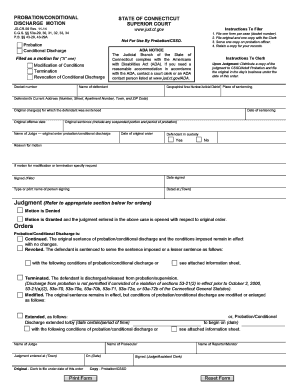
9A 1. File one form per case (docket number). 2. File original and one copy with the Clerk 3. Serve one copy on probation officer. 4. Retain a copy for your records. Not For Use By Probation/CSSD. Probation Conditional Discharge ADA NOTICE The Judicial Branch of the State of Connecticut complies with the Americans with Disabilities Act (ADA). If you need a reasonable accommodation in accordance with the ADA, contact a court clerk or an ADA contact person listed at www.jud.ct.gov/ADA. Filed.
Loading
Open form follow the instructions
Easily sign the form with your finger
Send filled & signed form or save
How to fill out the CT JD-CR-59 online
The CT JD-CR-59 is a crucial document for individuals seeking to file a motion regarding probation or conditional discharge in Connecticut. This guide provides step-by-step instructions to help you fill out this form online clearly and accurately.
Follow the steps to complete the CT JD-CR-59 online form.
- Click ‘Get Form’ button to obtain the CT JD-CR-59 and open it in the editor.
- Identify the specific motion you are filing by marking the appropriate box: modification of conditions, termination, or revocation of conditional discharge.
- Enter the docket number for your case in the designated field.
- Provide the geographical area number or judicial district where the sentencing took place.
- Fill in the name of the defendant and their current address, ensuring to include the street number, apartment number (if applicable), town, and ZIP code.
- Record the date of sentencing and the original charge(s) for which the defendant was sentenced, including the original offense date.
- Detail the original sentence, including any suspended portion and the period of probation.
- Indicate the name of the judge who issued the original order for probation or conditional discharge.
- State the date of the original order and whether the defendant is currently in custody by selecting 'Yes' or 'No'.
- If applicable, provide a clear reason for the motion, especially if it is for modification or termination, specifying your request.
- Sign the document where indicated and include the date signed.
- Print your name below your signature, indicating that you are the person signing.
- Indicate the town where the form is being signed.
- Review all entries for accuracy before final submission.
- Once completed, you can save changes, download a copy, print, or share the form as needed.
Complete your CT JD-CR-59 online today to ensure a smooth process for your motion.
Experience a faster way to fill out and sign forms on the web. Access the most extensive library of templates available.
Related content
JD-CR-59 Rev. 11-14. C.G.S. §§ 53a-29, 30, 31, 32, 33, 34. P.B. §§ 43-29, 43-29A...
CT scans generally are not required for initial evaluation or for follow-up. The staging...
by MC Cabarrus · 2017 · Cited by 24 — Multiparametric magnetic resonance imaging...
Get answers to your most pressing questions about US Legal Forms API.
How to vacate a warrant in CT?
To vacate a warrant in Connecticut, you typically must file a motion with the court outlining your reasons for the request. It can be helpful to work with legal professionals who understand the CT JD-CR-59 process to ensure your motion is adequately presented. Engaging with platforms like US Legal Forms can assist in preparing the necessary documentation.
What is a conditional discharge in CT?
In Connecticut, a conditional discharge is a judicial decision that defers the entry of a conviction pending completion of certain conditions. This process, guided by rules like CT JD-CR-59, allows individuals to avoid the stigma of a criminal record. It serves as an opportunity for rehabilitation rather than punishment.
What is the difference between a discharge and a conditional discharge?
A discharge typically implies an outcome where no further action is taken, while a conditional discharge requires compliance with specific terms set by the court. Under CT JD-CR-59, conditional discharge allows individuals to meet certain conditions while avoiding a criminal conviction. Understanding the nuances can help you better navigate your legal situation.
Can you go to the states with a conditional discharge?
Generally, you can travel to other states while under a conditional discharge in Connecticut, but it is essential to check the specific conditions of your release. Staying compliant with all terms of your discharge is crucial, especially under CT JD-CR-59. Always inform your probation officer about any travel plans to avoid complications.
Can you get off probation early in CT?
Yes, you can seek an early discharge from probation in Connecticut if you have successfully completed the required conditions. Providing evidence of compliance and demonstrating rehabilitation can strengthen your request. Using resources like US Legal Forms can help you navigate the necessary paperwork under CT JD-CR-59 to present your case effectively.
Does conditional discharge mean guilty?
No, conditional discharge does not imply that a person is guilty. Instead, it indicates that the court has chosen to defer a conviction while the individual fulfills specific conditions. Under CT JD-CR-59, this approach allows a person to maintain a clean record provided they comply with the outlined terms.
What is conditional discharge CT?
Conditional discharge in Connecticut refers to a court's decision to release a defendant without imposing an immediate sentence, provided they meet certain conditions set by the court. This option can be a crucial aspect of managing a case effectively under CT JD-CR-59, allowing defendants the chance to complete specified requirements while avoiding a criminal conviction. It serves as a second chance for many individuals.
What are the grounds for a motion to dismiss in CT?
In Connecticut, you can file a motion to dismiss based on several grounds, such as lack of jurisdiction, failure to state a claim upon which relief can be granted, or expiration of the statute of limitations. A well-prepared motion to dismiss could significantly impact a case under the CT JD-CR-59 judicial process. It is important to understand the specific reasons that could justify your motion, as this can shape the outcome of your legal issues.
What is the best thing to do if you have a warrant?
If you have a warrant, the best course of action is to handle it proactively. Consult with a legal professional to understand your options and rights. You may also consider using CT JD-CR-59 to submit necessary documents to the court. Ignoring the situation can lead to complications, so it’s advisable to address it as soon as possible.
How do you get a warrant lifted?
To get a warrant lifted in Connecticut, you typically need to appear in court and provide reasonable evidence or justification. Filing a motion, such as one using CT JD-CR-59, simplifies the legal requirements and can clarify your intentions to the court. It is also advisable to seek legal guidance to ensure all aspects of your case are covered effectively.
Use professional pre-built templates to fill in and sign documents online faster. Get access to thousands of forms.
If you believe that this page should be taken down, please follow our DMCA take down process here.