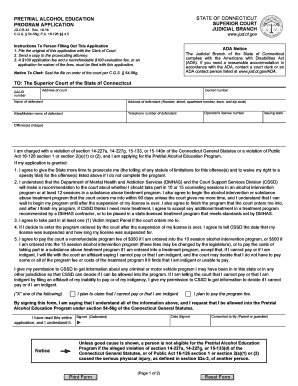
Filling Out This Application 1. File the original of this application with the Clerk of Court. 2. Send a copy to the prosecuting attorney. 3. A $100 application fee and a nonrefundable $100 evaluation fee, or an application for waiver of the fees, must be filed with this application. ADA Notice The Judicial Branch of the State of Connecticut complies with the Americans with Disabilities Act (ADA). If you need a reasonable accommodation in accordance with the ADA, contact a court clerk or an A.
Loading
Open form follow the instructions
Easily sign the form with your finger
Send filled & signed form or save
How to fill out the CT JD-CR-44 online
This guide provides clear instructions on how to effectively complete the CT JD-CR-44 form online. Whether you have prior experience with legal documents or are new to this process, the following steps will help you navigate the form with confidence.
Follow the steps to complete the CT JD-CR-44 form online.
- Click ‘Get Form’ button to access the CT JD-CR-44 form and open it in an online editing tool.
- Fill in the ‘TO’ section by providing the Superior Court's name, GA/JD number, and docket number. Include the address of the court where you are filing the form.
- Enter the following personal information in the defendant's section: full name, mailing address (including number, street, apartment number, town, and zip code), alias/maiden name, telephone number, and operator’s license number along with the issuing state.
- Indicate the offense(s) you are charged with by selecting the relevant violations outlined in the form. Ensure accuracy to avoid complications.
- Review and agree to the conditions related to the Pretrial Alcohol Education Program. Make sure to read each point carefully before agreeing.
- If applicable, indicate your intention about paying the program fee or requesting a waiver by selecting the appropriate checkbox.
- Sign and date the form at the designated area, indicating consent from a parent or guardian if required.
- Complete the Oath section by confirming that you understand the terms and conditions, and provide the necessary signature.
- Review all the information provided in the form to ensure everything is complete and accurate before submitting.
- Save changes, download the completed form, print it for your records, or share it as necessary.
Take the next step by completing your CT JD-CR-44 application online today.
Experience a faster way to fill out and sign forms on the web. Access the most extensive library of templates available.
Related content
Jul 18, 2025 — Information about the following criminal cases, including the date of the...
by R Iannaccone · 2003 · Cited by 209 — PURPOSE: To compare the performance of...
by MC Cabarrus · 2017 · Cited by 24 — Multiparametric magnetic resonance imaging...
Get answers to your most pressing questions about US Legal Forms API.
When should I receive my divorce decree?
Typically, you should receive your divorce decree shortly after your divorce is finalized in Connecticut. The time frame can vary based on court workload, but most cases conclude within a few weeks. If you want to ensure you receive your documents promptly, consider using US Legal Forms to guide you through the timeline and necessary steps for the CT JD-CR-44.
What happens at a pre-trial in CT?
During a pre-trial in Connecticut, both parties present their cases to a judge or a mediator. This meeting helps clarify the issues in dispute, and it is an opportunity to explore settlements. Being well-prepared can make a significant difference, and accessing resources like the CT JD-CR-44 forms through US Legal Forms can help you organize your documents effectively.
How do I get a copy of my divorce decree online in the US?
Many states allow you to request a copy of your divorce decree online. In Connecticut, it’s possible to access documents through the state's judicial website. For convenience, consider using US Legal Forms to navigate the process easily and ensure you have all the necessary details for your CT JD-CR-44 request.
How to get a copy of divorce decree CT?
To obtain a copy of your divorce decree in Connecticut, you can visit the Superior Court where your divorce was finalized. It's essential to provide identification and details about your case. Additionally, you can utilize platforms like US Legal Forms, which offer resources to help you request documents more efficiently.
What is the best thing to do if you have a warrant?
If you have a warrant, the best action is to address it as soon as possible. Ignoring it can lead to further legal complications, including arrest. Consult with a legal professional to understand your options, and consider using resources like CT JD-CR-44 from our platform to ensure you handle the situation appropriately and efficiently.
How do you get a warrant lifted?
To get a warrant lifted, you usually need to file a motion with the court that issued it. This motion should outline your reasons and any steps you have taken to address the underlying issues. Utilizing the CT JD-CR-44 form available through our platform can simplify this process, ensuring you present all necessary information clearly and effectively.
How long does a warrant stay active in Connecticut?
In Connecticut, a warrant remains active until it is executed or canceled by the court. Generally, if a warrant is issued, law enforcement can act on it at any time, creating potential long-term implications for the individual. It's important to stay informed about your legal status and consider using the CT JD-CR-44 form available on our platform to address this matter proactively.
How to vacate a warrant in CT?
To vacate a warrant in Connecticut, you typically need to file a motion to have the warrant removed. This involves presenting your reasons to the court and demonstrating that you have addressed the issues that led to the warrant. It is advisable to use resources such as CT JD-CR-44 from our platform, which can streamline your filing process and help you understand necessary legal steps.
What is the process of warrant of removal?
The process of warrant of removal involves legal actions to evict a tenant from a property. In Connecticut, the landlord must file a summary process action in court and obtain a judgment. Once a judgment is obtained, a warrant for removal can be issued, allowing law enforcement to execute the eviction. If you need assistance with this process, our platform offers forms like CT JD-CR-44 to guide you through.
How to file a complaint with the insurance commissioner in Connecticut?
If you wish to file a complaint with the insurance commissioner in Connecticut, you can do so by submitting your complaint in writing. Be sure to include all relevant details regarding your situation. Understanding CT JD-CR-44 can help clarify the context of your complaint and the expectations from the insurance coverage.
Use professional pre-built templates to fill in and sign documents online faster. Get access to thousands of forms.
If you believe that this page should be taken down, please follow our DMCA take down process here.
This form is available in several versions. Select the version you need from the drop-down list below.