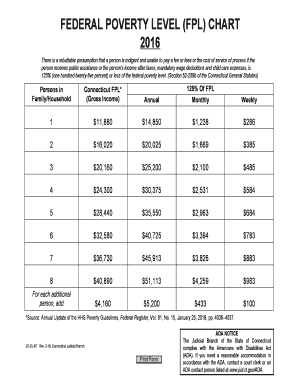
Or the person's income after taxes, mandatory wage deductions and child care expenses, is 125% (one hundred twenty-five percent) or less of the federal poverty level. (Section 52-259b of the Connecticut General Statutes) Annual 125% Of FPL Monthly Weekly $11,880 $14,850 $1,238 $286 2 $16,020 $20,025 $1,669 $385 3 $20,160 $25,200 $2,100 $485 4 $24,300 $30,375 $2,531 $584 5 $28,440 $35,550 $2,963 $684 6 $32,580 $40,725 $3,394 $783 7 $36,730 $45,913 $3,826 $883.
Open form follow the instructions
Easily sign the form with your finger
Send filled & signed form or save
How to use or fill out the CT JD-CL-67 online
The CT JD-CL-67 form is essential for individuals seeking to demonstrate their financial status, particularly in relation to the federal poverty level. This guide will provide comprehensive instructions on how to accurately complete the form online, ensuring you understand each section and its requirements.
Follow the steps to successfully complete the CT JD-CL-67 form online.
- Press the ‘Get Form’ button to access the CT JD-CL-67 form and open it in your preferred online editor.
- Begin by entering your personal information in the designated fields, including your name, address, and contact details. Make sure to provide accurate information as this will be critical for processing your form.
- Reference the federal poverty level chart included within the form to determine your eligibility based on the number of people in your household. Ensure to input the correct income levels as outlined.
- In the financial information section, provide a detailed account of your monthly income, including any public assistance or earnings. Double-check these figures to ensure they align with your documentation.
- Review your entries for any errors or omissions. It's crucial to ensure that all the information is correct to avoid any delays in processing.
- Once you have completed all sections of the form, you can save your changes. You should also have the option to download, print, or share the form, as needed.
Get started on filling out the CT JD-CL-67 form online today!
Experience a faster way to fill out and sign forms on the web. Access the most extensive library of templates available.
Related content
JD-CL-67 Rev. 1-25, Connecticut Judicial Branch. There is a rebuttable presumption that a...
This is an installation and operation manual for Body Protection Sensor Safety Light...
Get answers to your most pressing questions about US Legal Forms API.
What is 200% of the poverty line?
200% of the poverty line is calculated by taking the established poverty level for your household size and multiplying it by two. This figure indicates a higher income threshold for eligibility in various assistance programs. For legal forms and guidance related to these thresholds, CT JD-CL-67 is an excellent resource.
How to calculate the poverty line?
To calculate the poverty line, you typically refer to federal income guidelines published annually, which consider household size and income. For the most accurate determination, check the latest figures provided by government sources. If you are exploring your legal options, forms like CT JD-CL-67 offer insights into how poverty levels may impact your case.
Is 25k a year the poverty level?
An income of $25,000 a year is above the federal poverty level for a single individual. However, this figure may differ if you're calculating poverty based on household size. If you're considering legal assistance options, knowing your position related to the poverty level, such as under CT JD-CL-67, is vital.
What income puts you at the poverty line?
The income that places someone at the poverty line varies based on family size and is updated annually by the government. For example, in 2021, a single-person household would be at the poverty line with an income of around $12,880. Understanding this benchmark is crucial if you're assessing eligibility for legal resources under CT JD-CL-67.
What is 125% above the poverty level?
125% above the poverty level means an income that exceeds the poverty threshold by a quarter. This measure is often used to assess financial assistance eligibility. If you’re seeking aid or exploring legal resources under CT JD-CL-67, knowing this figure can be essential in your journey.
What does 200 percent of poverty level mean?
200 percent of the poverty level refers to an income threshold that is twice the established poverty line for a household size. This figure is important for various programs and assistance options, including legal help under forms like CT JD-CL-67. Understanding this level can help individuals determine their eligibility for specific services.
What is considered poverty level in CT?
The poverty level in Connecticut is determined by federal guidelines, which affect eligibility for various aid programs. This level is updated annually and often considered when assessing assistance for legal fees or court-related costs. If you're in a situation where you need to file using the CT JD-CL-67, check if you qualify for legal aid or other services based on your income. Resources are available to help you navigate these challenges.
How long do you have to file a lawsuit in CT?
In Connecticut, the time frame to file a lawsuit varies based on the type of claim but generally ranges from one to six years. For small claims, you typically have a maximum of six years to file, depending on the circumstances. Using the CT JD-CL-67 form within these timelines is crucial to ensure your case is valid. It's advisable to take action promptly to protect your rights.
Do you tell someone you are taking them to small claims court?
It is generally good practice to inform someone before taking them to small claims court. This conversation allows both parties to discuss the issue, and sometimes a resolution can be reached without involving the court. If you proceed, ensure that you have filled out the CT JD-CL-67 form correctly before formally notifying them. Open communication can often lead to positive outcomes.
What are the grounds for a motion to dismiss in CT?
In Connecticut, grounds for a motion to dismiss include lack of subject matter jurisdiction, lack of personal jurisdiction, and failure to state a claim upon which relief can be granted. Properly using the CT JD-CL-67 form ensures that your case is presented correctly and meets legal standards. If you believe there are valid reasons to dismiss, consult with a legal expert for guidance tailored to your situation.
Use professional pre-built templates to fill in and sign documents online faster. Get access to thousands of forms.
If you believe that this page should be taken down, please follow our DMCA take down process here.
This form is available in several versions. Select the version you need from the drop-down list below.