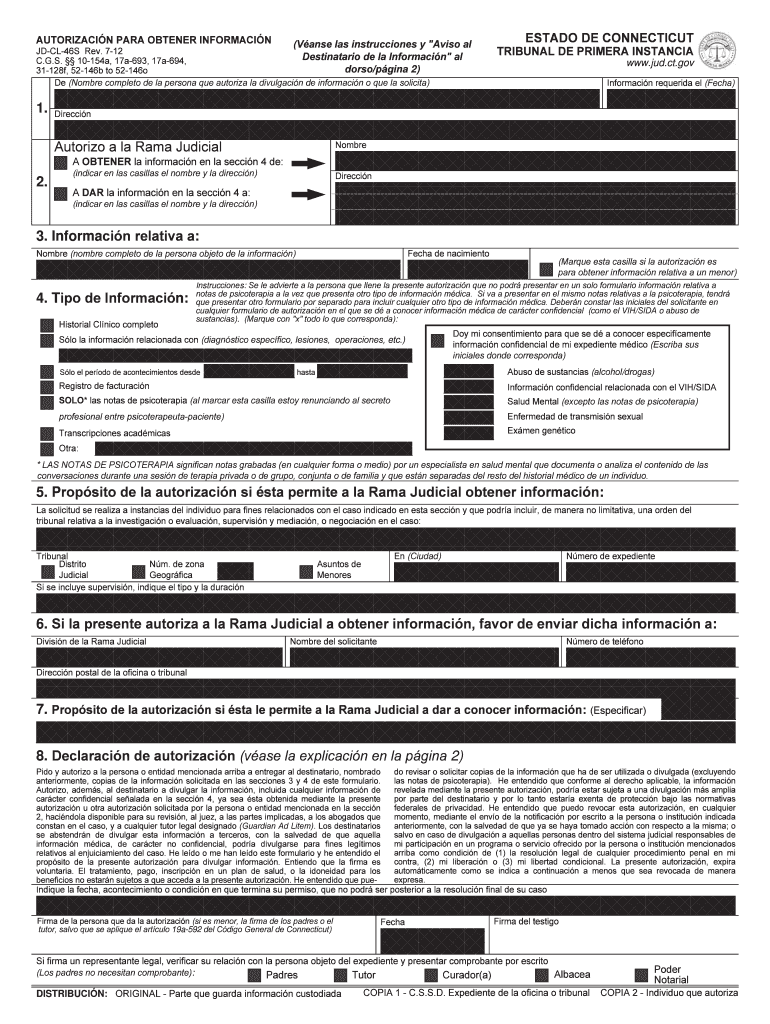
F, 52-146b to 52-146o De (Nombre completo de la persona que autoriza la divulgaci n de informaci n o que la solicita) 1. www.jud.ct.gov Informaci n requerida el (Fecha) Direcci n Autorizo a la Rama Judicial A OBTENER la informaci n en la secci n 4 de: 2. ESTADO DE CONNECTICUT TRIBUNAL DE PRIMERA INSTANCIA (indicar en las casillas el nombre y la direcci n) A DAR la informaci n en la secci n 4 a: (indicar en las casillas el nombre y la direcci n) Nombre T Direcci n T 3.

Open form follow the instructions

Easily sign the form with your finger

Send filled & signed form or save
How to fill out the CT JD-CL-46S online
The CT JD-CL-46S form is essential for authorizing the release of information within the Connecticut Judicial Branch. This guide provides clear instructions on how to complete the form online, ensuring your experience is straightforward and efficient.
Follow the steps to complete the CT JD-CL-46S form online.
- Click the ‘Get Form’ button to access the CT JD-CL-46S form and open it in the editor.
- In Section 1, provide your full name, the date of information requested, and your address.
- In Section 2, indicate that you authorize the Judicial Branch to obtain the information. Specify the name and address of the entity from which information is requested.
- Go to Section 3 and fill in the date of birth and the full name of the individual whose information is being requested.
- In Section 4, select the type of information you are authorized to obtain, such as full clinical history. If it relates to a minor, mark the corresponding box.
- Specify the purpose of the authorization in Section 5 and provide any details related to the court case or supervision if applicable.
- Complete Section 6 by providing the name, phone number, and mailing address of the person to whom the information should be sent.
- In Section 7, specify the purpose for which the Judicial Branch can disclose the information.
- Review the authorization statement in Section 8, indicate your understanding, and then sign and date the form.
- Once all sections are completed and reviewed, save the changes. You can download, print, or share the completed form as needed.
Complete your CT JD-CL-46S form online today for efficient processing.
Experience a faster way to fill out and sign forms on the web. Access the most extensive library of templates available.
Related content
by J Yu · 2023 · Cited by 4 — Contrary to the myth that “all old people are the...
by CL Jones — This Response or Comment is brought to you for free and open access by the...
Get answers to your most pressing questions about US Legal Forms API.
What does it mean when pleadings are closed?
When pleadings are closed, it means that all parties have submitted their claims, defenses, and rebuttals, and the court will no longer accept further written arguments. This closing allows for a focused resolution based on the established record. The process surrounding closed pleadings is explained in detail within the CT JD-CL-46S, making it a useful tool for understanding legal proceedings.
What happens if I miss my jury duty in CT?
If you miss your jury duty in Connecticut, you may face penalties, including fines or a court order requiring you to attend. It is imperative to respond promptly if you are unable to attend on your scheduled date. To avoid complications, stay informed about your obligations by referencing CT JD-CL-46S, as it can guide you through the process.
When to file certificate of closed pleadings CT?
You should file the certificate of closed pleadings in Connecticut once all parties have made their arguments and evidence is fully submitted. This document is crucial for advancing the case to the next phase, whether it be trial or other proceedings. Proper timing ensures that your case flows smoothly, which is emphasized in the guidelines set by the CT JD-CL-46S.
What is Section 10 35 of the CT practice book?
Section 10-35 of the Connecticut Practice Book outlines the requirements for pleadings in civil actions. This section details what must be included in legal documents to ensure a fair court process. If you require clarification on how to prepare your pleadings, the CT JD-CL-46S could serve as a valuable reference.
How do I file a FOIA request in CT?
Filing a Freedom of Information Act (FOIA) request in Connecticut involves submitting a written request to the appropriate public agency. You will need to clearly describe the records you seek, providing as much detail as possible. For assistance in navigating this process, consider utilizing resources like the CT JD-CL-46S to ensure you follow the correct procedures.
What does a certificate of closed pleadings mean?
A certificate of closed pleadings is an official document indicating that all submissions and responses in a legal case are complete. It signals that the parties have presented their arguments and evidence, allowing the court to proceed with the next steps. In Connecticut, the CT JD-CL-46S is essential for tracking these stages in legal proceedings.
How do I file a civil lawsuit without a lawyer?
Filing a civil lawsuit without a lawyer, also known as going pro se, requires you to understand the rules of the local court. You can access forms and instructions online, including the CT JD-CL-46S, to guide you through the process. While self-representation is possible, consider seeking legal advice if the case is complex.
How to file a civil lawsuit in CT?
To file a civil lawsuit in Connecticut, you must prepare your complaint, file it with the court, and serve the defendant. Using the CT JD-CL-46S form can help ensure that you complete necessary legal paperwork accurately. It’s advisable to familiarize yourself with the court's specific requirements for a smooth process.
What is the return date for a complaint in CT?
The return date for a complaint in Connecticut is typically set at least 12 days after the date of service. This date is crucial as it allows the defendant time to respond to the complaint. Knowing how to correctly fill out the CT JD-CL-46S can assist in setting the appropriate return date.
How long do you have to file a lawsuit in CT?
In Connecticut, the time limits for filing a lawsuit vary depending on the type of case. Generally, you must file within two years for personal injury claims and six years for breach of contract claims. Make sure to consult relevant legal timelines associated with the CT JD-CL-46S, if applicable.
Use professional pre-built templates to fill in and sign documents online faster. Get access to thousands of forms.
If you believe that this page should be taken down, please follow our DMCA take down process here.