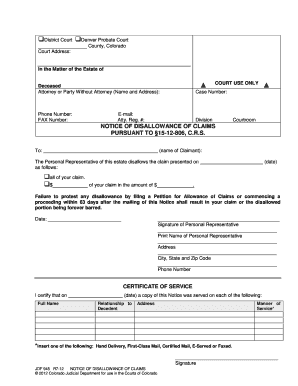
Ddress): Case Number: Phone Number: FAX Number: Division E-mail: Atty. Reg. #: Courtroom NOTICE OF DISALLOWANCE OF CLAIMS PURSUANT TO 15-12-806, C.R.S. To: (name of Claimant): The Personal Representative of this estate disallows the claim presented on as follows: all of your claim. $ of your claim in the amount of $ (date) . Failure to protest any disallowance by filing a Petition for Allowance of Claims or commencing a proceeding within 63 days after the mailing of this Not.
Open form follow the instructions
Easily sign the form with your finger
Send filled & signed form or save
How to fill out the CO JDF 945 online
The CO JDF 945, also known as the Notice of Disallowance of Claims, is an important document used in probate cases in Colorado. This guide will provide you with clear, step-by-step instructions on how to fill out this form online, ensuring you gather and submit the necessary information accurately.
Follow the steps to complete the CO JDF 945 online.
- Click the ‘Get Form’ button to obtain the document and open it in your preferred online editor.
- Begin by filling in the court information at the top of the form, including the court name and address. Make sure to indicate whether it is the District Court or the Denver Probate Court.
- Next, in the section labeled 'In the Matter of the Estate of,' enter the name of the deceased individual.
- Fill in the 'Court Use Only' section with the case number and division information, which might be provided by the court.
- Complete the attorney or party information section, including the name, address, phone number, and email of the attorney or individual who is submitting the notice.
- In the 'To:' section, write the name of the claimant whose claim is being disallowed.
- Specify the details of the disallowance by checking the appropriate box to indicate whether all of the claim is disallowed or specify the amount of the claim being disallowed.
- Enter the date of the notice and ensure to leave space for the personal representative's signature and their printed name, along with their address and contact information.
- Complete the certificate of service section by entering your full name and the date a copy of this notice was served to the claimant. Specify the relationship to the decedent and the address of the claimant.
- Indicate the manner of service used (e.g., hand delivery, first-class mail, certified mail) and provide your signature at the end of the certificate.
- After verifying all information is accurate and complete, you can save your changes, download a copy for your records, print the document, or share it with relevant parties.
Complete your CO JDF 945 online for a more efficient document filing experience.
Experience a faster way to fill out and sign forms on the web. Access the most extensive library of templates available.
Related content
JDF 945SC R6/19 NOTICE OF DISALLOWANCE OF CLAIMS. Page 1 of 2. ❑District Court ❑Denver...
by Y Vyas · 2016 · Cited by 42 — We ensure high-quality annotations by selecting all...
JPF 2A, 3A, 4A, 41A. 11. Dimensions and Weights. 11. Performance Chart. 11. Performance...
Get answers to your most pressing questions about US Legal Forms API.
What are the different types of probate in Colorado?
In Colorado, the types of probate include informal, formal, summary, and small estate probate. Each type addresses different estate sizes and complexities, allowing for tailored procedures that fit the situation. For instance, small estate probate simplifies the process for estates that fall under a certain threshold, ensuring quick access to assets. Utilizing forms such as the CO JDF 945 can guide you through the appropriate process, making it easier to manage the probate efficiently.
What is Rule 62 of the Colorado Rules of Probate Procedure?
Rule 62 of the Colorado Rules of Probate Procedure addresses the process for closing a probate estate. This rule outlines the necessary steps for filing a final report and approving the distribution of assets among the heirs. Understanding this rule is crucial for personal representatives who want to ensure compliance and a smooth closure of the estate. Utilizing resources like the CO JDF 945 can help clarify procedures and necessary documentation.
What are the three types of probate in Colorado?
Colorado recognizes three main types of probate: informal, formal, and summary probate. Informal probate is less complex and suited for small estates, allowing for a quicker process with fewer court hearings. Formal probate involves more judicial oversight and is used for larger estates or when disputes arise among beneficiaries. Summary probate, on the other hand, offers a streamlined process for estates under a certain value, allowing for quicker resolution with forms like the CO JDF 945.
How long does probate last in Colorado?
In Colorado, probate can last anywhere from a few months up to a year or more, depending on the complexity of the estate. Factors influencing the duration include the number of assets, the existence of disputes among heirs, and how straightforward the will is. Generally, the CO JDF 945 and other forms facilitate the process, helping to manage timeline expectations. Efficient management and cooperation among heirs often lead to a smoother, quicker resolution.
What is the best way to avoid probate in Colorado?
To avoid probate in Colorado, consider establishing a living trust or utilizing joint ownership with rights of survivorship. These methods help bypass the lengthy probate process by ensuring that assets transfer directly to beneficiaries upon death. Additionally, creating a beneficiary designation on accounts can streamline the transfer, making it more efficient. Using the CO JDF 945 form can assist in formalizing assets held within a trust.
How much does an estate have to be worth to go to probate in Colorado?
In Colorado, the estate must be worth more than $70,000 for probate to be necessary. If the estate's value is below this threshold, it may qualify for simplified procedures, allowing for a quicker resolution. Properly utilizing the CO JDF 945 form can help clarify the asset valuation and guide you through the initial decision-making process efficiently. Knowing these details can help you plan better.
Does having a will avoid probate in Colorado?
Having a will does not automatically avoid probate in Colorado. While a will outlines how you want your assets distributed, it still requires probate to validate it and ensure your wishes are honored. However, utilizing resources such as the CO JDF 945 can help streamline the probate process, making it less burdensome for your beneficiaries. Understanding these processes is vital for effective estate planning.
Do all wills have to go through probate in Colorado?
Not all wills must go through probate in Colorado. If the estate value is below a certain threshold, you may not need to file for probate. However, probate is required for many estates to ensure a clear and legal distribution of assets. Using tools like the CO JDF 945 can help clarify the necessary procedures related to probate.
How long do you have to file probate after death in Colorado?
You have one year to file for probate after death in Colorado. While this may seem sufficient, earlier filing can help manage the estate more effectively and avoid delays. The CO JDF 945 form can guide you through this crucial process, ensuring that you meet all necessary deadlines and legal requirements.
How long do you have to file probate after death?
In Colorado, you generally have up to one year after death to file for probate. However, it is advisable to initiate the process sooner to avoid potential complications and ensure timely administration of the estate. Using resources like the CO JDF 945 form from platforms such as US Legal Forms can provide clarity and support in adhering to this timeline.
Use professional pre-built templates to fill in and sign documents online faster. Get access to thousands of forms.
If you believe that this page should be taken down, please follow our DMCA take down process here.