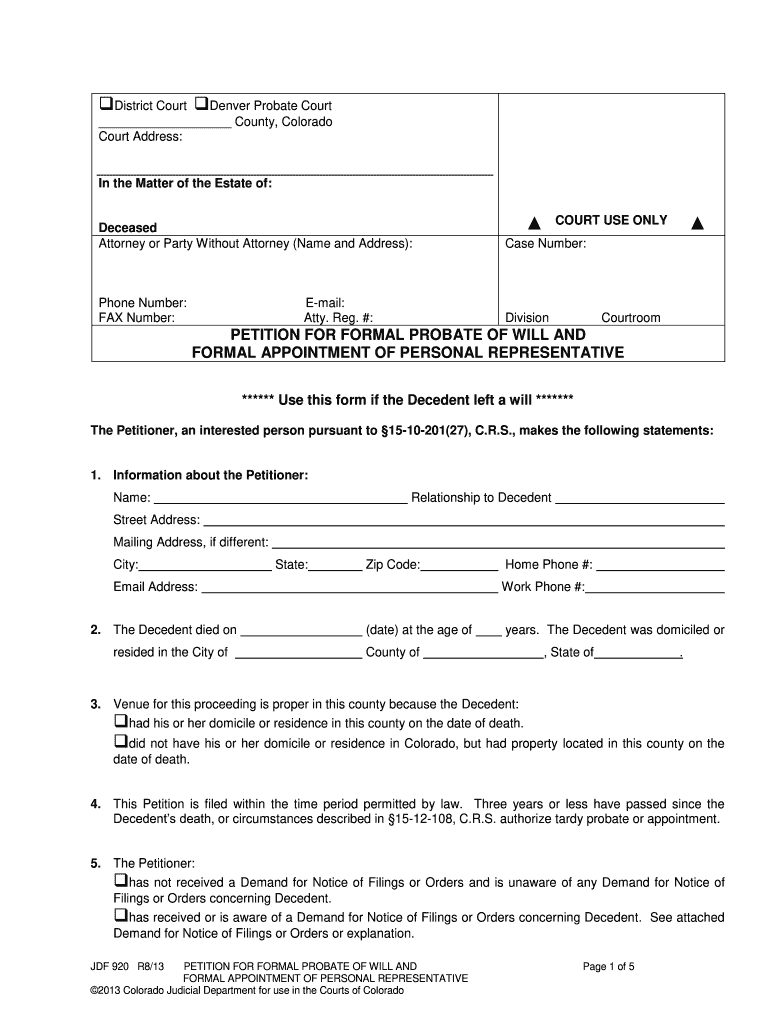
NLY Deceased Attorney or Party Without Attorney (Name and Address): Case Number: Phone Number: FAX Number: Division E-mail: Atty. Reg. #: Courtroom PETITION FOR FORMAL PROBATE OF WILL AND FORMAL APPOINTMENT OF PERSONAL REPRESENTATIVE ****** Use this form if the Decedent left a will ******* The Petitioner, an interested person pursuant to 15-10-201(27), C.R.S., makes the following statements: 1. Information about the Petitioner: Name: Relationship to Decedent Street Address: Mailing A.
Loading

Open form follow the instructions

Easily sign the form with your finger

Send filled & signed form or save
How to fill out the CO JDF 920 online
The CO JDF 920 form is used for filing a petition for formal probate of a will and for the formal appointment of a personal representative. This guide will walk you through the process of completing the form online, ensuring that you meet all necessary requirements.
Follow the steps to complete the CO JDF 920 form online.
- Click ‘Get Form’ button to obtain the form and open it in the editor.
- Fill in the court address and specify the court name, either District Court or Denver Probate Court. Enter the county name where the court is located.
- Provide information about the deceased, such as their name, date of death, and age at the time of death. Indicate the county and state where the decedent was domiciled.
- Indicate the venue for this proceeding by selecting the appropriate checkbox to confirm whether the decedent had their domicile in the county or if they had property in the county at the time of death.
- Confirm that the petition is filed within the legal time period, which is generally three years or less since the decedent’s death.
- Select whether a personal representative has been previously appointed or if an appointment proceeding is pending. Attach necessary documents if applicable.
- Provide the date of the decedent's last will and any codicils, including where the will is currently located or if it has been filed with the petition.
- Detail the marital and family status of the decedent, answering questions regarding surviving spouses, partners, parents, and children.
- List the names and addresses of the decedent’s spouse, children, heirs, and any other relevant individuals, noting special circumstances such as guardianship.
- Indicate who you are nominating as the personal representative and ensure that the nominee meets the age requirement. Include their contact information.
- Specify compensation arrangements for the personal representative and their counsel, providing hourly rates or fee schedules if available.
- Indicate whether bond is required and whether the administration is requested to be supervised or unsupervised.
- Complete the verification and acknowledgment section, providing your signature and date, as well as the notary's acknowledgment if applicable.
- Once all sections of the form are filled out correctly, save the changes, and you may choose to download, print, or share the completed form for further processing.
Complete your documents online today to ensure a smooth probate process.
Experience a faster way to fill out and sign forms on the web. Access the most extensive library of templates available.
Related content
I declare under penalty of perjury under the law of Colorado that the foregoing is true...
by VD Litvak · 2014 · Cited by 5 — Miocene arc volcanism is manifested widely in the...
NOTES: Grades shown in cross references are NLGI, ISO, AGMA and SAE. Conflicts are 1) 10...
Get answers to your most pressing questions about US Legal Forms API.
How do I close an estate in Colorado?
Closing an estate in Colorado typically requires settling the decedent's debts, distributing assets, and filing a final accounting with the probate court. Once these tasks are completed, you can file a motion to close the estate. Keeping organized records aids in this process, and using CO JDF 920 simplifies the paperwork involved. This way, you can manage the closure effectively and without confusion.
How do I obtain a letter of testamentary in Colorado?
Obtaining a letter of testamentary in Colorado involves several key steps. First, file a petition along with the decedent's will and a death certificate with the local probate court. After the filing, a judge will review the documents and issue the letters if everything is in order. You can also use forms like CO JDF 920 to help ensure your paperwork meets all necessary standards.
How to get letters of testamentary in Colorado?
To obtain letters of testamentary in Colorado, you must file a petition with the probate court. This includes submitting the will and other required documents. Remember that using CO JDF 920 can help you prepare these forms correctly, ensuring compliance with state guidelines. Taking this step will streamline the process for you.
What is an alternative to a letter of testamentary?
An alternative to a letter of testamentary in Colorado is a small estate affidavit. This option can facilitate the transfer of assets without formal probate, depending on the estate's value. If you find yourself in this situation, using CO JDF 920 can guide you through creating the necessary documentation. Simplifying your estate management can save you time and resources.
Do letters of testamentary expire in Colorado?
Letters of testamentary do not have a specific expiration date in Colorado. However, they are only valid for the duration of the estate's administration. Once the estate is fully settled, the letters become irrelevant. It's important to understand how CO JDF 920 can assist you in managing this administration process effectively.
Do wills in Colorado have to go through probate?
Yes, wills in Colorado generally must go through probate. This legal process validates the will and allows distribution of the deceased's assets. However, not all assets require probate, especially those with designated beneficiaries. Utilizing forms like CO JDF 920 can simplify this process significantly.
Are wills automatically filed?
Wills are not automatically filed in Colorado. Instead, they must be presented to the probate court after the death of the testator. To facilitate this process, you can use the CO JDF 920 form to ensure all necessary information is provided. It is crucial to guide your loved ones on how to handle your will to avoid any confusion.
Do wills have to be filed with the court in Colorado?
Wills do not have to be filed with the court in Colorado, but it is highly recommended. Filing your will can streamline the probate process and clarify your intentions for your estate. The CO JDF 920 form is essential for proper filing. It is beneficial to discuss your situation with a legal professional to make informed decisions.
How to file an informal probate?
To file an informal probate in Colorado, you must submit the CO JDF 920 form along with other required documentation to the probate court. This process allows for a less formal approach, avoiding a lengthy court trial. You should ensure that you meet all necessary conditions for informal probate. Consulting with an attorney can help you navigate this option effectively.
Do you have to file a will with the court in Colorado?
While it is not mandatory to file a will with the court in Colorado, doing so can simplify the probate process for your heirs. Filing the will provides a legal record and helps in addressing any potential disputes. Using the CO JDF 920 form will facilitate this process. It's a proactive step to ensure your wishes are honored.
Use professional pre-built templates to fill in and sign documents online faster. Get access to thousands of forms.
If you believe that this page should be taken down, please follow our DMCA take down process here.