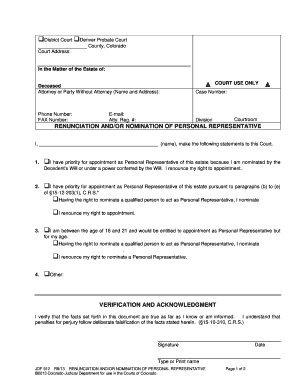
Ddress): Case Number: Phone Number: FAX Number: Division E-mail: Atty. Reg. #: Courtroom RENUNCIATION AND/OR NOMINATION OF PERSONAL REPRESENTATIVE I, 1. (name), make the following statements to this Court. I have priority for appointment as Personal Representative of this estate because I am nominated by the Decedent s Will or under a power conferred by the Will. I renounce my right to appointment. 2. I have priority for appointment as Personal Representative of this estate pu.
Open form follow the instructions
Easily sign the form with your finger
Send filled & signed form or save
How to fill out the CO JDF 912 online
Filling out the CO JDF 912 form can seem daunting, but this guide is designed to help you navigate the process with ease. Follow these step-by-step instructions to effectively complete and submit the form online.
Follow the steps to complete the CO JDF 912 form online.
- Click ‘Get Form’ button to obtain the form and open it in the editor.
- Begin by filling out the top section with the court details, including the district court or probate court, the county of residence, and the specific court address. This information is essential for the proper processing of your form.
- In the 'In the Matter of the Estate of' section, insert the name of the deceased individual whose estate is involved.
- Complete the field labeled 'Atttorney or Party Without Attorney (Name and Address)' with your own information or that of your legal representative, along with the case number, your phone number, and email address.
- Move to the 'Renunciation and/or Nomination of Personal Representative' section. Here, select the appropriate option that applies to you based on priority for appointment as Personal Representative. You may choose to renounce your right to appointment or nominate another qualified person.
- Verify all details and complete the 'Verification and Acknowledgment' section by providing your signature and date. Confirm that the facts you have supplied are accurate to the best of your knowledge.
- In the acknowledgment section, fill in the necessary details regarding the notary public or deputy clerk and include their signature, along with the date of acknowledgment.
- Once completed, review the entire document for accuracy. You can then save your changes, download a copy of the filled form, or print it for your records.
Take the next step and complete your CO JDF 912 form online today.
Experience a faster way to fill out and sign forms on the web. Access the most extensive library of templates available.
Related content
JDF 912SC R9/18 RENUNCIATION AND/OR NOMINATION OF PERSONAL REPRESENTATIVE. Page 1 of 2...
1) This module may not be included in commerical package or used for any 26 ! · 2) This...
NOTES: Grades shown in cross references are NLGI, ISO, AGMA and SAE. Conflicts are 1) 10...
Get answers to your most pressing questions about US Legal Forms API.
How long do you have to file probate after death in Colorado?
In Colorado, you typically have six months from the date of death to file for probate. Failing to file within this timeframe can lead to complications. To assist with the probate process, utilizing tools like the CO JDF 912 can help expedite your filing and ensure compliance with state law.
Where do I file a will in Colorado?
To file a will in Colorado, you must go to the appropriate probate court in the county where the deceased resided. When filing, you will need to use the CO JDF 912 form along with the original will. This ensures the court can start the probate process efficiently.
Where are wills recorded in Colorado?
Wills in Colorado are recorded in the probate court where the deceased lived at the time of their death. This court handles the processing and validation of the will. To make this process easier, consider using the CO JDF 912 form, which is specifically designed for Illinois probate procedures.
Do you have to file a will anywhere?
Yes, you are required to file a will in the probate court in the county of the deceased's residence. This ensures the will is legally recognized and can be acted upon. Using the CO JDF 912 form helps facilitate this filing and supports the claims made in the will.
Do wills need to be recorded in Colorado?
Yes, in Colorado, wills need to be filed with the probate court to be effective after the testator passes away. This recording secures the will's legal standing and allows the estate to be managed according to the deceased's wishes. Utilizing the CO JDF 912 form can simplify the recording process.
Where do you file a will in Colorado?
In Colorado, you file a will with the probate court in the county where the deceased lived at the time of their death. Using the CO JDF 912 form can streamline this process. Ensure you file the will as soon as possible, as there are specific time limits for submission.
How to obtain letters testamentary in Colorado?
To obtain letters testamentary in Colorado, first, you must file a petition in probate court along with the required CO JDF 912 form. This process involves providing details about the deceased and their estate. Once the court approves your petition, they will issue letters testamentary, granting you the authority to manage the deceased's estate.
How long does probate take in Colorado without a will?
Probate without a will in Colorado can take several months to over a year, depending on the complexity of the estate and any disputes among heirs. The process includes filing necessary paperwork, notifying creditors, and distributing assets, which can all affect the timeline. It is crucial to stay organized and informed throughout each step. To ensure you are on the right path, consider using CO JDF 912 to simplify your understanding of the process and required documentation.
How does probate work without a will in Colorado?
Probate without a will in Colorado involves the court appointing a personal representative to oversee the estate. This representative is responsible for settling debts, managing assets, and distributing what remains according to state laws. The absence of a will can complicate matters, but understanding the probate process can help you navigate this challenging situation. For guidance, check out the CO JDF 912, which provides forms and instructions to assist you.
Who inherits if there is no will in Colorado?
If there is no will in Colorado, the state's intestacy laws dictate who inherits the deceased's assets. Typically, close relatives such as spouses, children, parents, or siblings have first rights to the estate. If no immediate family exists, the inheritance may extend to more distant relatives. To navigate these laws effectively, CO JDF 912 offers essential forms and resources that can assist you in the probate process.
Use professional pre-built templates to fill in and sign documents online faster. Get access to thousands of forms.
If you believe that this page should be taken down, please follow our DMCA take down process here.