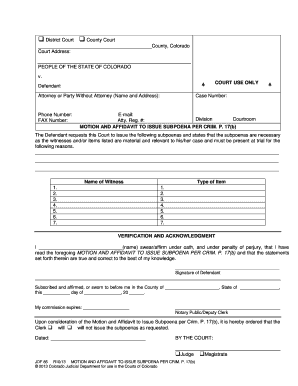
Orney (Name and Address): Phone Number: FAX Number: Case Number: E-mail: Division Courtroom Atty. Reg. #: MOTION AND AFFIDAVIT TO ISSUE SUBPOENA PER CRIM. P. 17(b) The Defendant requests this Court to issue the following subpoenas and states that the subpoenas are necessary as the witnesses and/or items listed are material and relevant to his/her case and must be present at trial for the following reasons.
Open form follow the instructions
Easily sign the form with your finger
Send filled & signed form or save
How to fill out the CO JDF 85 online
The CO JDF 85, or Motion and Affidavit to Issue Subpoena per Crim. P. 17(b), is a crucial legal document used in the State of Colorado. This guide provides step-by-step instructions to help users complete the form accurately and efficiently online.
Follow the steps to complete your CO JDF 85 online.
- Click the ‘Get Form’ button to obtain the form and open it in the editor.
- Begin by selecting the appropriate court type: District Court or County Court. Indicate the name of the county where the court is located.
- Enter the court address in the designated field.
- Fill in the section labeled 'People of the State of Colorado' and then move to enter the name of the defendant.
- Complete the information for the attorney or party without attorney, including their name, address, phone number, fax number, email address, and attorney registration number if applicable.
- Enter the case number related to the motion.
- In the section for the motion request, provide detailed reasons why the subpoenas are necessary, specifying what witnesses or items are requested.
- List the names of up to seven witnesses in the space provided, ensuring clarity and accuracy.
- Similarly, list the types of items you are requesting the court to subpoena, again using the offered space efficiently.
- As the final step, complete the verification and acknowledgment section by providing your name, then sign and date the document. After completing all fields, you can choose to save changes, download the form, print it, or share it.
Complete your documents online with confidence and accuracy.
Experience a faster way to fill out and sign forms on the web. Access the most extensive library of templates available.
Related content
JDF 85 - Motion and Order to Issue a Subpoena (Criminal Matters). R: May 18, 2022. Page 1...
... 85 implicit none 86 !jdf 87 ! integer, parameter :: iprint = 0 88 integer, parameter...
If the JDF job has a target path specified in the job, JDF output is always created. For...
Get answers to your most pressing questions about US Legal Forms API.
How do you look up someone's charges in Colorado?
To look up someone's charges in Colorado, you can visit the Colorado Judicial Branch website or contact the local courthouse directly. Utilizing the guidelines set forth in CO JDF 85 can streamline the process by ensuring you have the correct forms and information needed. This will help you access vital legal information with ease.
Is Colorado a public records state?
Yes, Colorado is a public records state, meaning that most court records and government documents are accessible to the public. This practice promotes transparency and accountability within the legal system. Utilizing resources like CO JDF 85 can help you understand how to obtain public records while ensuring you follow the correct procedures.
How to fill out a JDF 76?
Filling out a JDF 76 form involves providing specific information related to your case, such as names, contact information, and the nature of your request. CO JDF 85 offers guidelines and examples to assist you in completing this form accurately. For personalized assistance, consider using uslegalforms, which provides detailed instructions and templates tailored to your needs.
Can you look up a court case in Colorado?
Absolutely, you can look up court cases in Colorado through various online resources, including the Colorado court system's website. The CO JDF 85 facilitates this process by providing structured forms that help you clearly identify and request case information. Make sure you have the necessary details, such as case numbers or party names, to enhance your search.
What is Colorado Chief Justice Directive 85 31?
Colorado Chief Justice Directive 85 31, often referred to as CO JDF 85, outlines procedures regarding the management and availability of court records. This directive ensures transparency and promotes public access to court information while safeguarding sensitive data. Understanding CO JDF 85 can help individuals navigate legal processes more effectively.
Can you look up Colorado court cases?
Yes, you can look up Colorado court cases through the Colorado Judicial Branch's website or by visiting your local courthouse. To assist you, CO JDF 85 provides important forms that help you navigate the legal system and access court records. Using these resources can simplify your search for case information.
What type of subpoena orders the production of documents?
A subpoena duces tecum is specifically designed to order the production of documents in a legal context. This type of subpoena compels an individual or organization to provide specified documents relevant to a case. If you’re looking for comprehensive information on this process, consider consulting CO JDF 85, which offers useful insights into effective usage of subpoenas within the legal framework.
How to write a subpoena for documents?
Writing a subpoena for documents begins with identifying the case details, including the court and relevant parties. Specify the documents that you seek and include clear instructions for their production. Incorporating the guidelines from CO JDF 85 will assist in creating an effective subpoena that meets legal standards and facilitates the document retrieval process.
How to fill out a subpoena to produce documents?
To fill out a subpoena to produce documents, start by stating the title of the case and the court’s name at the top. Clearly specify the documents you need and include a deadline for compliance. Referencing the CO JDF 85 will help you ensure that your subpoena adheres to legal requirements and helps you obtain the necessary documents efficiently.
Is a request for production of documents the same as a subpoena?
A request for the production of documents and a subpoena serve different purposes in legal proceedings. A request is typically made during discovery, allowing parties to obtain relevant information from each other. In contrast, a subpoena is a legal document that compels someone to appear in court or produce documents. Understanding the distinctions, especially when dealing with CO JDF 85, is essential for effective legal practice.
Use professional pre-built templates to fill in and sign documents online faster. Get access to thousands of forms.
If you believe that this page should be taken down, please follow our DMCA take down process here.