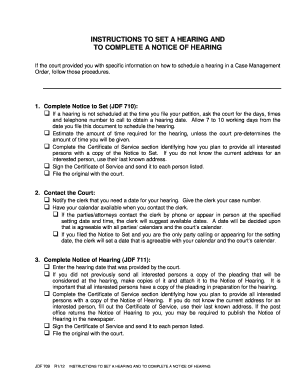
INSTRUCTIONS TO SET A HEARING AND TO COMPLETE A NOTICE OF HEARING If the court provided you with specific information on how to schedule a hearing in a Case Management Order, follow those procedures.
Open form follow the instructions
Easily sign the form with your finger
Send filled & signed form or save
How to fill out the CO JDF 709 online
Filling out the CO JDF 709 form is an important step in the legal process for scheduling a hearing. This guide will provide you with a clear, step-by-step approach to completing the form online, ensuring that you understand each component of the document.
Follow the steps to complete the CO JDF 709 form online.
- Click the ‘Get Form’ button to access the CO JDF 709 form and open it in the editor.
- Begin by entering the details required in the appropriate fields, including your name, contact information, and case number.
- Indicate the date provided by the court for the hearing. Make sure to double-check the date to avoid any discrepancies.
- Attach any relevant pleadings that will be considered at the hearing if you have not already provided copies to all interested persons.
- Complete the Certificate of Service section, indicating how you will notify all interested parties of the hearing.
- If you do not have the current addresses for any interested persons, use their last known addresses.
- Sign the Certificate of Service to confirm that you have sent the appropriate notifications.
- File the original CO JDF 709 form with the court to finalize the submission.
- Once you have completed the form, you can save your changes, download it for your records, print it, or share it as necessary.
Complete your documents online today for a smoother legal experience.
Experience a faster way to fill out and sign forms on the web. Access the most extensive library of templates available.
Related content
1) MOSAIC and its sub-modules ASTEEM, MESA, and MTEM may not be included in 34 ! · 2) The...
These operating instructions provide required information for the vehicle, and the owner...
Get answers to your most pressing questions about US Legal Forms API.
How long is probate in Colorado?
Probate is the legal process of 'settling' the estate of a deceased person, and it can take months, even years, for more complex estates. In Colorado, the average estate spends 9-24 months in probate.
How do you probate a will in Washington State?
File the decedent's original will with the appropriate superior court's probate division. ... Obtain a copy of the decedent's death certificate, if necessary. ... Fill out a case cover sheet and file it with the superior court, along with the will.
What is a PR deed?
A Personal Representative Deed is the correct way to transfer estate property to a buyer. If the property is being transferred to a beneficiary, a Distributive Deed from the PR is appropriate.
What is a personal representative deed in Washington state?
This form is a Personal Representative s Deed where the Grantor is the individual appointed as personal representative of a intestate estate and the Grantee is the surviving joint tenant entitled to the property interest of decedent in the joint tenancy property.
Can you sell a house during probate?
The home may be sold during the probate process but only by someone with legal authority to manage the estate assets. The Personal Representative (executor) must be formally appointed by the Probate Court to have authority over estate assets.
What is a personal representative for a will?
The Personal Representative ('Executor'/'Executrix' or 'Administrator/Administratrix') is the person you name (nominate) in your Will to handle your estate. ... If your Personal Representative and all the Alternatives are unable to act, the probate court will name a person to fill this role.
Does an executor have the right to sell property?
The Executor's Power to Sell Property (decedent died with a will) In a probate case, whether or not the the executor has the power to sell a piece of property depends on the language of the will. ... In short, if the will does not disallow a sale, the executor can sell a property without the beneficiaries consenting.
Can a personal representative be a beneficiary?
This person is referred to as a personal representative or executor. Since family members are often the most trusted people in the testator's life, one or more of them are frequently named as personal representatives even though they may also be devisees, or beneficiaries, under his will.
Can a personal representative sell a property?
Before selling real property, the personal representative may have to gain court approval. The real property may have to be appraised by a professional. He or she may also be required to inform the beneficiaries of the sale and possibly obtain their approval. The personal representative signs the sales documents.
What is the difference between a personal representative and executor?
Administrators, executors and personal representatives all perform the same job except that administrators are appointed by the court; personal representatives and executors are named by will.
Use professional pre-built templates to fill in and sign documents online faster. Get access to thousands of forms.
If you believe that this page should be taken down, please follow our DMCA take down process here.