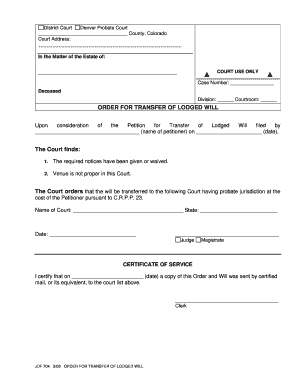
E ONLY Case Number: Deceased Division: Courtroom: ORDER FOR TRANSFER OF LODGED WILL Upon consideration of the Petition for Transfer of Lodged Will filed by (name of petitioner) on (date), The Court finds: 1. The required notices have been given or waived. 2. Venue is not proper in this Court. The Court orders that the will be transferred.

How it works
  • Open form

    Open form follow the instructions

  • Easily sign form

    Easily sign the form with your finger

  • Share form

    Send filled & signed form or save

How to fill out the CO JDF 704 online

Filling out the CO JDF 704 form is an essential process for transferring a lodged will in the Colorado District Court. This guide provides clear, step-by-step instructions to assist users in completing the form accurately and effectively online.

Follow the steps to complete the form successfully.

  1. Click ‘Get Form’ button to obtain the form and open it in your editor.
  2. Fill in the court's address at the top of the form. Ensure that you include the appropriate county, state, and any relevant contact information.
  3. Enter the details of the decedent under the section titled 'In the Matter of the Estate of'. This includes the name of the deceased individual.
  4. Record the case number provided to you by the court, along with the division and courtroom information as specified.
  5. In the section for the petitioner, write the name of the individual filing the petition, along with the date of submission.
  6. After the court's findings, fill in the name of the court to which the will will be transferred and indicate the state.
  7. Include the date on which you are completing the order.
  8. Sign the form where indicated to verify authenticity, ensuring that it is dated correctly.
  9. Complete the certificate of service by noting the date the order and lodged will were sent to the relevant court.
  10. Once all sections are filled, review the form for accuracy. Then, you can save the changes, download, print, or share the completed form as needed.

Begin filling out your documents online today for an efficient processing experience.

Get form

Experience a faster way to fill out and sign forms on the web. Access the most extensive library of templates available.

Related content

JDF704.pdf

JDF 704SC R11/2023 ORDER FOR TRANSFER OF LODGED WILL. ❑District Court ❑Denver Probate...

Learn more
module_mosaic_driver.F

1) MOSAIC and its sub-modules ASTEEM, MESA, and MTEM may not be included in 34 ! · 2) The...

Learn more
Class 55-lnclicators and Recorders

MARKINGS FOR BOW CQ:-IP.SN.SATJON AS WELL. AS ASrt.RN CO'-lPENSA.TION, RELATIVE SPEED...

Learn more
Questions & Answers

Get answers to your most pressing questions about US Legal Forms API.

Contact support

How long is probate in Colorado?

Probate is the legal process of 'settling' the estate of a deceased person, and it can take months, even years, for more complex estates. In Colorado, the average estate spends 9-24 months in probate.

File the decedent's original will with the appropriate superior court's probate division. ... Obtain a copy of the decedent's death certificate, if necessary. ... Fill out a case cover sheet and file it with the superior court, along with the will.

A Personal Representative Deed is the correct way to transfer estate property to a buyer. If the property is being transferred to a beneficiary, a Distributive Deed from the PR is appropriate.

This form is a Personal Representative s Deed where the Grantor is the individual appointed as personal representative of a intestate estate and the Grantee is the surviving joint tenant entitled to the property interest of decedent in the joint tenancy property.

The home may be sold during the probate process but only by someone with legal authority to manage the estate assets. The Personal Representative (executor) must be formally appointed by the Probate Court to have authority over estate assets.

The Personal Representative ('Executor'/'Executrix' or 'Administrator/Administratrix') is the person you name (nominate) in your Will to handle your estate. ... If your Personal Representative and all the Alternatives are unable to act, the probate court will name a person to fill this role.

The Executor's Power to Sell Property (decedent died with a will) In a probate case, whether or not the the executor has the power to sell a piece of property depends on the language of the will. ... In short, if the will does not disallow a sale, the executor can sell a property without the beneficiaries consenting.

This person is referred to as a personal representative or executor. Since family members are often the most trusted people in the testator's life, one or more of them are frequently named as personal representatives even though they may also be devisees, or beneficiaries, under his will.

Before selling real property, the personal representative may have to gain court approval. The real property may have to be appraised by a professional. He or she may also be required to inform the beneficiaries of the sale and possibly obtain their approval. The personal representative signs the sales documents.

Administrators, executors and personal representatives all perform the same job except that administrators are appointed by the court; personal representatives and executors are named by will.

Get This Form Now!

Use professional pre-built templates to fill in and sign documents online faster. Get access to thousands of forms.

If you believe that this page should be taken down, please follow our DMCA take down process here.

Get CO JDF 704