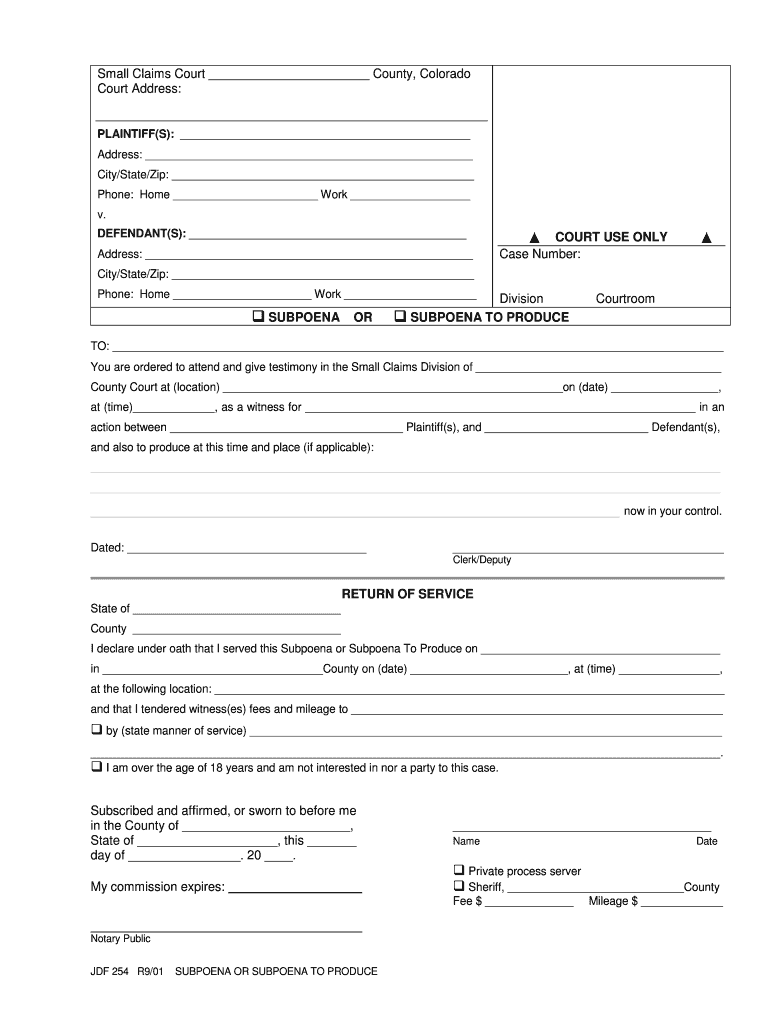
City/State/Zip: Phone: Home Work v. DEFENDANT(S): Address: COURT USE ONLY Case Number: City/State/Zip: Phone: Home Work ! SUBPOENA OR Division ! SUBPOENA TO PRODUCE Courtroom TO:.
Loading

Open form follow the instructions

Easily sign the form with your finger

Send filled & signed form or save
How to fill out the CO JDF 254 online
This guide provides clear instructions on how to complete the CO JDF 254 form online for Small Claims Court in Colorado. Whether you are a seasoned user or new to legal documents, this comprehensive resource is designed to support your filing process effectively.
Follow the steps to complete the CO JDF 254 online.
- Click the ‘Get Form’ button to obtain the form and open it in the editor.
- In the 'Plaintiff(s)' section, enter the name(s) of the person or entity initiating the claim. Include their complete address, city, state, and zip code, as well as both home and work phone numbers.
- In the 'Defendant(s)' section, input the name(s) of the person or entity being sued. Similarly, include their full address, city, state, and zip code.
- Next, locate the 'Court Use Only' section. Here, you will need to provide the case number once it is assigned by the court. Additionally, note details such as the county and phone numbers as needed.
- In the 'Subpoena or Subpoena to Produce' section, fill out the recipient's name and details, including the specific court location, date, and time for the witness to appear.
- Indicate the action between the plaintiff(s) and defendant(s) clearly in the provided fields.
- If applicable, specify any documents that the witness must produce at the time of the appearance.
- Complete the 'Return of Service' section by filling in the state and county where the subpoena is served. Document the date and time of service and the location of the witness.
- Lastly, ensure the signature section is completed with the name of the person serving the subpoena, including their age and the manner of service used, followed by a notary public's acknowledgment if required.
- Once all sections are filled out, review the form for accuracy, and then save your changes. You can download, print, or share the form as necessary.
Complete your CO JDF 254 online today to ensure your small claims filing is accurate and timely.
Experience a faster way to fill out and sign forms on the web. Access the most extensive library of templates available.
Related content
Apr 24, 2025 — A Subpoena Affidavit [Form JDF 80.3] must be attached with this Subpoena...
by MJ Lutz · 2007 · Cited by 539 — We investigate the functioning of the ocean's...
The Versant 180 is the latest model in the Xerox® Versant Family of 4-color, cut-sheet...
Get answers to your most pressing questions about US Legal Forms API.
How do I file a small claim in Colorado Springs?
File by taking the document to the courthouse's clerk of the small claims court. Pay required filing fees of $31 or $55, as determined by the court, to the clerk of the court. The clerk will set a trial date. Send notice of your lawsuit to the person you're suing at least 15 days prior to trial.
What is a court filing fee?
A filing fee is the amount of money you must pay to the court to begin your court case.
How much does it cost to file for custody in Colorado?
Filing fee: $166. Motion to modify, amend, or alter decree or order. This is the request you file with the court if you wish to change an existing Colorado child custody order. Filing fee: $105.
How much does it cost to file a lawsuit in Colorado?
Pay a filing fee. In Colorado federal court, you will need to pay $400.00 in order to file a lawsuit. You can pay the filing fee in cash, money order, credit card, or personal check.
How much does it cost to file a civil suit in Colorado?
The filing fee for a civil action, suit, or proceeding is $400.00. Please refer to the Fee Schedule on the Court's Home Page for a complete list of fees that the District of Colorado charges.
How much can you sue in civil court?
Generally, claims involving a relatively small amount of money (up to $10,000 depending on the state) should be filed in small claims court. A separate court will hear cases involving medium-sized claims (usually up to $25,000) and another court will hear most claims that exceed that amount.
How much can you claim at Small Claims Court?
Settle consumer disputes legally. The small claims court is the low-hassle way to take legal action for up to £10,000 against a firm or individual. But be confident you've got a case before you start as new fees mean you'll now pay twice as much if you lose.
Can I take someone to court who owes me money?
If someone owes you money and won't pay up, you might consider filing a lawsuit to have a judge order them to pay it. ... Beyond that, a court's order only gives you the legal right to get the money from the other person. The court won't collect the money for you.
How much money can you take someone to court?
As to the cost of taking someone to small claims court, you'll generally pay a filing fee of less than $100 that is recoverable if you win. Meanwhile, each state will cap the amount you are allowed to sue for. It typically ranges anywhere from $2,000 to $10,000, according to LegalZoom.
What is the minimum amount of money you can take someone to court for?
Small claims court is designed to be a way for people to recover money in cases that are too small to be worth going through regular litigation, which can be costly and time-consuming. There's not a minimum amount you can sue for in small claims court, but most courts have a filing fee that will be between $25 and $50.
Use professional pre-built templates to fill in and sign documents online faster. Get access to thousands of forms.
If you believe that this page should be taken down, please follow our DMCA take down process here.