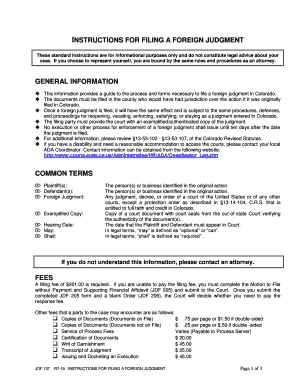
You are bound by the same rules and procedures as an attorney. GENERAL INFORMATION This information provides a guide to the process and forms necessary to file a foreign judgment in Colorado. The documents must be filed in the county who would have had jurisdiction over the action if it was originally filed in Colorado. Once a foreign judgment is filed, it will have the same effect and is subject to the same procedures, defenses, and proceedings for reopening, vacating, enforcing,.
Loading
Open form follow the instructions
Easily sign the form with your finger
Send filled & signed form or save
How to fill out the CO JDF 137 online
This guide provides clear and comprehensive instructions on how to fill out the CO JDF 137 form online for filing a foreign judgment in Colorado. Understanding each section of the form is essential to ensure accuracy and compliance with the requirements.
Follow the steps to properly complete the CO JDF 137 form online.
- Click ‘Get Form’ button to obtain the form and open it in the editor.
- Obtain exemplified copies of all judgment orders related to the case you wish to file in Colorado. Make sure to keep copies of all documents for your records and to provide to the other party.
- Identify yourself correctly in the forms as either Plaintiff or Defendant, as represented in the out-of-state case. Fill in the caption accurately on all forms, including the name of the court, your name, the opposing party's name, and contact information.
- Complete the Judgment Creditor Affidavit in Support of Foreign Judgment (JDF 138) and ensure that all sections are filled out. Attach authenticated copies of all judgment orders for verification.
- Fill out the Notice of Filing of Foreign Judgment (JDF 139) and ensure all sections are completed. Decide if you will mail the Notice to the Judgment Debtor or if the Court Clerk will do it. If mailing yourself, prepare extra copies and provide stamped, addressed envelopes.
- Review the filled forms to ensure all information is accurate and complete. Make copies of each completed form for your personal records.
- You are now ready to file your case with the Court. Pay the required filing fee of $201. Ensure the clerk sends notice of the filing to the Judgment Debtor using the provided address.
- After submission, await the Court's review of the documents and be prepared for any necessary hearings regarding objections.
Complete your CO JDF 137 form online today to initiate your filing process.
Experience a faster way to fill out and sign forms on the web. Access the most extensive library of templates available.
Related content
Mar 10, 2023 — This information provides a guide to the process and forms necessary to...
JdF plate interior and northern Gorda; (ii) the southern, internally deforming Gorda and...
Get answers to your most pressing questions about US Legal Forms API.
How to domesticate a foreign judgment in Colorado?
To domesticate a foreign judgment in Colorado, you must first file a copy of the judgment with the appropriate court, along with a verified petition, usually by using the CO JDF 137 form. The court will then review the foreign judgment to ensure it meets Colorado's requirements. After passing this review, the judgment can be enforced as if it originated in Colorado. It's an essential process that ensures fair legal practices across state lines.
What is notice of filing foreign judgment?
A notice of filing foreign judgment is a legal document that informs relevant parties about a judgment made in another state being recognized in Colorado. This process ensures transparency and accountability in enforcing judgments across state lines. If you need to handle such matters, incorporating the CO JDF 137 can simplify the paperwork involved, ensuring compliance with state laws.
How much can you sue for in Colorado?
In Colorado, the amount you can sue for generally depends on the nature of your claim and the damages incurred. There is no strict upper limit for most civil suits, but certain categories, such as small claims, may have restrictions. Always consider documenting your losses clearly to support your case when using the CO JDF 137. Consulting a legal expert can provide tailored guidance on your potential claim amount.
What is the difference between a lawsuit and a civil suit?
A lawsuit is a broad term encompassing any legal action brought by one party against another in court. A civil suit, however, specifically refers to legal disputes between individuals or entities regarding rights, obligations, and liabilities. Understanding these terms can help clarify your legal process. Utilizing tools like the CO JDF 137 can assist you in pursuing your civil suit effectively.
How long do you have to file a civil lawsuit in Colorado?
In Colorado, the time limit to file a civil lawsuit typically ranges from one to six years, depending on the type of claim. It's crucial to be aware of these deadlines to preserve your rights. Using the CO JDF 137 can help streamline your filing process. For specific cases, consider seeking advice from a legal professional to ensure compliance with the timeline.
How to sue someone in Colorado?
To sue someone in Colorado, start by determining the right court for your case. You will need to complete the required forms, including the CO JDF 137, and file them with the court. After filing, serve the other party with the legal documents to inform them about the lawsuit. Using platforms like US Legal Forms can simplify this process by providing easy access to necessary forms and instructions.
How to fill out a JDF 76?
To fill out a JDF 76, start by gathering the necessary information, including party details and case specifics. Provide clear and concise responses in each section, ensuring accuracy throughout, as this document plays a significant role in your proceedings. CO JDF 137 can assist you in structuring your submission correctly, making the process more manageable.
What is the format for a court case number in Colorado?
A court case number in Colorado generally follows a specific format: it includes the year the case was filed, a designation for the court, and a unique sequence of numbers. For instance, you might see a number formatted as '2021CV1234,' where 'CV' indicates a civil case. Understanding this format is essential when referencing your case, particularly when applying for documentation such as CO JDF 137.
What is the difference between a county court and a district court in Colorado?
In Colorado, county courts primarily handle civil cases with lower monetary limits and criminal misdemeanors, while district courts deal with more serious offenses and larger civil cases. County courts serve local communities, whereas district courts operate at a higher level within the judicial system. Familiarizing yourself with court types can help you properly navigate your legal needs, especially when utilizing CO JDF 137.
How to fill out a motion for court?
Filling out a motion for court involves several steps, including understanding the specific requirements for your case and using the appropriate forms. It's crucial to provide accurate information, as each claim needs careful documentation. Utilizing CO JDF 137 can guide you through this process effectively, helping you create a clear and organized motion.
Use professional pre-built templates to fill in and sign documents online faster. Get access to thousands of forms.
If you believe that this page should be taken down, please follow our DMCA take down process here.