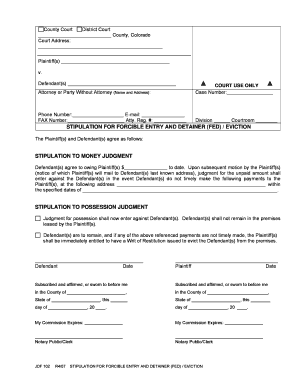
Ndant(s) Attorney or Party Without Attorney (Name and Address): COURT USE ONLY Case Number: Phone Number: E-mail: FAX Number: Atty. Reg. #: Division Courtroom STIPULATION FOR FORCIBLE ENTRY AND DETAINER (FED) / EVICTION The Plaintiff(s) and Defendant(s) agree as follows: STIPULATION TO MONEY JUDGMENT Defendant(s) agree to owing Plaintiff(s) $.
Open form follow the instructions
Easily sign the form with your finger
Send filled & signed form or save
How to fill out the CO JDF 102 online
Filling out the CO JDF 102 form online is an important step for users involved in eviction proceedings. This guide will provide you with clear instructions to ensure that you complete the form accurately and efficiently.
Follow the steps to successfully complete the CO JDF 102 online
- Click ‘Get Form’ button to access the CO JDF 102 form and open it in your document editor.
- Begin by filling in the court address at the top of the form. Make sure to provide the correct county and court information for accurate processing.
- Next, specify the names of the plaintiff(s) in the designated section. Ensure that all names are spelled correctly to avoid confusion.
- In the following section, enter the names of the defendant(s). Again, accuracy is crucial here.
- If an attorney is involved, fill out the corresponding section with the attorney's name and address or indicate if you are a party without an attorney.
- Complete the fields under 'COURT USE ONLY' by entering the case number, phone number, email address, FAX number, and attorney registration number if applicable.
- Proceed to fill out each stipulation section carefully. Clearly state the agreement regarding money judgment and possession judgment, ensuring that all amounts, dates, and payment addresses are specified as required.
- Finally, review the form for accuracy. Once everything is complete, you can choose to save any changes, download a copy of the form, print it for your records, or share it as needed.
Complete your CO JDF 102 form online to streamline your eviction process today.
Experience a faster way to fill out and sign forms on the web. Access the most extensive library of templates available.
Related content
JDF 102 – Eviction Summons (Form 1A). R: May 6, 2024. Page 1 of 5. JDF 102. Eviction...
This chapter will review predictive factors currently in use and discuss some of the...
JPF 2A, 3A, 4A, 41A. 11. Dimensions and Weights. 11. Performance Chart. 11. Performance...
Get answers to your most pressing questions about US Legal Forms API.
What is an illegal eviction in Colorado?
An illegal eviction in Colorado occurs when a landlord tries to remove a tenant without following the required legal process. This can include changing locks or shutting off utilities without a court order. Tenants can protect themselves by referring to legal resources, including the CO JDF 102, to ensure their rights are upheld.
What if a tenant moves out before hearing?
If a tenant moves out before the hearing, the landlord may still pursue the eviction process if they have initiated it. However, it’s vital for landlords to document the circumstances surrounding the move-out. Tenants should know that using the CO JDF 102 form can provide clarity on obligations and rights during this transitional period.
Can a landlord evict you without a court order in Colorado?
In Colorado, a landlord cannot evict you without a court order. Any landlord attempting to remove you from the property without following the legal eviction process could face penalties. It's essential to familiarize yourself with the eviction laws and forms like CO JDF 102 to protect your rights.
Can a landlord evict you immediately in Colorado?
No, a landlord cannot evict you immediately in Colorado. State law requires landlords to follow specific steps, including providing written notice to the tenant. Utilizing resources, such as the CO JDF 102, can help you comprehend your rights and ensure a proper process is followed.
What is the new eviction law in Colorado?
The new eviction law in Colorado introduces significant changes to the eviction process, emphasizing tenant rights and clear procedures. Under this law, landlords must provide comprehensive notices and follow strict timelines. For tenants, understanding these changes, such as the CO JDF 102 form, is crucial for navigating potential disputes effectively.
Who pays for eviction?
In Colorado, the landlord is typically responsible for the costs associated with the eviction process. However, if the landlord wins the case, they may recover some costs from the tenant. Understanding these financial aspects is crucial as you navigate the eviction process. Tools like CO JDF 102 can clarify these responsibilities and guide you on what to expect.
How to avoid eviction in Colorado?
Avoiding eviction in Colorado often involves communication with your landlord and understanding your lease agreement. You may also explore options such as negotiating a payment plan or seeking legal assistance to address outstanding issues. Keeping open lines of dialogue can lead to more favorable outcomes. Resources like CO JDF 102 offer valuable information that can help you make informed decisions and potentially avoid eviction.
How long does it take to evict a tenant in Colorado?
The timeline to evict a tenant in Colorado can vary but typically ranges from a few weeks to a couple of months. Factors such as court schedules, tenant responses, and compliance with legal notices play a crucial role. It’s important to be prepared and informed about the eviction process. Utilizing tools like CO JDF 102 can streamline the necessary steps and ensure compliance with state regulations.
How quickly can you evict someone in Colorado?
In Colorado, the eviction process can take as little as a few weeks, depending on various factors such as the type of eviction and court schedules. Landlords must follow legal procedures, which include providing notice and allowing time for the tenant to respond. It's beneficial to familiarize yourself with the steps outlined in CO JDF 102, which can assist you in understanding the timeline and required documents.
Is there a grant to stop eviction?
Certain programs and grants can aid individuals facing eviction in Colorado, especially for those experiencing financial hardship. These funds may be available through community organizations or government resources. It is wise to check available options, as CO JDF 102 helps guide you through eviction-related issues and may point you towards relevant resources.
Use professional pre-built templates to fill in and sign documents online faster. Get access to thousands of forms.
If you believe that this page should be taken down, please follow our DMCA take down process here.