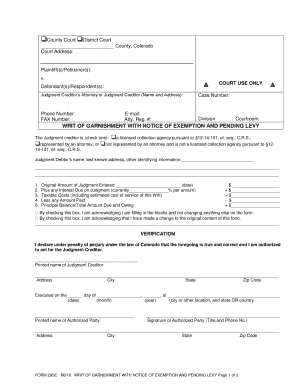
County Court District Court County, Colorado Court Address:Plaintiff(s)/Petitioner(s): v. COURT USE ONLYDefendant(s)/Respondent(s): Judgment Creditors Attorney or Judgment Creditor (Name and Address):Case.

How it works
  • Open form

    Open form follow the instructions

  • Easily sign form

    Easily sign the form with your finger

  • Share form

    Send filled & signed form or save

How to fill out the CO Form 29SC online

Navigating the CO Form 29SC can be straightforward with the right guidance. This guide provides clear, step-by-step instructions to help you complete the form online efficiently and accurately.

Follow the steps to fill out the CO Form 29SC online successfully.

  1. Press the ‘Get Form’ button to access the form and open it in the designated online editor.
  2. Begin by filling in the court details, including the county, court address, and whichever court applies — either County Court or District Court.
  3. Enter the names of the plaintiffs or petitioners and the defendants or respondents in their respective fields.
  4. Provide the judgment creditor’s attorney details if applicable, including their name, address, and contact information.
  5. Fill in the case number and contact information, including phone number, fax number, email address, and attorney registration number if relevant.
  6. Indicate whether the judgment creditor is a licensed collection agency, represented by an attorney, or unrepresented and not a licensed agency.
  7. Input the judgment debtor’s name, last known address, and any other identifying information required.
  8. Complete the financial details related to the judgment, including the original amount of judgment entered, interest due, taxable costs, amounts paid, and the total balance due.
  9. Acknowledge the changes made by checking the appropriate box regarding filling in the blanks or making changes to the form’s original content.
  10. Complete the verification section by filling in the printed name of the judgment creditor and their address, including the execution date.
  11. Lastly, review all entries for accuracy and completeness, then save your changes, download, print, or share the completed form as needed.

Complete your documents online with confidence today.

Get form

Experience a faster way to fill out and sign forms on the web. Access the most extensive library of templates available.

Related content

rule change 2024(03)

Jan 11, 2024 — Form 29 SC - Writ of Garnishment with Notice of Exemption. R: 1/2224...

Learn more
Organization of Corporations--Chapter 1.4...

by WJ Bristow Jr · 1963 — INTRODUCTION. One of the major benefits, both to lawyers and...

Learn more
hobart

Place a spirit level on top of the base unit and level the base, side to side and front to...

Learn more
Questions & Answers

Get answers to your most pressing questions about US Legal Forms API.

Contact support

How do I write a third party authorization letter?

To write a third party authorization letter, start by clearly stating your intent to authorize another individual. Include the date, your name, contact information, and the details of the third party. Finally, specify the scope of the authorization and sign the document, ensuring to maintain a copy for your records. Utilizing the CO Form 29SC can simplify the process and enhance your letter's effectiveness.

A third party authorization form is a document that grants someone else the authority to act on your behalf regarding specific matters. This can be useful when dealing with legal, tax, or financial issues. The CO Form 29SC serves as a reliable tool for establishing this authorization clearly and effectively.

Filling out the Employee Withholding Certificate form involves providing your personal information and then determining your withholding amount based on your tax situation. You will need to follow the instructions on the form and consult the tax tables if necessary. Making use of the CO Form 29SC can help you ensure that your financial information is accurately documented.

In Colorado, a court can seize personal property such as bank accounts, vehicles, and any valuable assets to satisfy a judgment. However, certain protections are in place for essentials like household goods and necessary personal items. Understanding these rules can help you navigate potential court situations, and resources like the CO Form 29SC can guide you in presenting your case effectively.

To file a third party authorization with the IRS, fill out the CO Form 29SC completely and accurately. Make sure to include all necessary signatures and details of both you and the third party. Once completed, you can submit the form to the IRS with your tax documents or send it directly to the relevant department.

A third party authorization allows someone you trust to access your information and make decisions on your behalf when dealing with government entities or organizations. This is particularly useful for tax matters, as it enables your authorized representative to communicate with the IRS on your behalf. Utilizing the CO Form 29SC streamlines this process, providing clarity and simplicity.

To fill out the third party authorization form, start by providing your personal information such as name, address, and Social Security number. Next, specify the third party's details, including their name and contact information. Finally, ensure you sign and date the CO Form 29SC, confirming your consent for the designated third party to act on your behalf.

To enforce a judgment in Colorado, you typically would need to file a motion with the court to initiate the enforcement process. You may also consider pursuing wage garnishment or asset seizure to collect what you are owed. If you’re looking for assistance in drafting necessary documentation, US Legal Forms provides valuable templates, including those related to CO Form 29SC, to help you successfully navigate the enforcement process.

Yes, you can file Form 8332 online through the IRS e-file system or various tax preparation software. This method simplifies the submission process and helps ensure you meet all deadlines efficiently. Combining this with the filing of CO Form 29SC can enhance overall tax compliance, making your filing experience smoother and more reliable.

A Writ of garnishment with notice of exemption and pending levy in Colorado is a legal document that orders a third party to withhold funds from a debtor's account while notifying the debtor of their rights to claim exemptions. This instrument serves to collect debts legally while providing protections to the debtor. If you find yourself in such a situation, the resources available on US Legal Forms can assist you in navigating related forms, including instructional support for CO Form 29SC.

Get This Form Now!

Use professional pre-built templates to fill in and sign documents online faster. Get access to thousands of forms.

If you believe that this page should be taken down, please follow our DMCA take down process here.

Get CO Form 29SC