Open form follow the instructions
Easily sign the form with your finger
Send filled & signed form or save
How to fill out the CO C.R.C.C.P. 1C online
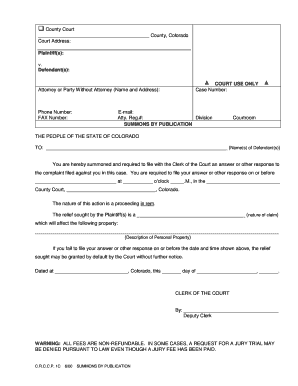
Filling out the CO C.R.C.C.P. 1C form online can seem daunting, but with a detailed understanding of its components, the process can be straightforward. This guide provides clear, step-by-step instructions to assist you in completing this important legal document efficiently.
Follow the steps to complete the CO C.R.C.C.P. 1C form successfully.
- Click ‘Get Form’ button to access the CO C.R.C.C.P. 1C form and open it in your preferred editor.
- Begin filling in the top section of the form with the county name and court address, ensuring accuracy for proper filing.
- Identify and input the names of the plaintiff(s) and defendant(s) in their respective fields, making sure to include full legal names.
- Enter the case number provided by the court in the designated area, which is essential for court record identification.
- Complete the section for the attorney or party without an attorney by providing their name, address, phone number, fax number, email, and attorney registration number if applicable.
- Fill out the details of the summons by writing the names of the defendant(s) being summoned and completing any necessary descriptions of the legal action.
- Clearly state the date and time by which the defendant(s) must respond, ensuring to double-check these for accuracy.
- Describe the nature of the claim being filed and detail the personal property affected by this claim in the relevant fields.
- Review all information for accuracy and completeness before finalizing the form.
- Once completed, save changes, download a copy for your records, and prepare to print or share the form as needed.
Complete your documents online effortlessly and ensure all your legal forms are filed correctly.
Experience a faster way to fill out and sign forms on the web. Access the most extensive library of templates available.
Related content
Dec 18, 2024 — The CRCCP is a program aimed at increasing colorectal cancer (CRC)...
1 Not all definitions are conclusive. Some patients may have other symptoms. These are...
Get answers to your most pressing questions about US Legal Forms API.
How do I file an answer to a summons in Colorado?
Filing an answer to a summons in Colorado requires you to prepare a written response following the specifics found in CO C.R.C.C.P. 1C. Ensure you include all necessary elements, such as your defenses and facts pertinent to the case. Once you have completed your answer, file it with the court and serve your response to the other party involved. For additional support, USLegalForms offers resources that can simplify this process for you.
What is the Rule 69 in Colorado?
Rule 69 in Colorado pertains to the enforcement of judgments. It outlines the procedures that can be taken to enforce a monetary judgment following a court ruling. If you are dealing with a situation where a judgment must be collected, understanding this rule is vital. For more details and resources on judicial rules in Colorado, consider visiting USLegalForms, which offers comprehensive legal information.
Can you respond to a summons without a lawyer?
Yes, you can respond to a summons without a lawyer. Many individuals choose to represent themselves in legal matters, especially for straightforward cases. However, it's important to familiarize yourself with the rules in CO C.R.C.C.P. 1C to ensure your response is properly formatted and submitted. If you need assistance, resources like USLegalForms can provide valuable information and templates.
How do you write a written response to a summons?
Writing a response to a summons involves a few essential steps. Begin with a proper heading that includes your name, the court name, and case number. Clearly state your defenses and any counterclaims in a concise manner, adhering to the requirements outlined in CO C.R.C.C.P. 1C. If you prefer guidance during this process, consider using USLegalForms to access templates specifically designed for crafting legal responses.
How to file an answer to a summons in Colorado?
To file an answer to a summons in Colorado, you must first gather the necessary documents. Locate the summons and complaint that you received, then prepare your written response according to the guidelines provided in CO C.R.C.C.P. 1C. You will need to submit your answer to the court where the original case was filed, and ensure that you provide a copy to the opposing party. Be mindful of the deadline for filing, as this can affect your case.
What does 3 allowances mean?
Claiming 3 allowances typically means that you are accounting for yourself and two dependents or additional factors that may lower your tax liability. This amount directly influences how much tax is withheld from your paycheck. Navigating these allowances in line with CO C.R.C.C.P. 1C may help optimize your payroll deductions.
Where to put 0 or 1 on W4?
On the W-4 form, you will fill in the number of allowances you are claiming in the designated section. If you choose to claim 0, it means more tax will be withheld from your paycheck; claiming 1 means less tax will be withheld. Understanding the implications of claiming 0 or 1 is crucial, especially within the framework of CO C.R.C.C.P. 1C.
How to fill out a withholding allowance form?
To fill out a withholding allowance form, start by completing your personal information accurately. Then, assess your tax situation to determine the correct number of allowances based on your dependents and other factors. Utilizing resources like uslegalforms can simplify this process with clear templates aligned with CO C.R.C.C.P. 1C.
What should I put for withholding allowance?
When determining your withholding allowance, consider your federal tax situation and family status. Generally, you can claim one allowance for yourself, another for a spouse, and additional allowances for any dependents. Using the CO C.R.C.C.P. 1C guidelines can help ensure you accurately reflect your situation on your W-4 form.
What are the margins for Colorado Rules of Civil Procedure?
The Colorado Rules of Civil Procedure typically mandate specific margin requirements for submitted documents, generally one inch on all sides. Adhering to these standards is essential to ensure compliance with CO C.R.C.C.P. 1C. Understanding these formatting rules can help you present documents more professionally. Guideline templates can be found on UsLegalForms to assist you.
Use professional pre-built templates to fill in and sign documents online faster. Get access to thousands of forms.
If you believe that this page should be taken down, please follow our DMCA take down process here.