Get Ca Sv-200 2014-2026
How it works
-

Open form follow the instructions
-

Easily sign the form with your finger
-

Send filled & signed form or save
How to fill out the CA SV-200 online
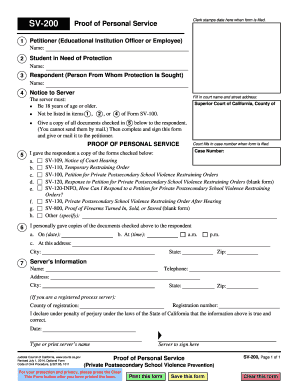
The CA SV-200 form is essential for documenting the proof of personal service related to private postsecondary school violence restraining orders. This guide will provide you with detailed, step-by-step instructions to fill out this form efficiently and accurately online.
Follow the steps to fill out the CA SV-200 form online
- Click ‘Get Form’ button to obtain the form and open it in the editor.
- Begin by entering the name of the petitioner, which refers to the educational institution officer or employee. This should be placed in the designated field titled 'Petitioner'.
- Next, specify the name of the student in need of protection in the section provided for 'Student in Need of Protection'.
- In the 'Respondent' section, provide the name of the individual from whom protection is being sought.
- Fill in the court name and street address under the 'Notice to Server' section. Make sure to clearly state the court's details.
- Ensure that the individual serving the documents meets the requirements: they must be at least 18 years old and not connected to the parties listed in items 1, 2, or 4 of Form SV-100.
- Check all forms that were served to the respondent in section 5, noting each one as applicable, such as SV-109, SV-110, and SV-120.
- Document the date and time of service by completing the relevant fields for 'I personally gave copies of the documents checked above to the respondent'.
- Fill out the address where the service took place, including the city, state, and zip code.
- Provide the server's information, including telephone number, name, address, and, if applicable, registration number and county of registration if the server is a registered process server.
- Lastly, confirm the accuracy of the provided information by signing and dating the form. Remember to declare under penalty of perjury that the information is true and correct.
- Once completed, you can save changes, download, print, or share the form as needed.
Complete your CA SV-200 form online now to ensure timely processing.
A writ of garnishment and a writ of execution serve different purposes in legal proceedings. A writ of execution is used to enforce a judgment by allowing the seizure of property to satisfy a debt. In contrast, a writ of garnishment specifically targets a debtor's wages or bank accounts, requiring third parties to redirect funds to the creditor. Understanding these distinctions empowers you to navigate the legal landscape more effectively.