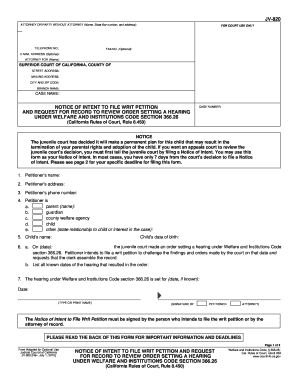
ANENT PLAN? File this Notice of Intent to File Writ Petition and Request for Record in the juvenile court within the time specified below in the next box. This will let the court know you intend to file a writ petition, and the court will prepare the record. You will be notified after the record is filed in the Court of Appeal, and you will get copies of the record. You have 10 days after the record is filed in the Court of Appeal to file and serve your writ petition. You may use the.
Open form follow the instructions
Easily sign the form with your finger
Send filled & signed form or save
How to fill out the CA JV-820 online
Filling out the CA JV-820 form, also known as the Notice of Intent to File Writ Petition, is an important step for those seeking to challenge a juvenile court's decision regarding a child's permanent plan. This guide will provide clear, step-by-step instructions to help users, regardless of their legal experience, complete the form online effectively.
Follow the steps to successfully complete the CA JV-820 online.
- Press the ‘Get Form’ button to access the CA JV-820 form and open it in your preferred editing tool.
- Provide your contact information as the attorney or party without an attorney. Include your name, State Bar number, address, telephone number, and, if applicable, your fax number and email address.
- Fill out the information for the court, including the superior court's name, street address, mailing address, city, zip code, and branch name.
- Enter the case name as well as the case number in the specified fields.
- In the petitioner section, provide the petitioner's name, address, and phone number. Indicate the relationship or role of the petitioner (e.g., parent, guardian, etc.).
- Input the child's name and date of birth in the designated fields.
- Record the date on which the juvenile court made the decision for the hearing under Welfare and Institutions Code section 366.26, and list any known dates of the hearings that led to this decision.
- Include the date for the scheduled hearing under the Welfare and Institutions Code, if known.
- Sign the form, either as the petitioner or the attorney of record, ensuring that the signature is provided on the designated line.
- Review your entries for accuracy and clarity. Once complete, you can save your changes, download a copy, print, or share the completed form as needed.
Take action now by filling out the CA JV-820 online to ensure your intent to file a writ petition is properly submitted.
Experience a faster way to fill out and sign forms on the web. Access the most extensive library of templates available.
Related content
Form JV-820 is a notice of intent to file a writ petition to challenge a juvenile court's...
PDB id: 4V64 (explore in PDB, NAKB, or RNA 3D Hub) ; Description: Crystal structure of the...
En la Parte 1 se proporcionan datos esenciales con respecto al tipo de información...
Get answers to your most pressing questions about US Legal Forms API.
How to get a juvenile record expunged in California?
To expunge a juvenile record in California, a minor must typically petition the court, outlining reasons for expungement and showing rehabilitation. The process often requires completing certain conditions, such as community service or counseling. Utilizing the CA JV-820 form may help streamline your petition and ensure all necessary information is presented to the court.
What are the three types of cases handled in juvenile court?
Juvenile court in California generally handles three types of cases: delinquency, dependency, and status offenses. Delinquency cases involve law violations, dependency cases address the needs of minors who may be neglected or abused, and status offenses pertain to behaviors illegal only for minors. Each case type follows a specific process, which may involve forms such as the CA JV-820.
What is a JV 820?
The JV-820 is a specific form used in California's juvenile court system to request a hearing or modification of a previous order. This form is crucial for addressing issues related to a juvenile's case by ensuring all relevant information is available to the judge. It supports the goal of appropriate intervention and rehabilitation for the individual.
What happens to first-time juvenile offenders?
First-time juvenile offenders typically have access to diversion programs aimed at rehabilitation. These programs can help youth avoid formal court intervention and criminal records. However, if the case progresses, the CA JV-820 form may be relevant to establish prior behavior or assess the appropriate judicial response.
What are the 4 steps in the juvenile justice process?
The juvenile justice process generally involves four key steps: arrest, detention, the adjudication hearing, and disposition. Initially, a juvenile may be taken into custody for alleged offenses, followed by a decision on whether the juvenile should remain in a detention facility. Next, an adjudication hearing occurs, similar to a trial, where evidence is examined. Finally, a disposition occurs, where the court decides on rehabilitation or consequences, often guided by forms like the CA JV-820.
How are juvenile cases handled in California?
In California, juvenile cases are processed through a system designed to protect minors while addressing their behavior. The court conducts hearings where evidence is presented, and a judge decides the best course of action. Utilizing resources, such as the CA JV-820 form, can streamline this process and ensure fairness in assessing the situation.
How is juvenile delinquency handled?
Juvenile delinquency is managed through a structured process that includes intervention and rehabilitation. When a juvenile is accused of a crime, the case is often referred to the juvenile court system, which focuses on education and reform, rather than punishment. It's important to understand the procedures involved, especially in cases involving forms like the CA JV-820.
What is GC-210 CA?
GC-210 CA is a legal form used in California to seek court approval for various guardianship matters. This form is primarily used to inform the court of changes or requests regarding guardianship, such as the termination of guardianship. It requires detailed information to ensure the court can make an informed decision. For easy access to this form and others, check out resources on USLegalForms.
How hard is it to terminate guardianship in California?
Terminating guardianship in California can be a complex process. It requires filing the appropriate forms, like GC-210 or related documents, and presenting a valid case to the court. The difficulty often depends on individual circumstances and the legal grounds for termination. Utilize USLegalForms to access resources and templates that simplify this process for you.
What form is needed to terminate parental rights in California?
To terminate parental rights in California, you typically need the form CA JV-820. This form is crucial for initiating the legal process and outlines the necessary details regarding the termination. It is essential to ensure that the form is filled out correctly to avoid delays in your case. You can find helpful templates and guidance on USLegalForms to support you throughout the process.
Use professional pre-built templates to fill in and sign documents online faster. Get access to thousands of forms.
If you believe that this page should be taken down, please follow our DMCA take down process here.