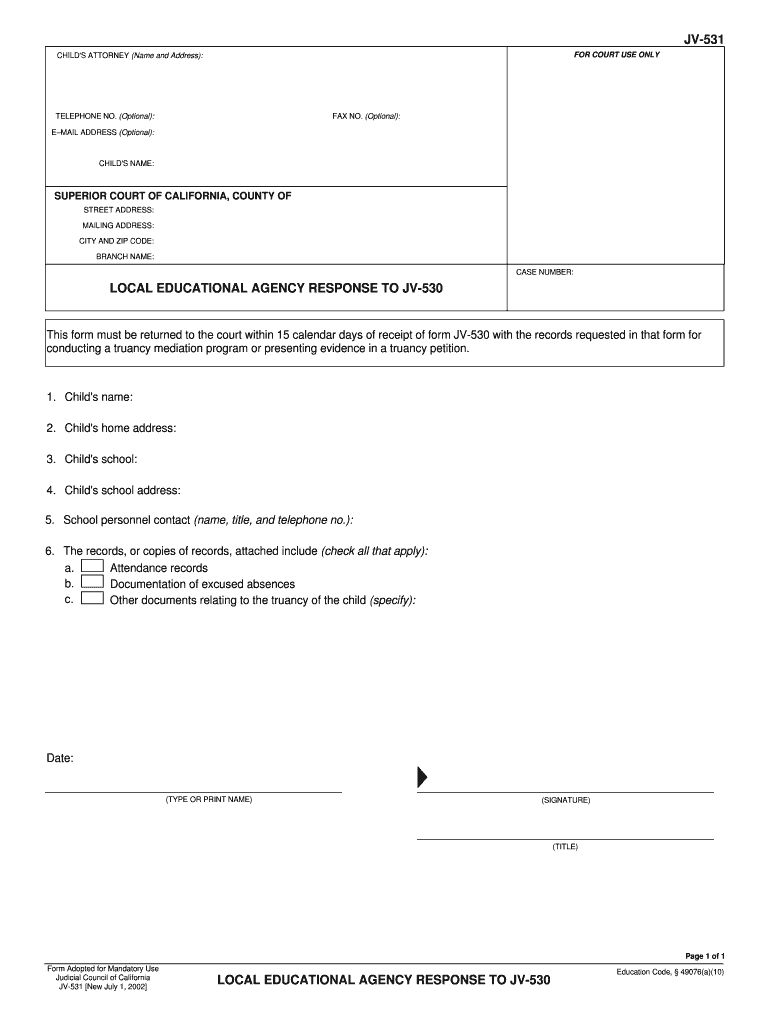
R form, please press the Clear This Form button at the end of the form when finished. CHILD'S NAME: SUPERIOR COURT OF CALIFORNIA, COUNTY OF STREET ADDRESS: MAILING ADDRESS: CITY AND ZIP CODE: BRANCH NAME: CASE NUMBER: LOCAL EDUCATIONAL AGENCY RESPONSE TO JV-530 This form must be returned to the court within 15 calendar days of receipt of form JV-530 with the records requested in that form for conducting a truancy mediation program or presenting evidence in a truancy petition. 1. Child's nam.
Loading

Open form follow the instructions

Easily sign the form with your finger

Send filled & signed form or save
How to fill out the CA JV-531 online
The CA JV-531 form is a crucial document used in response to a truancy mediation program or truancy petition. This guide provides a clear and supportive approach to help users fill out the form online accurately and efficiently.
Follow the steps to complete the CA JV-531 online.
- Press the ‘Get Form’ button to access the form and open it in your preferred digital editor.
- Begin by entering the child's name in the designated field.
- Provide the child's home address in the appropriate section, ensuring accuracy.
- Indicate the child's school name clearly.
- Fill in the school's address to maintain precise information.
- Add the name, title, and contact telephone number of the school personnel responsible.
- Below this section, check all applicable boxes to indicate the records or copies of records that are attached.
- Ensure to specify any additional documents related to the child's truancy, if applicable.
- Date the form in the designated area.
- Type or print your name clearly in the provided space.
- Sign the form in the signature section.
- Indicate your title in the designated field.
- Once you have filled out all necessary information, save your changes. You can also choose to print or share the completed form.
Complete your documents online now to ensure a smooth filing process.
Experience a faster way to fill out and sign forms on the web. Access the most extensive library of templates available.
Related content
This form must be returned to the court within 15 calendar days of receipt of form JV-530...
3D structure. PDB id: 4WQY (explore in PDB, NAKB, or RNA 3D Hub); Description: Crystal...
A PIONEER DO BRASIL LTDA. Garante que o aparelho desempenhará suas funções em...
Get answers to your most pressing questions about US Legal Forms API.
What is a JV 575 form?
The JV 575 form serves as a notice regarding juvenile court proceedings. It ensures all parties involved are informed of the status and next steps in a case. Recognizing the importance of this form can aid in prompt compliances and preparations. To ensure you follow the correct procedures, consider using uslegalforms for assistance with the CA JV-531.
What is a JV 183?
The JV 183 form is a request for juvenile court records. This form allows individuals to retrieve case documents necessary for various legal processes. Having access to these records can be critical for understanding a minor’s legal history. For efficiency, users can refer to resources provided by uslegalforms pertaining to CA JV-531.
What is a JV 570?
The JV 570 form is used to apply for a waiver of court fees in juvenile cases. This form is particularly helpful for families who may face financial hardships but need to ensure access to legal support for their minors. By completing and filing the JV 570, individuals can maintain their rights without the burden of fees, a process that aligns well with the resources offered through uslegalforms and the CA JV-531.
What does JV mean in court?
In a court context, 'JV' stands for 'Juvenile.' This designation is used for cases and forms related to individuals under the age of 18, often reflecting the court's focus on rehabilitation rather than punishment. Understanding this term helps clarify the purpose behind various legal procedures, including those encompassing the CA JV-531 form.
What is a JV 140?
The JV 140 form serves as a notice of the court’s decision in a juvenile court case. It is crucial for informing involved parties of the outcomes and any subsequent legal obligations. Understanding how to navigate the JV 140 can streamline communication regarding court mandates. Users may find valuable insights through uslegalforms, especially concerning the CA JV-531.
What is a JV 535?
The JV 535 form is a request for modification orders in juvenile cases. This form is important for those seeking changes to existing court orders that may affect a minor's circumstances. Properly filing the JV 535 helps ensure that the court considers the request effectively. To simplify this process, you may want to utilize tools offered by uslegalforms, particularly those related to CA JV-531.
What is a JV 100?
A JV 100 is a specific form used in California to petition the juvenile court. This form is pivotal for individuals looking to seek the court's intervention regarding a minor's welfare or status. When completing the JV 100, it is essential to provide clear and accurate information. For additional support, users can explore the resources available on uslegalforms related to CA JV-531.
What are the three types of cases handled in juvenile court?
Juvenile court generally handles three main types of cases: delinquency cases, status offense cases, and dependency cases. Delinquency cases involve minors accused of committing criminal acts, while status offenses are actions considered illegal only for minors, such as truancy. Dependency cases focus on minors who may need protection due to abuse or neglect. Understanding these nuances can help when dealing with forms like CA JV-531.
What is the joinder rule in California?
The joinder rule in California facilitates the inclusion of parties in a lawsuit to promote justice and efficiency. It ensures all necessary parties are part of the legal action to prevent multiple lawsuits on the same issue. Familiarizing yourself with this rule and using resources like the CA JV-531 can streamline your legal proceedings and help ensure an effective outcome.
What are the two types of joinder?
The two types of joinder are permissive joinder and mandatory joinder. Permissive joinder allows for additional parties to be included if their claims arise from the same event, while mandatory joinder requires that certain parties must be joined to ensure a fair resolution. These concepts are integral when filing forms like the CA JV-531.
Use professional pre-built templates to fill in and sign documents online faster. Get access to thousands of forms.
If you believe that this page should be taken down, please follow our DMCA take down process here.