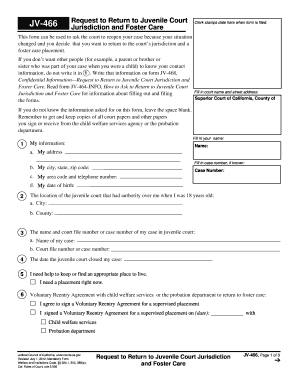
As information, do not write it in 1 . Write that information on form JV-468, Confidential Information Request to Return to Juvenile Court Jurisdiction and Foster Care. Read form JV-464-INFO, How to Ask to Return to Juvenile Court Fill in court name and street address: Jurisdiction and Foster Care for information about filling out and filing Superior Court of California, County of the forms. If you do not know the information asked for on this form, leave the space blank. Remember to get and k.

How it works
  • Open form

    Open form follow the instructions

  • Easily sign form

    Easily sign the form with your finger

  • Share form

    Send filled & signed form or save

How to fill out the CA JV-466 online

The CA JV-466 form allows individuals to request the return to juvenile court jurisdiction and foster care. This guide provides clear, step-by-step instructions to assist users in efficiently completing this important document online.

Follow the steps to successfully fill out the CA JV-466 form online.

  1. Click ‘Get Form’ button to access the form and open it in your online editor.
  2. Begin by filling in the court name and street address where your case was previously handled. You can find this information on previous court documents.
  3. Enter your personal information, including your name, address, city, state, zip code, and contact number. Provide your date of birth as requested.
  4. Fill in the location of the juvenile court that had jurisdiction over you at 18 years old, which includes the city and county.
  5. Provide the name and case number of your juvenile court case if known. This is important for the court to identify your records.
  6. Indicate the date when the juvenile court closed your case.
  7. Specify the placement needs by checking if you require help finding a suitable living arrangement or if you need placement immediately.
  8. Mark your agreement regarding the Voluntary Reentry Agreement with child welfare services or the probation department, and include the date you signed this agreement if applicable.
  9. Demonstrate your intentions by checking at least one of the five conditions related to your education or employment plans.
  10. Decide if you want your parents or former legal guardian notified about the hearing, and provide their information if you opt for notification.
  11. If you had a previous lawyer or a Court Appointed Special Advocate (CASA), provide their details and consent for them to be notified about your hearing.
  12. Indicate whether the Indian Child Welfare Act applied to you during your youth and if you wish it to apply again, providing any necessary tribal information.
  13. Finally, complete the verification section by declaring the truthfulness of your information under penalty of perjury. Ensure your name is typed or printed, sign, and date the form.
  14. Once all sections are completed, save your changes, and you can download, print, or share the document as needed.

Complete the CA JV-466 form online today and take the necessary steps towards reestablishing your juvenile court jurisdiction.

Get form

Experience a faster way to fill out and sign forms on the web. Access the most extensive library of templates available.

Related content

JV-466 Request to Return to Juvenile Court...

This form can be used to ask the court to reopen your case because your situation changed...

Learn more
CHART D Request by Nonminor for the Juvenile Court...

Dec 14, 2011 — The form JV-466 may be filed by the nonminor or the county child welfare...

Learn more
USER MANUAL JOVIA - Dolce Gusto

Read all instructions, use only NESCAFÉ DOLCE GUSTO capsules, and use on a stable...

Learn more
Questions & Answers

Get answers to your most pressing questions about US Legal Forms API.

Contact support

How to file California corporate disclosure statement online?

Filing a California corporate disclosure statement online requires accessing the official state website or an authorized platform. You will need to complete relevant forms, including any necessary details from CA JV-466 if applicable. After filling out the forms, you can submit them electronically for efficiency. Using our service can simplify this process by guiding you through each step, ensuring correctness and compliance.

To file a trial by written declaration in California, you need to complete the required paperwork, such as CA JV-466. Once you prepare your declaration, file it with the appropriate court and keep a copy for yourself. It’s essential to file this paperwork ahead of your hearing date to ensure your case is considered. Our platform can streamline this process by providing the necessary forms and tips for an effective declaration.

Declarations can be admissible at trial in California, providing they meet certain legal standards. The information in the declaration must be relevant and pertinent to the case. Utilizing forms like CA JV-466 can help you structure your declaration appropriately. Be mindful of the rules of evidence when preparing your documents.

Yes, you can use a declaration at trial in California. Declarations, including those filed using CA JV-466, serve as a form of written evidence that supports your claims. They can help clarify facts and provide context for your case when presented to the judge. Ensure your declaration is drafted clearly and accurately for the best results.

Filing a trial by written declaration in California involves completing the appropriate forms, including CA JV-466. You must submit these forms to the court before your appointed hearing date. This process allows you to present your case in writing, which can be advantageous for your situation. Consider using our platform for precise guidance on filling out the declarations correctly.

To file for conservatorship in California, begin by filling out the required forms, including CA JV-466. Next, you will need to file these forms at the local courthouse. After filing, schedule a court hearing where you will present your case to the judge. It’s also advisable to consult an attorney or use our platform for accurate forms and guidance through the process.

In California, juvenile court jurisdiction applies to individuals aged 17 years and younger. This system is designed to focus on rehabilitation rather than punishment, allowing young people a chance to correct their behaviors. Understanding the implications of the CA JV-466 is important for guardians and minors alike. Our platform can assist in navigating this framework effectively.

Juvenile court jurisdiction in California typically ends when a minor turns 18 years old. At this point, the individual may find themselves entering adult court if further legal action is needed. The CA JV-466 form is crucial for understanding the rights and options available at this stage. If you’re looking for clarity, uslegalforms provides detailed information to help you.

The upper age limit for juvenile court jurisdiction typically varies between 17 and 18 years old, depending on specific circumstances related to the case. Laws may differ slightly based on the state, but in California, the transition usually happens at 18. Being informed about CA JV-466 is important during this transition. Our resources can clarify your questions regarding these age limits.

A JV 570 is a form used in California juvenile court proceedings. It relates specifically to the petition for the court to determine whether to maintain a minor's jurisdiction. Understanding the CA JV-466 process can help you navigate these legal waters more effectively. Our platform offers helpful guidance on using this form and more.

Get This Form Now!

Use professional pre-built templates to fill in and sign documents online faster. Get access to thousands of forms.

If you believe that this page should be taken down, please follow our DMCA take down process here.

CA JV-466 Form

This form is available in several versions. Select the version you need from the drop-down list below.

Get CA JV-466