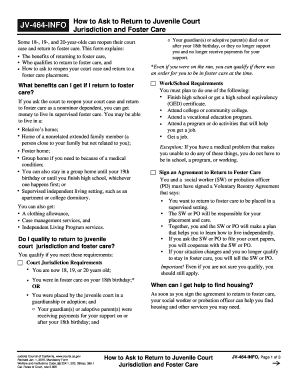
Nefits of returning to foster care, Who qualifies to return to foster care, and How to ask to reopen your court case and return to a foster care placement. What benefits can I get if I return to foster care? If you ask the court to reopen your court case and return to foster care as a nonminor dependent, you can get money to live in supervised foster care. You may be able to live in a: Relative s home; Home of a nonrelated extended family member (a person close to your family.
Open form follow the instructions
Easily sign the form with your finger
Send filled & signed form or save
How to fill out the CA JV-464-INFO online
This guide provides step-by-step instructions for filling out the CA JV-464-INFO form, which assists individuals aged 18-20 in requesting to return to juvenile court and foster care. By following these detailed directions, users can navigate the online process effectively.
Follow the steps to complete the CA JV-464-INFO form online.
- Click ‘Get Form’ button to obtain the form and open it in your online editor.
- Carefully read the instructions provided in the form to understand the requirements and benefits of returning to foster care.
- Complete the personal information section, ensuring that you provide accurate details, including your name, date of birth, and contact information.
- Fill out the court jurisdiction requirements by indicating if you were in foster care on your 18th birthday, or if you have other relevant circumstances.
- Provide any additional information required regarding your current situation and reasons for requesting to return to foster care.
- Review all the information you have entered to ensure accuracy and completeness.
- Save your changes and download the completed form in your desired format.
- If needed, print a copy of the form for your records. Finally, submit the form as instructed, either by mail or in person to the appropriate juvenile court clerk's office.
Start filling out your forms online today to take the first step towards returning to foster care.
Experience a faster way to fill out and sign forms on the web. Access the most extensive library of templates available.
Related content
If you ask the court to reopen your court case and return to foster care as a nonminor...
Dec 14, 2011 — A copy of How to Ask to Return to Juvenile Court Jurisdiction and Foster...
Hardware Features. • Supports both 120 and 240 VAC, 60 Hz installations. • External...
Get answers to your most pressing questions about US Legal Forms API.
How long can a minor be detained in California?
A minor can be detained in California for specific lengths depending on their case and court rulings. Typically, a minor could face a few hours to a few weeks in detention following court proceedings. Extended detentions may occur in cases where rehabilitation plans or other legal obligations are deemed necessary. The CA JV-464-INFO can be a useful tool to learn about these time frames and what they entail.
What is the youngest age to go to jail in California?
In California, the youngest age at which a minor can be detained in a juvenile facility is typically 12 years old, depending on the nature of the offense. Minors under 12 are generally handled through other interventions rather than jail time. Understanding these age-related rules can be complex, so referring to the CA JV-464-INFO can be beneficial. Moreover, for clarity on any legal concerns, uslegalforms can offer accessible assistance.
How long can you go to jail for as a minor?
The length of time a minor can spend in jail in California depends on the severity of the offense. For less serious offenses, a juvenile might face a detention period of a few days to several months. However, for more serious crimes, the detention can result in longer stays, potentially up to a year or longer. The CA JV-464-INFO outlines various options and consequences based on specific situations.
How are juvenile cases handled in California?
Juvenile cases in California are typically handled through a unique system designed to focus more on rehabilitation rather than punishment. The process involves hearings where a judge assesses the minor's actions and decides on interventions or services they may require. The CA JV-464-INFO provides insights into the procedures and possible outcomes of juvenile cases. For anyone navigating this system, using uslegalforms can simplify understanding what to expect.
How long can you legally be detained in California?
In California, a minor can be legally detained for varying lengths depending on the circumstances of the case. Generally, they can be held for up to 48 hours for initial processing before a hearing is required. After the hearing, the court will determine the appropriate duration of detention. For more details on this process, the CA JV-464-INFO form can be a helpful resource.
At what age does juvenile court jurisdiction end in California?
In California, juvenile court jurisdiction typically ends when a minor turns 18 years old. However, in some cases, juveniles may remain under jurisdiction until they turn 21, especially if they are involved in specific ongoing programs. The CA JV-464-INFO can provide detailed information regarding your personal circumstances. It's wise to consult with a legal expert if you have specific questions about your case.
How do I access my juvenile record in California?
To access your juvenile record in California, you can request a copy from the court that handled your case. Alternatively, you can use resources such as the CA JV-464-INFO form to help you navigate this process. It's important to ensure that you have the necessary information, such as your case number and personal identification. If you need assistance or more information, consider using uslegalforms for guidance.
Who files a notice of entry of judgment in California?
The party that receives a favorable judgment is usually responsible for filing the notice of entry of judgment in California. This document is essential as it provides official notification of the court's decision to all parties involved. To ensure that you complete this process correctly, you can rely on guides offered through services associated with CA JV-464-INFO.
What happens after notice of entry of judgment?
After the notice of entry of judgment is filed, the court generally sends this notice to all parties involved in the case. This serves as an official acknowledgment of the court's decision. Following this notice, the judgment usually becomes enforceable, meaning the winning party can take further action if necessary. For efficient management of related documents, consider using resources from CA JV-464-INFO.
Who files the notice of settlement in California?
In California, the party who is settling a case typically files the notice of settlement. This document informs the court and the other parties involved that a settlement has been reached. It is important to file this promptly to avoid any delays in the case. Utilizing tools like CA JV-464-INFO can guide you through this process and ensure compliance with legal protocols.
Use professional pre-built templates to fill in and sign documents online faster. Get access to thousands of forms.
If you believe that this page should be taken down, please follow our DMCA take down process here.
This form is available in several versions. Select the version you need from the drop-down list below.