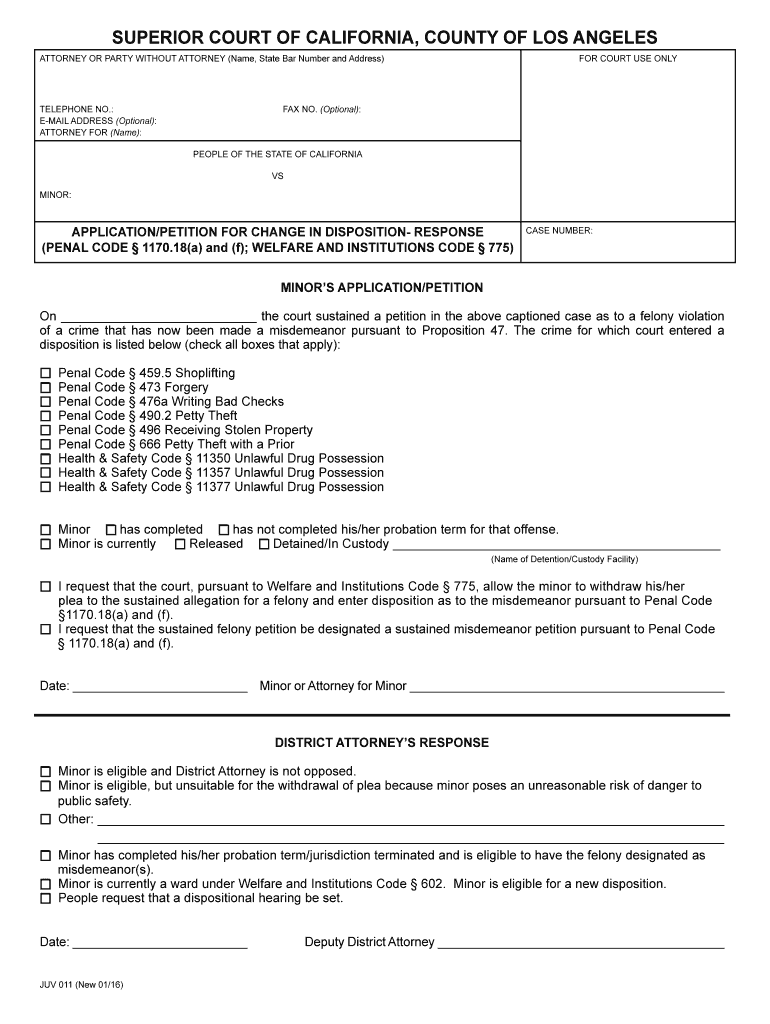
URT USE ONLY FAX NO. (Optional): PEOPLE OF THE STATE OF CALIFORNIA VS MINOR: APPLICATION/PETITION FOR CHANGE IN DISPOSITION- RESPONSE (PENAL CODE 1170.18(a) and (f); WELFARE AND INSTITUTIONS CODE 775) CASE NUMBER: MINOR S APPLICATION/PETITION On the court sustained a petition in the above captioned case as to a felony violation of a crime that has now been made a misdemeanor pursuant to Proposition 47. The crime for which court entered a disposition is l.
Loading

Open form follow the instructions

Easily sign the form with your finger

Send filled & signed form or save
How to fill out the CA JUV 011 online
The CA JUV 011 form is an important document for individuals seeking a change in disposition regarding a minor's felony charge that has been reduced to a misdemeanor under California law. This guide will provide you with clear, step-by-step instructions for completing the form online.
Follow the steps to accurately complete the CA JUV 011 form.
- Click ‘Get Form’ button to obtain the form and open it in the editor.
- Begin by filling in the attorney or party's name, state bar number, and address in the designated fields at the top of the form. Ensure all contact information is accurate.
- Fill in your phone number and email address in the optional fields. If applicable, include the name of the person you are representing in the ‘Attorney for’ section.
- In the ‘For Court Use Only’ section, leave the fields blank as these are reserved for court personnel.
- Enter the case number associated with the minor's application or petition in the provided space.
- In the section labeled ‘Minor’s Application/Petition,’ provide the date on which the court sustained the felony petition and check the appropriate boxes for all relevant misdemeanor offenses that apply to the minor's case.
- Indicate whether the minor has completed their probation term and their current status by checking the appropriate boxes. If the minor is in custody, include the name of the detention facility where applicable.
- Complete the request section by selecting what you are seeking from the court, specifically regarding the plea withdrawal or designation of the sustained petition.
- Sign and date the form at the bottom. Ensure the signature corresponds to the minor or the attorney representing them.
- Once all fields are filled out, save the changes to your form. You may download, print, or share the final document as needed.
Complete the CA JUV 011 online to facilitate the petition process smoothly.
Experience a faster way to fill out and sign forms on the web. Access the most extensive library of templates available.
Related content
Apr 15, 2020 — You may drop off your documents in person or you may mail your documents...
by RTA Felipe — À Escola Superior de Agricultura ‗Luiz de Queiroz' e ao Programa de...
DISCLAIMER OF ALL WARRANTIES & LIABILITIES. Corvus Systems, Inc. makes no warranties...
Get answers to your most pressing questions about US Legal Forms API.
Do you automatically go to jail for violating probation in California?
No, a juvenile does not automatically go to jail for violating probation in California. The court will review the circumstances surrounding the violation before deciding on the next steps. Many times, interventions are sought to help the minor learn from their mistakes rather than resorting to incarceration. Engaging with resources like CA JUV 011 can provide essential strategies for managing probation effectively.
What is the age of responsibility for a minor to go through prosecution in California?
In California, minors as young as 12 years old can be held responsible for certain serious crimes, allowing for prosecution. However, the juvenile justice system emphasizes rehabilitation over punishment, especially for younger offenders. Each case is assessed individually, factoring in the minor's age and understanding of their actions. For comprehensive guidance, families should consider exploring CA JUV 011.
How long can a juvenile be on probation in California?
Juveniles in California can be placed on probation for a duration that typically ranges from six months to three years, depending on the offense. The specific length often depends on the severity of the crime and the minor's compliance with the probation conditions. Successful completion of probation can result in a case being closed, and this emphasizes the importance of support. Utilizing CA JUV 011 can assist families in understanding the probation process and its implications.
How long can a minor be detained in California?
In California, the length of time a minor can be detained varies based on the nature of the offense and the specific circumstances of the case. Generally, a minor can be held until a court hearing is scheduled, which usually happens within a few days. In some cases, detention may last longer if the minor poses a danger to themselves or others. For clarity on these timelines, refer to CA JUV 011 as a helpful guide.
What happens if a juvenile violates probation in California?
When a juvenile violates probation in California, the court may take several actions, ranging from a warning to more serious consequences. The system often seeks to understand the reasons behind the violation and may impose additional services or requirements. In certain cases, it may lead to a minor being placed in a more structured environment. Accessing CA JUV 011 can help parents and guardians understand their options in such scenarios.
What is a minor probation violation?
A minor probation violation occurs when a juvenile fails to comply with the conditions set by the court during probation. Common violations include missing appointments, breaking curfew, or failing drug tests. Instead of facing severe penalties, the minor may receive additional requirements to fulfill. The CA JUV 011 resource can provide valuable insights on how to manage these situations effectively.
Can a juvenile be charged with a felony?
Yes, a juvenile can be charged with a felony, depending on the nature and severity of the crime. Serious offenses such as robbery or aggravated assault may lead to felony charges even for minors. It's crucial to understand that the legal system treats these cases differently, prioritizing rehabilitation over punishment. Parents should consult CA JUV 011 to navigate these complex legal waters.
What happens to first time juvenile offenders?
First time juvenile offenders typically undergo a rehabilitation process rather than facing harsh punishment. The system focuses on helping minors learn from their mistakes while promoting positive development. Programs often include counseling, community service, or restorative justice initiatives, emphasizing education and growth. Utilizing resources like CA JUV 011 through US Legal can guide families through this process.
How to file DBA in California?
To file a DBA (Doing Business As) in California, you need to start by choosing a unique name that represents your business. Then, submit your DBA application to the county clerk's office in the county where your business operates. For added convenience, consider using US Legal Forms, which can assist you with the CA JUV 011 DBA filing process by providing step-by-step instructions and customizable documents. Your business will stand out with the right name.
How do I file a California corporate disclosure statement?
Filing a California corporate disclosure statement requires you to gather essential information about your corporation, such as its legal name and business address. You can file this statement online or by mail to the appropriate state office. If you seek to save time and avoid common pitfalls, US Legal Forms provides useful templates and support for CA JUV 011 submissions. Ensure your business remains compliant and in good standing.
Use professional pre-built templates to fill in and sign documents online faster. Get access to thousands of forms.
If you believe that this page should be taken down, please follow our DMCA take down process here.
This form is available in several versions. Select the version you need from the drop-down list below.