Ey fees $ % Cross-complainant to receive nothing from cross-defendant named in item 5d. Cross-defendant named in item 5d to recover costs $ and attorney fees $ Other (specify): Date: JUDICIAL OFFICER Date: Clerk, by , Deputy CLERK'S CERTIFICATE (Optional) (SEAL) I certify that this is a true copy of the original judgment on file in the court. Date: Clerk, by , Deputy Page 2 of 2 JUD-100 New January 1, 2002 For your protection and privacy, please press the Clear This Form button a.
Loading

Open form follow the instructions

Easily sign the form with your finger

Send filled & signed form or save
How to fill out the CA JUD-100 online
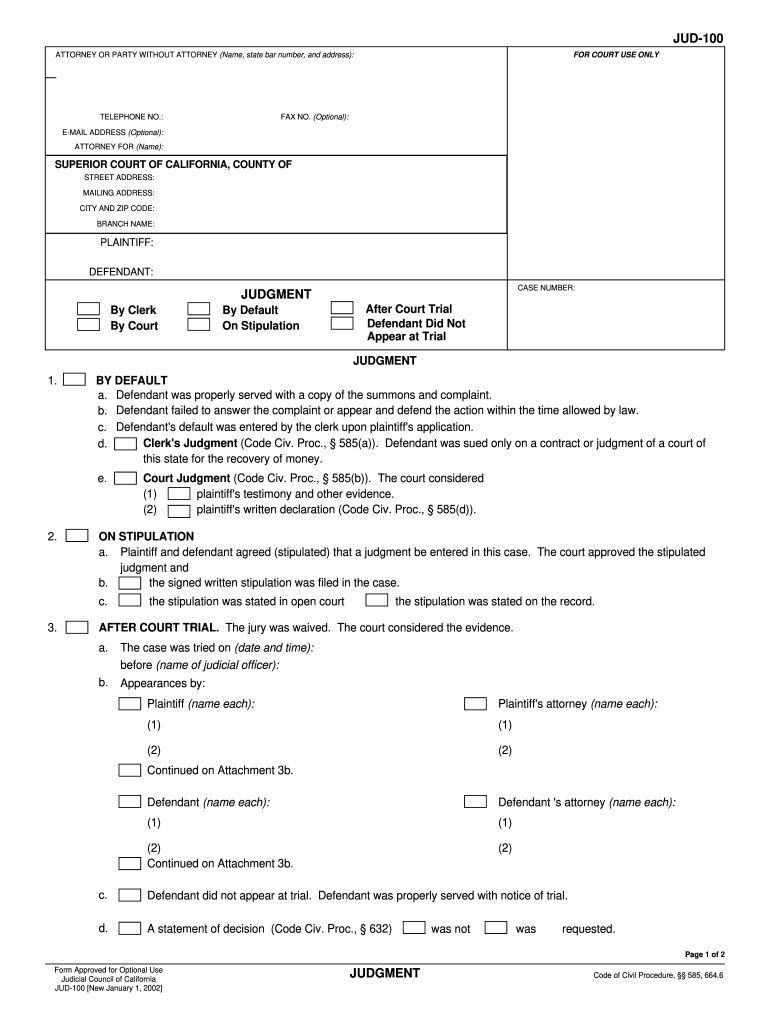
The CA JUD-100 form is essential for documenting judgments in civil cases within the California court system. This guide will provide you with clear, step-by-step instructions on how to complete this form online, ensuring that you can navigate the process with confidence and clarity.
Follow the steps to fill out the CA JUD-100 effectively.
- To start, press the ‘Get Form’ button to obtain the CA JUD-100 form and open it in your online editor.
- Begin by entering your contact details in the 'Attorney or party without attorney' section, including your name, state bar number, address, telephone number, and email address, if applicable.
- Proceed to the 'Superior Court of California' section. Fill in the county, street address, mailing address, city, and zip code. Make sure to indicate the branch name of the court handling the case.
- Next, indicate the names of the plaintiff and defendant in the designated areas, followed by the case number. This information is crucial for associating the judgment with the correct case.
- In the 'Judgment' section, specify whether the judgment is by default, on stipulation, or after a court trial. Follow the prompts to provide necessary details based on your choice.
- If the judgment is by default, ensure to fill out the appropriate subsections detailing the service of process and the defendant's failure to respond.
- For a stipulated judgment, include the necessary agreement details and confirm it was filed and approved by the court.
- If your judgment follows a court trial, document the case specifics, including the date of trial and names of all parties present. Indicate whether a statement of decision was requested.
- Under the 'Parties' section, list who the judgment is for and against, categorizing them according to plaintiff and defendant roles.
- Finally, complete the 'Amount' section by entering all applicable damages, fees, and costs. Make sure to calculate the total accurately.
- Once you have filled in all the necessary fields, you can save your changes, download the completed form, print it, or share it as needed.
Complete your CA JUD-100 online today to ensure your judgment is properly documented and submitted.
Experience a faster way to fill out and sign forms on the web. Access the most extensive library of templates available.
Related content
Judgment (JUD-100) States the final decision of the court in a limited or unlimited civil...
In some cases, the judge may ask that an adult. (someone 18 years old or older), like a...
Recursos da impressora. As impressoras Epson SureColor T3470/T5470/T5470M incluem os...
Get answers to your most pressing questions about US Legal Forms API.
What happens after a default judgement is issued in California?
Once a default judgement is issued in California, the winning party can initiate collection activities. This may include garnishing wages, placing liens, or levying bank accounts. The CA JUD-100 plays a pivotal role in this process, as it formally establishes the right to collect. It is wise to take proactive steps at this stage, such as using the resources available on uslegalforms.
How long after a default judgement can wages be garnished?
Wages can be garnished after a default judgement is issued, typically within a few days of the judgement being entered. However, the timeline can vary based on specific legal procedures and local laws. Understanding the CA JUD-100 can help clarify the process and ensure compliance with legal requirements. Engaging with professionals can help you better navigate this situation.
What happens after a default judgement in California?
After a default judgement in California, the prevailing party can take steps to collect the owed amount. The CA JUD-100 marks the beginning of this collection process, allowing the claimant to enforce the judgement. It is important to understand your rights and responsibilities post-judgement. You may also consider consulting with an attorney or using resources like uslegalforms for guidance.
What is a Jud 100 form?
The Jud 100 form is a legal document used in California courts to request a default judgement. It is an essential part of the CA JUD-100 process and serves to outline the claim and the desired judgement. By utilizing the CA JUD-100, you ensure that your case is presented clearly and accurately. This form is crucial for those looking to resolve a legal situation efficiently.
Can you negotiate after a default judgement?
Yes, you can negotiate after a default judgement. While a default judgement may seem final, there are still opportunities for negotiation. Understanding the CA JUD-100 process can help you navigate these discussions effectively. Engaging in negotiation can lead to more manageable payment arrangements.
How do you request a dismissal of DOE defendants?
To request a dismissal of DOE defendants in your case, you will need to file a motion with the court detailing your reasons for the dismissal. Make sure to comply with the relevant court rules and procedures when submitting this request. This process helps clean up your case and focus on the active defendants, improving your chances of resolution.
What is a CA JUD-100 form?
The CA JUD-100 form is a legal document used in California to request a judgment in a civil case. This form is essential for getting formal recognition of a default judgment by the court. By using the CA JUD-100, you can help ensure your claim is considered and processed appropriately.
How to calculate interest for a default judgment?
To calculate interest for a default judgment, first identify the judgment amount. Then, apply the appropriate statutory interest rate to this amount, along with the length of time since the judgment was entered. This will give you a clearer picture of the total amount you will be entitled to receive.
How do you calculate interest on a default judgment?
Calculating interest on a default judgment typically involves identifying the principal amount and applying the interest rate specified by California law. You multiply the principal by the interest rate and the time the judgment has been outstanding. This calculation helps ensure you receive fair compensation based on the amount owed to you.
How to fill out form CA JUD-100?
To complete the CA JUD-100 form, begin by carefully reading the instructions provided. Fill in the necessary details such as the case number, parties involved, and the amount you are claiming. Make sure to double-check your entries for accuracy, as any mistakes could delay processing or lead to a rejection of your form.
Use professional pre-built templates to fill in and sign documents online faster. Get access to thousands of forms.
If you believe that this page should be taken down, please follow our DMCA take down process here.
This form is available in several versions. Select the version you need from the drop-down list below.