Loading
Form preview
  • US Legal Forms
  • Other Templates
  • Legal Forms
  • California Legal Forms
  • Ca Fl-344 2007

Get Ca Fl-344 2007-2026

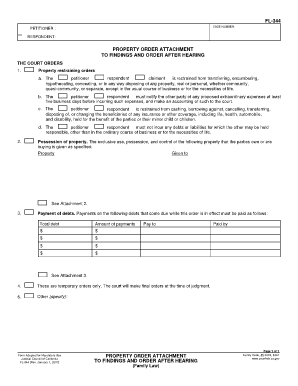
FL-344 CASE NUMBER PETITIONER RESPONDENT PROPERTY ORDER ATTACHMENT TO FINDINGS AND ORDER AFTER HEARING THE COURT ORDERS Property restraining orders respondent petitioner claimant is restrained from transferring encumbering a. The hypothecating concealing or in any way disposing of any property real or personal whether community quasi-community or separate except in the usual course of business or for the necessities of life. The court will make final orders at the time of judgment. Other specify Form Adopted for Mandatory Use Judicial Council of California FL-344 Rev. January 1 2007 Family Law Page 1 of 1 Family Code 2045 6324 www.courtinfo.ca.gov. Possession of property. The exclusive use possession and control of the following property that the parties own or are buying is given as specified Given to Property See Attachment 2. Payment of debts. Payments on the following debts that come due while this order is in effect must be paid as follows Total debt Amount of payments Pay to Paid....

How it works

  1. Open form

    Open form follow the instructions

  2. Easily sign form

    Easily sign the form with your finger

  3. Share form

    Send filled & signed form or save

How to fill out the CA FL-344 online

The CA FL-344 is a property order attachment form used in family law cases to address interim property issues following a court hearing. This guide provides step-by-step instructions for filling out the CA FL-344 online, ensuring that users understand each section and field.

Follow the steps to complete the CA FL-344 form online.

  1. Click the ‘Get Form’ button to access the CA FL-344 form and open it in the online editor.
  2. Begin by entering the case number at the top of the form. This is crucial for identifying your specific legal matter.
  3. Next, fill in the names of the petitioner and the respondent in the designated fields. These are the parties involved in the case.
  4. In Section 1, you will address property restraining orders. Clearly indicate the restrictions placed on both the petitioner and respondent regarding property transactions.
  5. Proceed to specify possession of property in Section 2. List the property being discussed and the party that has exclusive use or possession, referring to Attachment 2 as necessary.
  6. In Section 3, outline the payment arrangements for debts that come due while the order is in effect. Provide specific details such as the total debt amount and payments to be made.
  7. Note that all the orders listed are temporary. Ensure you understand that final orders will be given at the time of judgment, as mentioned in Section 4.
  8. If there are any additional orders or specifications, include them in Section 5. Make sure to detail any other relevant information.
  9. Once you have completed all sections, review the form for accuracy. After verifying the information, you can save changes, download, print, or share the form as needed.

Complete the CA FL-344 form online to address important property issues in your family law case.

Get form

Experience a faster way to fill out and sign forms on the web. Access the most extensive library of templates available.
Get form

Related content

Property Order Attachment to Findings and Order...
States the court's decisions (orders) about the parties' assets and debts. This is...
Learn more
Naval Education and Training Command - NETC
Naval Education and Training Command (NETC), headquartered at Naval Air Station Pensacola...
Learn more
CS7010 Parts List
DESCRIPTION. PAGE. Chassis System-GASOLINE-PETROL-LPG & DIESEL...
Learn more

Related links form

UK Police Scotland 052-002 2021 UK Police Scotland 052-002 2022 UK Allianz AND 2 2018 PA DL-9106 2021

Questions & Answers

Get answers to your most pressing questions about US Legal Forms API.

Contact support

Finding and order after hearing refers to the resolution that a court reaches, confirming evidence and deciding on the matter discussed in a hearing. This established order reflects the court's conclusions and is essential for anyone navigating legal processes. Understanding this concept is vital for effectively managing cases that involve CA FL-344.

Responding to an Order to Show Cause involves preparing a written response that addresses the issues raised in the order. You must file this document with the court and serve it to the involved parties. Utilizing resources like uslegalforms can provide guidance and templates, ensuring that your response aligns with requirements related to CA FL-344.

An 'order' in a court case represents a directive issued by the judge regarding how a case will proceed. It is legally binding and can dictate various actions, including deadlines for submissions and compliance with certain stipulations. Knowing the nature of such orders is vital, especially when dealing with documents like CA FL-344.

The phrase 'findings and order after hearing' indicates that the court has made decisions following a hearing where both parties presented their cases. This process is vital as it culminates in a legally binding order based on the presented evidence. If you encounter this in your case involving CA FL-344, understanding its implications is essential.

The FL 334 is a court form used primarily in California family law cases. It facilitates the process of requesting temporary orders, ensuring that all relevant information is presented to the court. Familiarizing yourself with forms like the FL 334 can streamline your engagement with legal procedures related to the CA FL-344.

In the context of the CA FL-344 form, 'findings and order' refers to the formal conclusions made by the court regarding evidence presented in a case. It outlines the court's decisions based on these findings, establishing important legal standings. Understanding these terms is crucial for anyone involved in legal proceedings, as it impacts future actions.

An order to show cause in California family court is a request that prompts a party to appear before the court to explain why a certain action should not be taken. This is especially relevant in situations covered by CA FL-344, where urgent matters may require immediate judicial attention. The party receiving the order must present their case, allowing the court to make an informed decision.

A Request for order hearing in California is a scheduled court session where the judge reviews requests submitted under CA FL-344. During this hearing, involved parties can present evidence and provide their arguments. The judge listens to both sides and ultimately makes a decision based on the information shared in court.

A request for order in California is a legal document that a party submits to the court to ask for specific actions or decisions. Typically, this request addresses matters such as child custody, visitation, or spousal support. Through CA FL-344, you can effectively file your request, ensuring that your legal needs are formally recognized and addressed by the court.

A court order of hearing refers to a formal directive issued by a judge that establishes a time and place for the parties involved to present their case. In the context of CA FL-344, this process ensures that all relevant issues are heard in open court. It allows the judge to make informed decisions based on the arguments and evidence presented during the hearing.

Get This Form Now!

Use professional pre-built templates to fill in and sign documents online faster. Get access to thousands of forms.
Get form
If you believe that this page should be taken down, please follow our DMCA take down processhere.
Get CA FL-344
Get form
  • Adoption
  • Bankruptcy
  • Contractors
  • Divorce
  • Home Sales
  • Employment
  • Identity Theft
  • Incorporation
  • Landlord Tenant
  • Living Trust
  • Name Change
  • Personal Planning
  • Small Business
  • Wills & Estates
  • Packages A-Z
  • Affidavits
  • Bankruptcy
  • Bill of Sale
  • Corporate - LLC
  • Divorce
  • Employment
  • Identity Theft
  • Internet Technology
  • Landlord Tenant
  • Living Wills
  • Name Change
  • Power of Attorney
  • Real Estate
  • Small Estates
  • Wills
  • All Forms
  • Forms A-Z
  • Other Templates
  • Legal Hub
  • About Us
  • Help Portal
  • Legal Resources
  • Blog
  • Affiliates
  • Contact Us
  • Delete My Account
  • Site Map
  • Industries
  • Forms in Spanish
  • Localized Forms
  • State-specific Forms
  • Forms Kit
  • Real Estate Handbook
  • All Guides
  • Notarize
  • Incorporation services
  • For Consumers
  • For Small Business
  • For Attorneys
  • USLegal
  • FormsPass
  • pdfFiller
  • signNow
  • altaFlow
  • DocHub
  • Instapage
Form Packages
  • Adoption
  • Bankruptcy
  • Contractors
  • Divorce
  • Home Sales
  • Employment
  • Identity Theft
  • Incorporation
  • Landlord Tenant
  • Living Trust
  • Name Change
  • Personal Planning
  • Small Business
  • Wills & Estates
  • Packages A-Z
Form Categories
  • Affidavits
  • Bankruptcy
  • Bill of Sale
  • Corporate - LLC
  • Divorce
  • Employment
  • Identity Theft
  • Internet Technology
  • Landlord Tenant
  • Living Wills
  • Name Change
  • Power of Attorney
  • Real Estate
  • Small Estates
  • Wills
  • All Forms
  • Forms A-Z
  • Other Templates
Customer Service
  • Legal Hub
  • About Us
  • Help Portal
  • Legal Resources
  • Blog
  • Affiliates
  • Contact Us
  • Delete My Account
  • Site Map
  • Industries
  • Forms in Spanish
  • Localized Forms
  • State-specific Forms
  • Forms Kit
Legal Guides
  • Real Estate Handbook
  • All Guides
Prepared for you
  • Notarize
  • Incorporation services
Our Customers
  • For Consumers
  • For Small Business
  • For Attorneys
Our Sites
  • USLegal
  • FormsPass
  • pdfFiller
  • signNow
  • altaFlow
  • DocHub
  • Instapage
Social Media
Call us now toll free:
+1 833 426 79 33
As seen in:
© Copyright 1999-2026 airSlate Legal Forms, Inc. 17 Station Street, Suite 303, Brookline, MA 02445
  • Your Privacy Choices
  • Terms of Service
  • Privacy Notice
  • Content Takedown Policy
  • Bug Bounty Program