Loading
Form preview
  • US Legal Forms
  • Other Templates
  • Legal Forms
  • California Legal Forms
  • Ca Ej-160 2009

Get Ca Ej-160 2009-2026

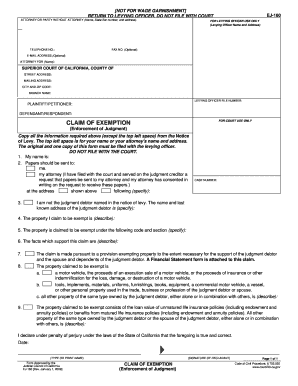
E This Form Page 1 of 1 Code of Civil Procedure, 703.520 www.courtinfo.ca.gov CLAIM OF EXEMPTION (Enforcement of Judgment) Print This Form Clear This Form.

How it works

  1. Open form

    Open form follow the instructions

  2. Easily sign form

    Easily sign the form with your finger

  3. Share form

    Send filled & signed form or save

How to fill out the CA EJ-160 online

The CA EJ-160 is a form used to claim an exemption from a judgment enforcement process in the state of California. This guide provides step-by-step instructions to assist you in filling out the form online efficiently.

Follow the steps to complete the CA EJ-160 online.

  1. Click ‘Get Form’ button to access the CA EJ-160 form and open it in your preferred online editor.
  2. Fill in the attorney or party name along with their State Bar number and address at the top of the form. Ensure this information is accurate to prevent delays.
  3. Provide the contact telephone number and optional fax number, if necessary, to facilitate communication.
  4. Enter your email address if you would like to receive communications electronically regarding this form.
  5. Identify the superior court by filling in the name of the county, the street address, mailing address, city and zip code, and branch name.
  6. Next, complete the section for the levying officer file number, and include the names of the plaintiff/petitioner and defendant/respondent.
  7. In the 'Claim of Exemption' section, copy the required information from the Notice of Levy, except for the top left space where you will insert your name or your attorney's name and address.
  8. Specify whether papers should be sent to you or your attorney, including their consent where applicable, and provide the address.
  9. Indicate that you are not the judgment debtor and provide the name and last known address of the judgment debtor.
  10. Describe the property you claim to be exempt, including details on the relevant code and section numbers that apply.
  11. Provide facts supporting your exemption claim, explaining why the property falls under the designated exemption.
  12. Include details about any motor vehicles or other property types relevant to your exemption claim.
  13. After completing the form, thoroughly review all entered information for accuracy.
  14. Finally, save your changes, download, print, or share the completed form as needed.

Complete your CA EJ-160 and related documents online today.

Get form

Experience a faster way to fill out and sign forms on the web. Access the most extensive library of templates available.
Get form

Related content

EJ-160 Claim of Exemption - California Courts
Copy all the information required above (except the top left space) from the Notice of...
Learn more
SU-E-J-160: 4D Dynamic Arc of Non-Modulated...
The aim of this study is to assess the suitability of 5 mm millennium multileaf collimator...
Learn more
MICRO COMPONENT SYSTEM
Mar 3, 2013 — CAUTION—STANDBY/ON button! Disconnect the mains plug to shut the power...
Learn more

Related links form

OH DTE 23A 2017 OH DTE 23A 2015 TX Request For Jail Time Credit - City Of Sugar Land 2018 MI Vehicle Bid Form - DeWitt Charter Township 2021

Questions & Answers

Get answers to your most pressing questions about US Legal Forms API.

Contact support

Creditors, including banks and government entities, can put a levy on your bank account after obtaining a court judgment against you. This action allows them to collect owed debts directly from your account. Filing CA EJ-160 could be a protective measure to ensure that certain funds remain accessible during this process. Being proactive about your financial rights will empower you to address potential levies effectively.

A legal hold on your bank account can be placed by government agencies, creditors, or even courts involved in a legal dispute. Such holds prevent you from accessing your funds until specific conditions are met. Understanding the implications of CA EJ-160 can help you find ways to contest these holds, depending on your situation. Utilizing resources like uslegalforms can provide guidance through this process.

To protect your bank account from levy, you should consider filing a claim of exemption using CA EJ-160. This legal form allows you to argue why certain funds should be exempt from seizure, based on state laws. Moreover, staying informed about your financial obligations and seeking legal advice can help you navigate potential levies. Regularly monitoring your accounts also helps you act quickly if needed.

To file a claim of exemption for wage garnishment in California, use the CA EJ-160 form. You need to fill it out accurately, providing relevant information about your income and expenses. After submitting the form to the court, a hearing will likely be scheduled. This process allows you to present your case for exempting your wages from garnishment.

Typically, creditors who have obtained a judgment against you may place a lien on your bank account. This means they can legally access your funds to fulfill a debt obligation. Understanding your rights under CA EJ-160 is critical, as it provides potential protections against such actions. By filing a claim of exemption, you may prevent certain funds from being affected by a lien.

The claim of exemption on CA EJ-160 allows a debtor to request a court to exempt certain assets from being seized or levied. This claim is essential when dealing with wage garnishments or bank levies. By filing CA EJ-160, you provide evidence that specific funds or wages are protected under state law. This process helps ensure that you retain access to necessary resources for living expenses.

Completing a writ of execution in California involves a clear understanding of the process. Begin by obtaining and filling out the necessary forms to request the writ. If the CA EJ-160 applies to your situation, include it with your submission to the court. Finally, ensure to follow all local guidelines for serving the writ to the other party.

To file a response to a divorce petition in California, first complete the necessary court forms, including the CA EJ-160 if required. Be sure to provide detailed responses to the points raised in the petition. Once your paperwork is ready, file it with the court and serve a copy to your spouse, following California’s legal procedures.

Responding to a divorce petition in California involves several important steps. Begin by obtaining the petition and reviewing it thoroughly. Using the CA EJ-160 form, you will respond to each claim made in the petition, providing your own information and evidence where needed. Submit your response to the court within the specified timeframe.

If your spouse ignores the divorce petition, you can take several steps to move forward. First, make sure you have properly served the divorce papers. Then, you can file a request for a default judgment with the court, which utilizes the CA EJ-160 form if necessary. This process will allow you to proceed without their participation.

Get This Form Now!

Use professional pre-built templates to fill in and sign documents online faster. Get access to thousands of forms.
Get form
If you believe that this page should be taken down, please follow our DMCA take down processhere.
Get CA EJ-160
Get form
  • Adoption
  • Bankruptcy
  • Contractors
  • Divorce
  • Home Sales
  • Employment
  • Identity Theft
  • Incorporation
  • Landlord Tenant
  • Living Trust
  • Name Change
  • Personal Planning
  • Small Business
  • Wills & Estates
  • Packages A-Z
  • Affidavits
  • Bankruptcy
  • Bill of Sale
  • Corporate - LLC
  • Divorce
  • Employment
  • Identity Theft
  • Internet Technology
  • Landlord Tenant
  • Living Wills
  • Name Change
  • Power of Attorney
  • Real Estate
  • Small Estates
  • Wills
  • All Forms
  • Forms A-Z
  • Other Templates
  • Legal Hub
  • About Us
  • Help Portal
  • Legal Resources
  • Blog
  • Affiliates
  • Contact Us
  • Delete My Account
  • Site Map
  • Industries
  • Forms in Spanish
  • Localized Forms
  • State-specific Forms
  • Forms Kit
  • Real Estate Handbook
  • All Guides
  • Notarize
  • Incorporation services
  • For Consumers
  • For Small Business
  • For Attorneys
  • USLegal
  • FormsPass
  • pdfFiller
  • signNow
  • altaFlow
  • DocHub
  • Instapage
Form Packages
  • Adoption
  • Bankruptcy
  • Contractors
  • Divorce
  • Home Sales
  • Employment
  • Identity Theft
  • Incorporation
  • Landlord Tenant
  • Living Trust
  • Name Change
  • Personal Planning
  • Small Business
  • Wills & Estates
  • Packages A-Z
Form Categories
  • Affidavits
  • Bankruptcy
  • Bill of Sale
  • Corporate - LLC
  • Divorce
  • Employment
  • Identity Theft
  • Internet Technology
  • Landlord Tenant
  • Living Wills
  • Name Change
  • Power of Attorney
  • Real Estate
  • Small Estates
  • Wills
  • All Forms
  • Forms A-Z
  • Other Templates
Customer Service
  • Legal Hub
  • About Us
  • Help Portal
  • Legal Resources
  • Blog
  • Affiliates
  • Contact Us
  • Delete My Account
  • Site Map
  • Industries
  • Forms in Spanish
  • Localized Forms
  • State-specific Forms
  • Forms Kit
Legal Guides
  • Real Estate Handbook
  • All Guides
Prepared for you
  • Notarize
  • Incorporation services
Our Customers
  • For Consumers
  • For Small Business
  • For Attorneys
Our Sites
  • USLegal
  • FormsPass
  • pdfFiller
  • signNow
  • altaFlow
  • DocHub
  • Instapage
Social Media
Call us now toll free:
+1 833 426 79 33
As seen in:
© Copyright 1999-2026 airSlate Legal Forms, Inc. 17 Station Street, Suite 303, Brookline, MA 02445
  • Your Privacy Choices
  • Terms of Service
  • Privacy Notice
  • Content Takedown Policy
  • Bug Bounty Program