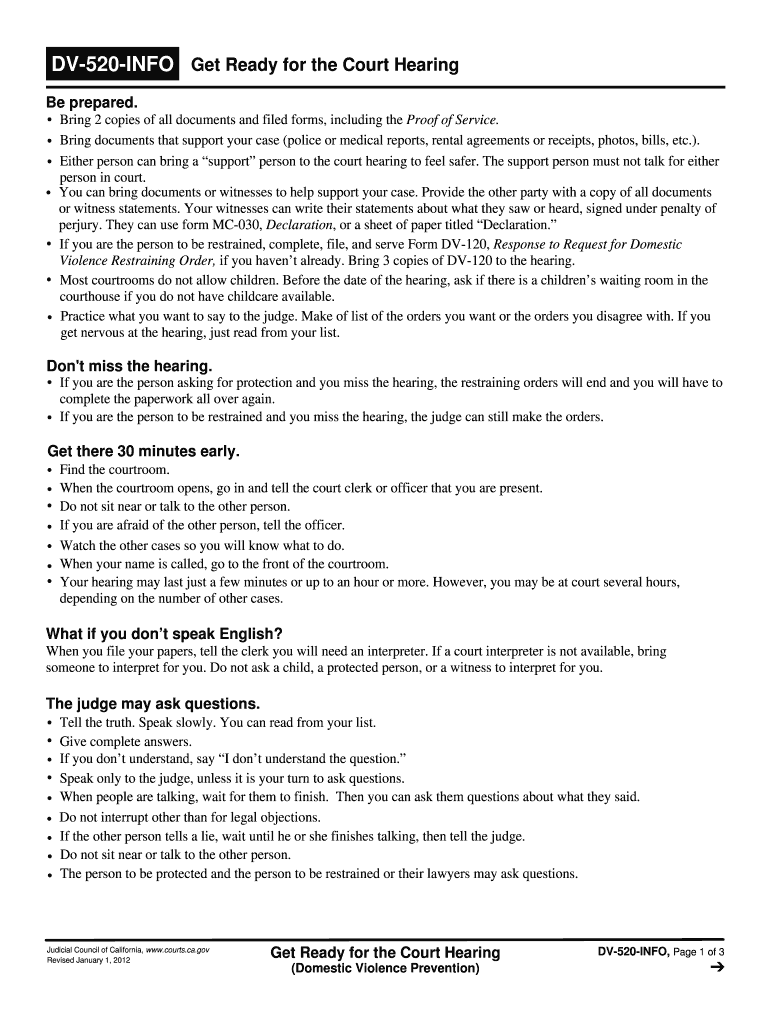
Medical reports, rental agreements or receipts, photos, bills, etc.). Either person can bring a support person to the court hearing to feel safer. The support person must not talk for either person in court. You can bring documents or witnesses to help support your case. Provide the other party with a copy of all documents or witness statements. Your witnesses can write their statements about what they saw or heard, signed under penalty of perjury. They can use form MC-030, Declar.
Loading

Open form follow the instructions

Easily sign the form with your finger

Send filled & signed form or save
How to fill out the CA DV-520-INFO online
The CA DV-520-INFO is a crucial document designed to help individuals prepare for court hearings related to domestic violence prevention. This guide offers step-by-step instructions on how to fill out the form online, ensuring you have the necessary information for a successful court appearance.
Follow the steps to accurately complete the CA DV-520-INFO online.
- Click the ‘Get Form’ button to obtain the CA DV-520-INFO and open it in the editing interface.
- Begin by filling in your personal information, including your name, contact details, and the names of any other parties involved in the case. Ensure that all information is accurate and clearly legible.
- Provide details related to the history of domestic violence, including any incidents that took place, dates, and relevant supporting documents like police or medical reports.
- If applicable, include any requests for protection orders. Clearly specify the type of restraining orders you are seeking and the reasons for those requests.
- In the designated section, outline the arrangements you wish to make regarding child custody or visitation if it is relevant to your case.
- Include any additional information or comments in the appropriate field that may support your arguments or requests.
- Review the completed form thoroughly, checking for any errors or missing information before saving your changes.
- Once you are satisfied with the form, download and print it, ensuring you have sufficient copies as required for your court hearing.
Complete your documents online now to ensure you are fully prepared for your court hearing.
Experience a faster way to fill out and sign forms on the web. Access the most extensive library of templates available.
Related content
Make arrangements, bring evidence/witnesses, plan what you want to say, and focus on...
To ask for a restraining order, complete forms DV-100, DV-109, and DV-110, and be 12 or...
Form DV-110: If you were served with form. DV-110, it means that the judge granted a...
Get answers to your most pressing questions about US Legal Forms API.
What is the burden of proof for a DVRO in California?
For a Domestic Violence Restraining Order (DVRO) in California, the burden of proof resembles that of a regular restraining order under the CA DV-520-INFO. The petitioner must show that domestic violence occurred, which can include physical harm or threats. Clear documentation and witness statements can support the case. Meeting this burden is vital for obtaining the necessary protection.
What happens if both parties don't show up for a restraining order?
If both parties fail to appear for the restraining order hearing, the court may dismiss the case. This outcome occurs because a judge needs to hear from both sides to make an informed decision. It is essential to ensure that you or your legal representation attends these hearings. Otherwise, your request may be denied or postponed, delaying any necessary protection.
How to file a restraining order in California?
Filing a restraining order in California involves several steps. First, you need to complete the CA DV-520-INFO form detailing your situation. Next, you will submit this form to the local courthouse. Additionally, it's advisable to seek help and guidance from legal resources or platforms like UsLegalForms for clear navigation through the process.
Do you need a reason for a restraining order in California?
Yes, to file for a restraining order in California, you must present specific reasons. The CA DV-520-INFO requires you to explain why you feel threatened or unsafe. These reasons can include harassment, stalking, or domestic violence. Having valid justifications helps the court determine the necessity of the order.
What is the burden of proof for a restraining order in California?
In California, the burden of proof for a restraining order under the CA DV-520-INFO form is on the person seeking the order. They must demonstrate to the court that there is a credible threat of harm. This typically involves providing clear evidence or testimony supporting their claims. Meeting this burden effectively is crucial for obtaining the order.
What happens if the respondent fails to appear in court for a protection order?
If the respondent does not show up in court, the judge may still grant the protection order in their absence. This can work in your favor, as it allows you to obtain the protective measures you need. It is important to document the absence and any related circumstances. For comprehensive insights on this process, refer to the reliable information found in CA DV-520-INFO.
What happens if both parties don't show up to court?
When both parties fail to attend court, the judge usually dismisses the case. Not showing up may prevent the issuance of a restraining order that could protect you or enforce necessary actions. To avoid this outcome, staying informed and prepared is critical. The CA DV-520-INFO is an excellent resource that can help keep you on track.
What forms do I need for a restraining order in California?
In California, you will typically need to fill out several forms to obtain a restraining order. These include the request form, the notice of court hearing, and any additional declarations that support your case. To ensure you have the right documentation, consult resources like CA DV-520-INFO, which can guide you on completing the necessary paperwork.
Does a no contact order go both ways?
Yes, a no contact order generally applies to both parties involved in the case. This means that neither party can initiate communication with the other. If you are affected by such an order, it is crucial to understand the implications fully. The CA DV-520-INFO can provide you with essential details on the order's enforcement and your responsibilities.
What is the standard of proof for a restraining order in California?
In California, the standard of proof for a restraining order is 'preponderance of the evidence,' which means that the evidence must show that it is more likely than not that the allegations are true. It is crucial to present a compelling case backed by relevant documentation and testimony. Utilizing resources like the CA DV-520-INFO can clarify this standard for you.
Use professional pre-built templates to fill in and sign documents online faster. Get access to thousands of forms.
If you believe that this page should be taken down, please follow our DMCA take down process here.
This form is available in several versions. Select the version you need from the drop-down list below.