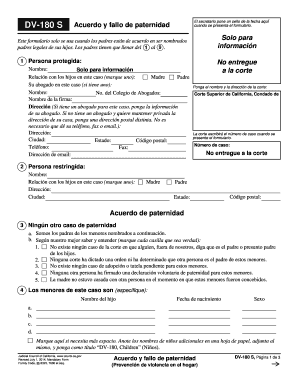
Brados padres legales de sus hijos. Los padres tienen que llenar del 1 al 9 . Solo para informaci n 1 Persona protegida: No entregue Nombre: Solo para informaci n a la corte Relaci n con los hijos en este caso (marque uno): Madre Padre Su abogado en este caso (si tiene uno): Ponga el nombre y la direcci n de la corte: Nombre: No. del Colegio de Abogados: Corte Superior de California, Condado de Nombre de la firma: Direcci n (Si tiene un abogado para este caso, ponga la informaci n de su.
Open form follow the instructions
Easily sign the form with your finger
Send filled & signed form or save
How to fill out the CA DV-180 S online
Filling out the CA DV-180 S form can seem daunting, especially for those with little legal experience. This guide aims to provide clear, step-by-step instructions to help users navigate the form easily and confidently.
Follow the steps to complete the form accurately.
- Press the ‘Get Form’ button to access the CA DV-180 S form and open it for editing.
- Start by filling in the information regarding the protected person. Enter their full name in the designated field, and specify their relationship with the children involved in this case by marking the appropriate option.
- Provide your attorney's information if applicable, including their name and address. If you don’t have an attorney and wish to keep your home address private, consider using an alternative mailing address.
- Next, you will identify the restricted person. Fill in their name and select their relationship with the children by checking the appropriate box. Then, enter their address and other contact information.
- In section 3, confirm that there are no other paternity cases involving the children by checking the relevant boxes to indicate what is true.
- List the names and birth dates of the children in question. If necessary, indicate that you need additional space for more children's details and attach an additional sheet titled 'DV-180, Children.'
- In section 5, specify the orders you are requesting from the court, such as naming you as the legal parents of the minors and amendments to their birth records.
- Understand the rights you are waiving by signing this document, as outlined in section 6. Review these carefully, and if needed, consult a legal professional.
- Both parties must sign and date the form in the designated signature areas, confirming their understanding and agreement to the contents of the form.
- Finally, save your changes, download the completed form, and print it for submission.
Start filling out your forms online to ensure a smooth process.
Experience a faster way to fill out and sign forms on the web. Access the most extensive library of templates available.
Related content
Use this form if both parties agree that they are the parents of the children involved in...
CADV 180. Statistics in Applied Developmental Science (3). Prerequisite: Child and...
Você acaba de adquirir uma câmera de vídeo Sony Handycam. Com sua câmera, você...
Get answers to your most pressing questions about US Legal Forms API.
What is domestic diversion?
Domestic diversion refers to legal programs that offer alternatives to incarceration for individuals charged with domestic violence. These programs focus on rehabilitation, providing necessary resources to address underlying issues. The main goal is to prevent recidivism while ensuring community safety. Exploring the options available through CA DV-180 S can help you understand your best path forward.
What is a domestic violence diversion program?
A domestic violence diversion program is designed for first-time offenders to prevent future incidents through education and behavioral change. Participants often engage in counseling, victim awareness classes, and community service. This approach aims to promote healing and accountability. Many resources, including those related to CA DV-180 S, can help you find a suitable program.
How long are most diversion programs?
Most diversion programs for domestic violence offenders last between six months to a year. The duration may vary based on the specific program's requirements and the individual’s progress. Completing these programs can have a positive impact on your legal standing. Engaging with options connected to CA DV-180 S can enhance your chances of successful completion.
What is the purpose of diversion programs?
Diversion programs aim to provide an alternative to traditional sentencing for first-time offenders of domestic violence. These programs often include counseling, community service, and education on healthy relationships. The goal is rehabilitation rather than punishment, helping individuals change their behavior. Programs related to CA DV-180 S can facilitate this process effectively.
How long does a DV stay on your record in California?
In California, a domestic violence conviction can remain on your record indefinitely. However, individuals may seek expungement after completing their sentence, including probation. Removing a DV from your record can open new opportunities, making it essential to understand the process involved. Consulting resources related to CA DV-180 S can guide you through these steps.
How long does it take to issue a warrant for domestic violence?
In California, the issuance of a warrant for domestic violence typically takes a few hours to a couple of days, depending on the circumstances. Law enforcement usually prioritizes such cases due to their serious nature. It’s vital to provide all relevant details to expedite this process. Utilizing resources like CA DV-180 S can help you navigate the legal steps more effectively.
Can a domestic violence case be reopened California?
There are specific conditions that need to be met before the court will agree to reopen a case. These include: The abuser has shown remorse for their actions. After receiving professional counseling, they have managed to change their behavior and stop inflicting harm on others.
What is the 3 year statute of limitations in California?
Three-year limitation California Penal Code 801 PC states that apart from those crimes that fall into the two prior statutes, the statute of limitations for offenses punishable by imprisonment is three years. For example: Penal Code 245 PC – assault with a deadly weapon, Penal Code 459 PC - burglary.
What is the statute of limitations for DV CA?
In 2020, California lawmakers passed a bill (SB 273) that extended the statute of limitations for domestic violence to five years. This means that victims of domestic violence now have five years to file a police report or charge the abuser with a crime.
What is a DV 180?
Use this form if both parties agree that they are the parents of the children involved in the case.
Use professional pre-built templates to fill in and sign documents online faster. Get access to thousands of forms.
If you believe that this page should be taken down, please follow our DMCA take down process here.