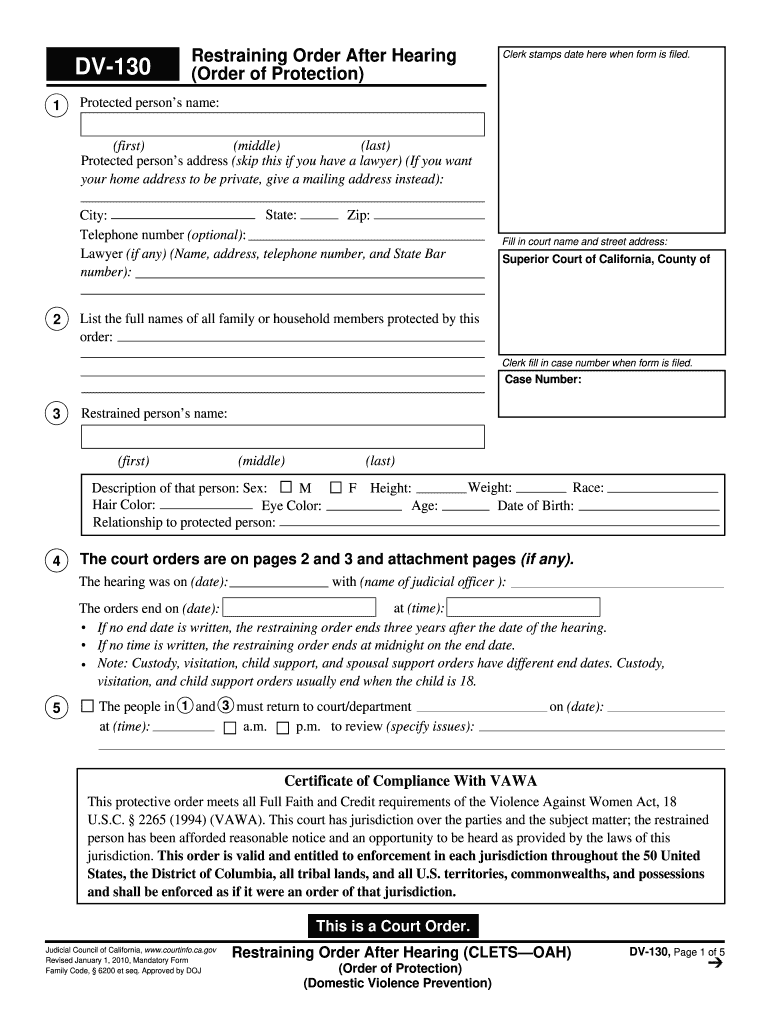
This Form button at the end of the form when finished. Protected person s name: (last) (middle) (first) Protected person s address (skip this if you have a lawyer) (If you want your home address to be private, give a mailing address instead): State: Zip: City: Telephone number (optional): Lawyer (if any) (Name, address, telephone number, and State Bar number): 2 Fill in court name and street address: Superior Court of California, County of List the full names of all family or household.
Loading

Open form follow the instructions

Easily sign the form with your finger

Send filled & signed form or save
How to fill out the CA DV-130 online
The CA DV-130 is an essential legal document used to obtain a restraining order after a hearing. This guide will provide you with step-by-step instructions to help you complete the form accurately and effectively.
Follow the steps to complete the CA DV-130 online
- Press the ‘Get Form’ button to acquire the form and open it for completion.
- Input the protected person’s name clearly in the designated fields (last, first, middle). If there is a lawyer involved, provide their details or use an alternative mailing address if needed.
- Fill in the court name and address accurately to ensure proper jurisdiction.
- List all family or household members who are protected under this order.
- Complete the restrained person’s information, including their full name, description (sex, hair color, eye color, height, weight, race, and date of birth).
- Specify the date of the hearing, the name of the judicial officer, and the time of the hearing.
- Indicate the duration of the orders and any specific end dates as instructed.
- Detail the personal conduct orders, specifically what the restrained person is prohibited from doing.
- Describe stay-away orders, including specific distances from various locations.
- Complete sections regarding child custody, visitation, support, and any additional orders as necessary.
- Ensure to finalize your form by saving your changes, and choose to download, print, or share the document.
Complete your documents online with confidence and clarity.
Experience a faster way to fill out and sign forms on the web. Access the most extensive library of templates available.
Related content
If child or spousal support was requested, the court has considered whether failure to...
Before going to the hearing, you should prepare. Form DV-130, Restraining Order After...
I was served with form DV-100, DV-109, or. DV-110. What does this mean? Someone has asked...
Get answers to your most pressing questions about US Legal Forms API.
How do I know if a restraining order is still active?
To check if a restraining order, such as the CA DV-130, is still active, you can contact the court that issued the order. Courts can provide records and confirm the status of your order. It is important to keep this information in mind, as it affects your safety and legal standing. Platforms like US Legal Forms can offer guidance on how to access this information effectively.
How to file a restraining order in California?
To file a restraining order in California, you need to complete the appropriate forms, including the CA DV-130, and submit them to the court. This process may involve outlining the reasons for your request and providing supporting details. After filing, you must arrange for the order to be served to the other party. Using US Legal Forms can help streamline this process by providing templates and instructions.
How long are restraining orders good for in California?
Restraining orders in California can last for several years, depending on the case specifics. A temporary restraining order may only last a few weeks, while permanent orders can last up to five years or more. If you need ongoing protection, timely filing a renewal using the CA DV-130 is essential. Resources like US Legal Forms make this process clear and manageable.
What happens when a restraining order expires in California?
When a restraining order, such as the CA DV-130, expires, the protections it offers cease immediately. This means that the individual the order protected from can legally contact you again. It is crucial to be proactive and seek a renewal before your order expires to maintain your safety. Platforms like US Legal Forms can assist in preparing renewal paperwork efficiently.
Can a restraining order be served by mail in California?
In California, a restraining order like the CA DV-130 must typically be served in person. However, in some cases, the court may allow service by mail if specified conditions are met. This method often requires you to also provide proof of service. Utilizing services such as US Legal Forms can simplify understanding these requirements.
How difficult is it to renew a restraining order in California?
Renewing a restraining order in California, like the CA DV-130, can vary in difficulty based on circumstances. Generally, if you can demonstrate ongoing fear or need for protection, the court may grant your renewal request. It's essential to file your renewal application before the current order expires to avoid gaps in protection. Resources like US Legal Forms can guide you through this process efficiently.
What's the difference between a restraining order and a PPO?
A restraining order typically refers to a legal order that prevents someone from contacting or approaching another person due to threats or harm. In contrast, a Personal Protection Order (PPO) is often specific to certain jurisdictions and may emphasize ongoing harassment protection. Understanding these distinctions is important when filing for protection. The CA DV-130 form can help clarify the type of order you need based on your situation.
Why would a judge dismiss a protective order?
A judge may dismiss a protective order due to several factors, such as a lack of evidence supporting the need for protection. If the judge believes that the risk of harm has diminished significantly or that the request was made in bad faith, they may choose to dismiss it. It is essential to present your case effectively if you are seeking dismissal. Understanding the CA DV-130 can assist in preparing for the court process.
What are good reasons to drop a restraining order?
Good reasons to drop a restraining order can include a change in relationship dynamics or evidence of improved circumstances. If the individuals involved have resolved their conflicts or if there is a mutual agreement for safety, this can also be a solid basis. It's vital to communicate these reasons effectively in court when requesting to lift the order. Referencing the CA DV-130 as part of your documentation can help make your case clear.
What is a dv 130?
The CA DV-130 is a legal form used in California to request a Domestic Violence Restraining Order. This form provides critical information about the situation and the requester's need for protection from abuse or harassment. Using the CA DV-130 ensures that you are following the correct legal processes to obtain the necessary protections. It's vital for anyone seeking legal assistance in domestic violence cases.
Use professional pre-built templates to fill in and sign documents online faster. Get access to thousands of forms.
If you believe that this page should be taken down, please follow our DMCA take down process here.
This form is available in several versions. Select the version you need from the drop-down list below.