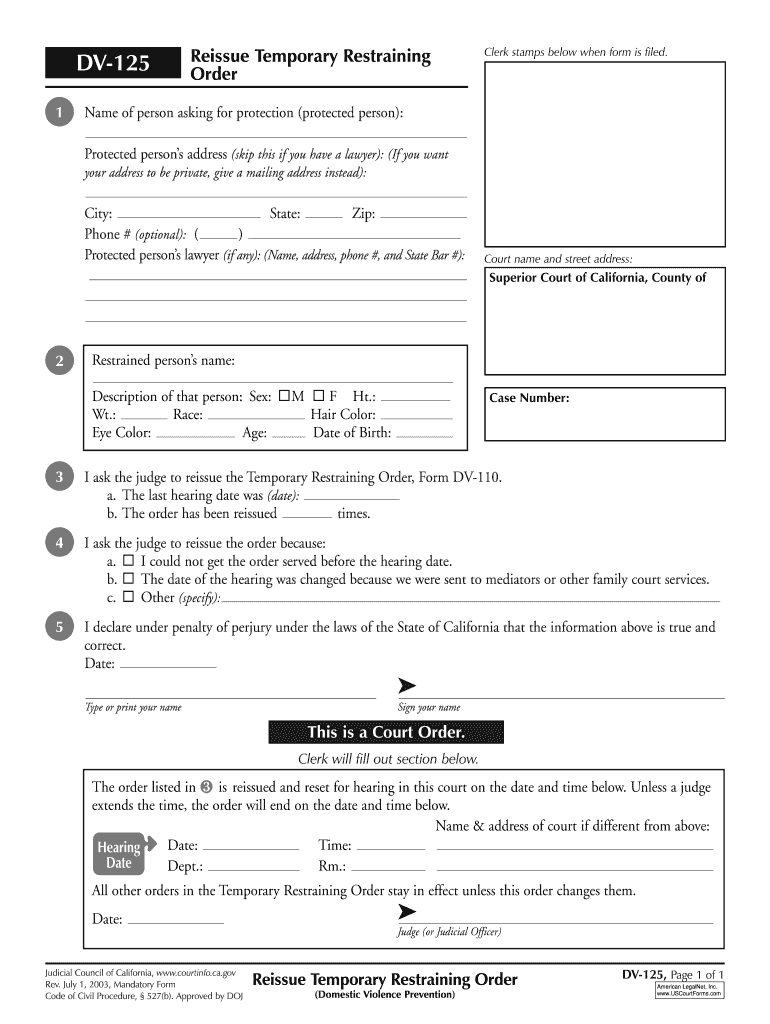
Of the form when finished. Name of person asking for protection (protected person): Protected person s address (skip this if you have a lawyer): (If you want your address to be private, give a mailing address instead): City: State: Zip: Phone # (optional): ( ) Protected person s lawyer (if any): (Name, address, phone #, and State Bar #): Court name and street address: Superior Court of California, County of 2 Restrained person s name: COURT .COUNTY . . . . . . . . .OF .
Loading

Open form follow the instructions

Easily sign the form with your finger

Send filled & signed form or save
How to fill out the CA DV-125 online
The CA DV-125 form is used to request the reissuance of a temporary restraining order. It is important to complete this form accurately to ensure your petition is processed effectively. This guide will provide clear and concise instructions on how to fill out the CA DV-125 online.
Follow the steps to properly complete the CA DV-125 form online.
- Click ‘Get Form’ button to obtain the form and open it in the editor.
- Begin by entering the name of the person asking for protection in the designated field labeled 'Name of person asking for protection (protected person)'. This is a critical part that identifies you as the protected person.
- Provide the protected person’s address. If you have legal representation, you can skip this step. If privacy is a concern, consider using a mailing address instead.
- Fill out the details regarding the protected person's lawyer, if applicable. Include the name, address, phone number, and state bar number.
- In the next section, enter the name and address of the court where you are filing the form. Make sure you select the correct Superior Court of California and include the county.
- Next, fill in the information about the restrained person. This includes their name and a description that encompasses sex, height, weight, race, hair color, eye color, age, and date of birth.
- Specify the request to the judge by stating that you are asking them to reissue the temporary restraining order, referencing Form DV-110. Additionally, include the last hearing date and how many times the order has been reissued.
- Indicate the reasons for reissuing the order. Select the appropriate reason, which may include difficulty serving the order before the hearing date, a change in the hearing date due to mediation, or any other specified reason.
- In the declaration section, affirm the truthfulness of the information provided by signing your name and including the date and court information.
- Finally, after reviewing all the fields for accuracy, save your changes. You have the options to download, print, or share the completed form.
Begin filling out your CA DV-125 form online today to ensure your protective measures are in place.
Experience a faster way to fill out and sign forms on the web. Access the most extensive library of templates available.
Related content
This form is attached to form DV-120. How to complete this form: To answer the questions...
by E Somigliana · Cited by 217 — The study used serum levels of CA 125, CA 19-9, and...
Esta filmadora é designada para ser utilizada com sinais de televisão colorida tipo...
Get answers to your most pressing questions about US Legal Forms API.
Can I text someone I put a restraining order on?
Generally, if a restraining order is in place, you should avoid any direct communication, including texting the person. Doing so could violate the terms of the order and lead to legal consequences. It is vital to respect the boundaries set by the CA DV-125 and seek legal advice if you have specific concerns about communication and compliance.
What forms do I need for a restraining order in California?
For a restraining order in California, you typically need the CA DV-125 to start the application process. Additionally, other forms like the DV 100 and DV 130 may be required based on your situation. Utilizing platforms like US Legal Forms can simplify your access to these documents and provide guidance on completing them correctly.
What paperwork is needed for a restraining order in California?
To file for a restraining order in California, you need several key forms, including the CA DV-125 form, which initiates the process. You’ll also need the DV 100 form and potentially the DV 130, depending on your circumstances. Collecting all necessary paperwork in advance can streamline the process, ensuring you present a complete case to the court.
How do I respond to a restraining order in California?
To respond to a restraining order in California, you must file a response form with the court within the time limit specified. This response allows you to present your side of the story and challenge the order. It’s important to include necessary evidence and complete any related forms, like the CA DV-125, to strengthen your case and clarify your perspective.
What is a DV 130 form?
The DV 130 form is an essential document used in California for obtaining a restraining order regarding domestic violence cases. This form helps outline the details of the situation and the specific protections you are seeking. Filling out the CA DV-125 and the DV 130 accurately is vital as both forms support your request for safety and help the court understand your needs.
Do you have to appear in court for a restraining order in California?
Yes, in California, you typically must appear in court for a restraining order. This appearance allows the judge to review your request and hear any opposing arguments. After submitting your initial forms, including the CA DV-125, you will receive a court date to present your case. It's crucial to prepare adequately for this appearance to ensure your concerns are addressed.
What is the difference between a protective order and a restraining order in California?
In California, a protective order and a restraining order serve similar purposes but are used in different contexts. A protective order generally pertains to specific legal circumstances, such as domestic violence cases, and focuses on ensuring the safety of individuals involved. On the other hand, a restraining order often applies to various conflicts, including harassment or stalking. Understanding these distinctions is essential, especially when dealing with forms like the CA DV-125.
How to file a response to a restraining order in California?
To file a response to a restraining order in California, you'll need to fill out the appropriate forms, such as the CA DV-125, to formally contest the order. It's important to clearly provide your side of the story and any evidence that supports your argument against the allegations. File your response with the court and ensure that the other party receives a copy before the scheduled hearing. Preparing a solid defense can influence the court's decision on whether to grant or deny the restraining order.
How fast can you get a restraining order in California?
In California, you can often receive a temporary restraining order within a day or two after filing your CA DV-125 form, particularly in urgent situations. However, the full restraining order may take a few weeks as it requires a court hearing where both parties can state their cases. Staying proactive by gathering evidence and submitting your forms can help expedite the process. Always consult with a legal expert to understand the timelines specific to your case.
How to file for legal custody of a child in California?
To file for legal custody of a child in California, start by completing the necessary forms, which include the CA DV-125 for any domestic violence concerns. Ensure that you include relevant details about the child's best interests in your petition. After completing the forms, file them with your local family court and serve copies to the other parent. Attending a court hearing may be required, where both parties can present their case.
Use professional pre-built templates to fill in and sign documents online faster. Get access to thousands of forms.
If you believe that this page should be taken down, please follow our DMCA take down process here.