Died intestate. Copy of decedent's will dated: codicil dated (specify for each): are affixed as Attachment 3f(2). (Include typed copies of handwritten documents and English translations of foreignlanguage documents.) The will and all codicils are self-proving (Prob. Code, 8220). (3) The original of the will and/or codicil identified above has been lost. (Affix a copy of the lost will or codicil or a written statement of the testamentary words or their substance in Attachment 3f(3), and st.

Open form follow the instructions

Easily sign the form with your finger

Send filled & signed form or save
How to fill out the CA DE-111 online
The CA DE-111 is a crucial form used in California probate proceedings. This guide provides user-friendly, step-by-step instructions to help you accurately complete the form online, ensuring your documents are filled out correctly and efficiently.
Follow the steps to successfully complete the CA DE-111 form.
- Click ‘Get Form’ button to obtain the form and open it in the editor.
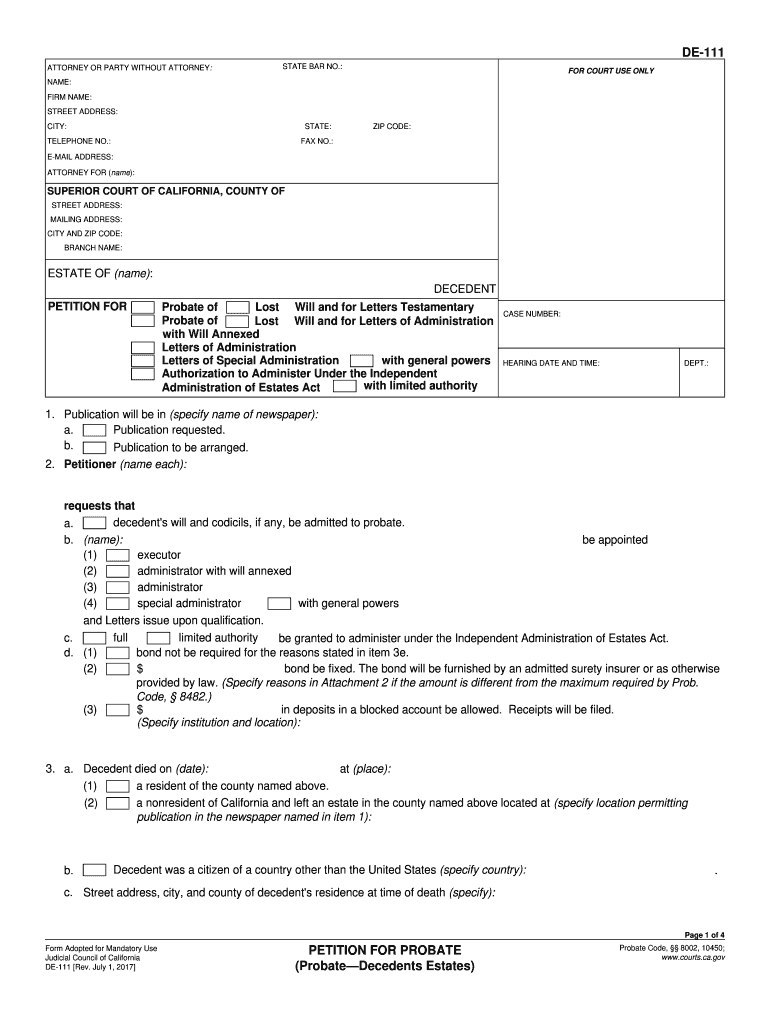
- Begin by entering your information in the 'Attorney or party without attorney' section. Fill in your name, firm name, street address, city, state, and ZIP code. If applicable, provide your telephone number, fax number, email address, and state bar number.
- In the 'For Court Use Only' section, leave this area blank as it is reserved for court personnel.
- Fill in the information related to the estate of the decedent. Specify the name of the decedent and select from the options regarding the type of petition you are filing (such as Probate of Lost Will, Letters Testamentary, etc.).
- Enter the case number, hearing date and time, and department details as needed.
- Provide information regarding publication requests, identifying the name of the newspaper where the publication will occur.
- List the name of the petitioner(s) and detail their requests for the admission of the decedent's will to probate, appointment as executor or administrator, and any requests for bond adjustments.
- In the estate’s financial section, accurately detail the character and estimated value of the property of the estate, including personal property and real property, along with gross income and encumbrances.
- Complete the sections regarding the decedent’s familial survivors, including spouse, children, and any other relevant relations. This includes checking applicable boxes and providing their information as required.
- Finally, review the entire document for accuracy, then proceed to save your changes and print the form or share it as needed. Remember to click 'Clear This Form' for your privacy after printing.
Complete your CA DE-111 form online with confidence today!
Experience a faster way to fill out and sign forms on the web. Access the most extensive library of templates available.
Related content
Ask the court to start the process for distributing a deceased person's property, paying...
SAKF 111 (P129379) · 1. 2(u) sa gi# x · 2. 1(u) sa gi sza3-nig2-du10#? · 3. 5(disz) sa...
Cuidado: para evitar ruído, manter as antenas longe das partos metálicas do CA-D3S, do...
Get answers to your most pressing questions about US Legal Forms API.
Can you do probate without a lawyer in California?
Conducting probate without a lawyer in California is entirely possible, especially if you feel confident in managing the task. You will need to complete the CA DE-111 form as an initial step. While navigating this process solo can be challenging, US Legal Forms provides tools and support for self-filers. With the right resources, you can efficiently complete probate on your own terms.
How do you apply for the executor of an estate?
To apply for the role of executor in California, you must file the CA DE-111 along with the will and a petition for probate. This step formally appoints you to manage the deceased’s estate. It’s essential to gather necessary documents and information before submitting your application. US Legal Forms offers assistance to help you navigate this process smoothly.
Can I file probate myself in California?
Yes, you can file probate yourself in California with proper preparation. This process starts with completing the CA DE-111 form, which is crucial for moving forward. While managing probate independently may seem daunting, using resources from US Legal Forms can simplify your journey. Ensure you understand all requirements to avoid complications.
Do it yourself probate in California?
You can indeed handle probate on your own in California, but it requires a clear understanding of the process. The CA DE-111 form is an essential step, as it initiates the probate process. If you feel uncertain, platforms like US Legal Forms can provide resources to guide you through each step effectively. Self-filing can save costs, but be sure to research thoroughly.
How to fill out form de-111 in California?
Filling out the CA DE-111 requires you to gather information about the deceased, their assets, and debts. Start by obtaining the form from the California Courts website or through legal assistance platforms like US Legal Forms. Carefully complete each section and ensure you provide accurate details to avoid delays. Once filled, file the form with your local probate court.
What is form DE 111 used for?
Form DE 111, also known as the California Spousal Property Petition, serves to transfer property held by a deceased spouse easily. This form helps streamline the legal process, making it straightforward for eligible beneficiaries to claim their rightful assets. By providing the necessary details, you can resolve the affairs of the estate more efficiently. Leveraging platforms like US Legal Forms can help you obtain and file CA DE-111 correctly.
Which is the correct order of payment from an estate?
When settling an estate in California, the correct order of payment must be followed to ensure fairness and legality. Debts such as funeral expenses and taxes take precedence, followed by administrative costs, then distributions to beneficiaries. It is essential to adhere to this order to avoid disputes among heirs and ensure a smooth settlement process. Utilizing the CA DE-111 form can simplify these steps for you.
What is the order of heirs in California?
In California, the order of heirs is crucial for estate distribution. Typically, the deceased's spouse and children receive priority, followed by parents, siblings, and then more distant relatives. This hierarchy ensures that the estate is passed on to the closest family members. Understanding this order can help you navigate the probate process effectively, especially when using forms like CA DE-111.
What assets are exempt from probate in California?
Certain assets are exempt from probate in California, including life insurance policies, retirement accounts, and properties held in joint tenancy. Additionally, assets held in a living trust are also protected from probate. To clarify your asset situation, referencing the CA DE-111 form can be a helpful step.
Do all estates have to go through probate in California?
Not all estates must go through probate in California, especially if they fall under specific exemptions. For instance, properties held in a living trust or assets below the $166,250 threshold can avoid this process. Consulting the CA DE-111 can provide clarity and assist you in understanding when probate is necessary.
Use professional pre-built templates to fill in and sign documents online faster. Get access to thousands of forms.
If you believe that this page should be taken down, please follow our DMCA take down process here.