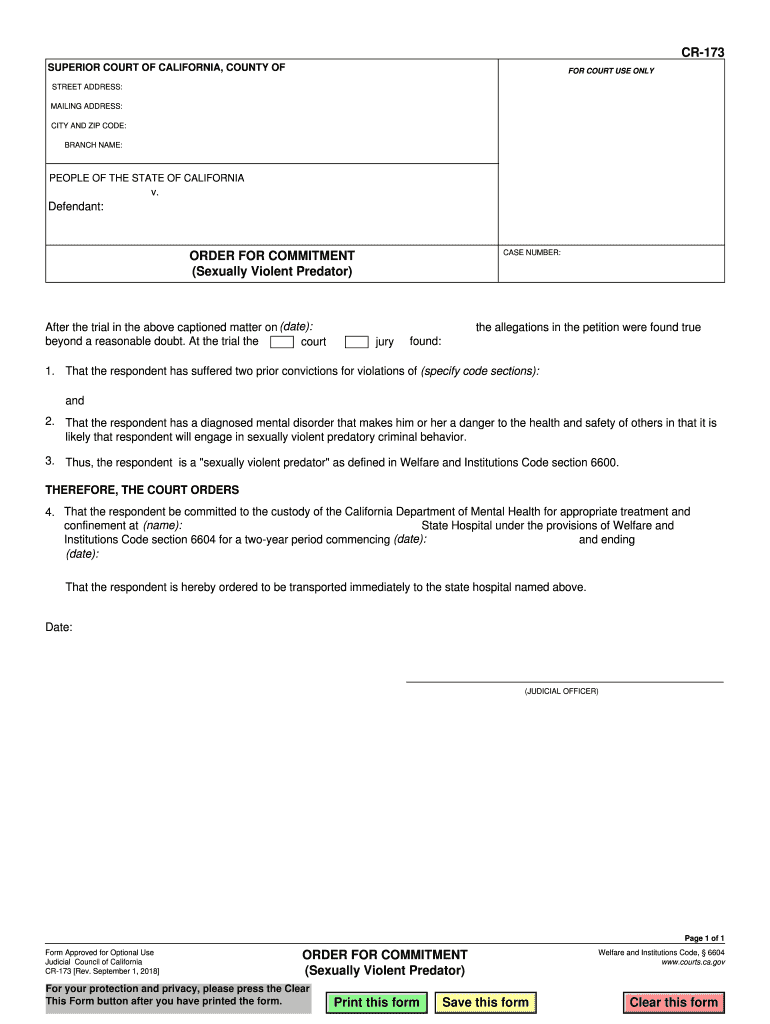
CR173 SUPERIOR COURT OF CALIFORNIA, COUNTY OFFOR COURT USE ONLYSTREET ADDRESS: MAILING ADDRESS: CITY AND ZIP CODE: BRANCH NAME:PEOPLE OF THE STATE OF CALIFORNIA v.Defendant:CASE NUMBER:ORDER FOR COMMITMENT (Sexually.
Loading

Open form follow the instructions

Easily sign the form with your finger

Send filled & signed form or save
How to fill out the CA CR-173 (formerly MC-280) online
Filling out legal forms can seem daunting, but this guide aims to simplify the process of completing the CA CR-173 form online. By following the outlined steps, you will effectively navigate through each section of the form with ease.
Follow the steps to fill out the form correctly and efficiently.
- Click the ‘Get Form’ button to access the form and open it in your preferred editor.
- Begin by entering the details for the court, including the street address, mailing address, city and zip code, and branch name.
- In the section for the case number, accurately input the relevant case number associated with the trial.
- Fill in the name of the defendant in the designated area, ensuring there are no typos.
- Specify the date of the trial in the section provided, as this is crucial for record keeping.
- In the section that outlines the court’s findings, indicate whether the court found the allegations in the petition to be true.
- Complete the numbered items, detailing prior convictions and the diagnosed mental disorder of the respondent.
- Fill out the section that states the commitment order, specifying the name of the state hospital and the starting and ending dates for the confinement period.
- Review all entered information for accuracy and completeness before proceeding.
- Once everything is complete, save the changes, and remember to download, print, or share the form as necessary.
Complete your documents online to ensure a smooth and efficient process.
Experience a faster way to fill out and sign forms on the web. Access the most extensive library of templates available.
Related content
CR-173. 1/1/2022 Order for Commitment (Sexually Violent Predator). CR-174. 9/1...
by K Goldberg · 2016 · Cited by 80 — ABSTRACT: Paleoredox indicators were used to...
Apr 5, 2019 — Short three poles of the inrush current limit MC, and use one MC for one...
Get answers to your most pressing questions about US Legal Forms API.
What does it mean when a case is quashed?
When a case is quashed, it means that the court has invalidated certain legal actions taken, typically related to service of process. In essence, if a judge grants a motion to quash under CA CR-173 (formerly MC-280), the court cannot proceed with the case against the party named in the original complaint. This action can significantly impact the course of litigation, safeguarding the affected party’s rights and interests.
What's the difference between a motion to quash and a motion to dismiss?
A motion to quash and a motion to dismiss serve different purposes in legal proceedings. A motion to quash, particularly under CA CR-173 (formerly MC-280), challenges the validity of the service of process, while a motion to dismiss seeks to end a case based on various legal grounds, such as jurisdiction or failure to state a claim. Understanding these distinctions is vital for deciding the best legal strategy for your situation.
How to open a court case?
Opening a court case typically begins with filing a complaint or petition in the relevant court. You'll need to complete the appropriate forms and submit them, which may include the CA CR-173 (formerly MC-280) if applicable to your situation. After filing, serve copies of the documents to the other party to notify them of the case. Throughout this process, utilizing resources from uslegalforms can simplify your experience, providing essential templates and guidance.
What is a motion to quash service of process in California?
A motion to quash service of process in California is a legal request to invalidate a summons or complaint issued to you. Under CA CR-173 (formerly MC-280), this motion asserts that the service was executed improperly, thus preventing the court from exercising jurisdiction over you. It’s an essential tool to protect your rights and can be crucial if you believe the process did not adhere to established laws. Taking prompt action is vital for optimal results.
What is the procedure for filing a motion?
Filing a motion involves several clear steps, ensuring compliance with court rules. First, prepare your motion, which includes the CA CR-173 (formerly MC-280) form, and make sure to include all necessary supporting documents. Next, file your motion with the court, paying any required fees. Lastly, serve a copy to all involved parties and attend the court hearing to present your case.
What does it mean to quash service of process?
To quash service of process means to invalidate the legal notice that a court has issued to a party. When you quash service, you contest its legality, which can prevent a court case from proceeding against you. Utilizing CA CR-173 (formerly MC-280), you argue that the service either did not follow proper legal procedures or was not delivered correctly. This is a crucial step to safeguard your legal rights.
What is the burden of proof for a motion to quash in California?
In California, the burden of proof for a motion to quash under CA CR-173 (formerly MC-280) rests primarily on the party seeking to quash the service. This means that the person making the motion must provide sufficient evidence to show that the service of process was not valid. Essentially, you need to demonstrate that the court does not have personal jurisdiction over you because of improper service. Clear and convincing documentation can significantly bolster your case.
Use professional pre-built templates to fill in and sign documents online faster. Get access to thousands of forms.
If you believe that this page should be taken down, please follow our DMCA take down process here.