Ourt has a statutory lien on that recovery. The court may refuse to dismiss the case until the lien is satisfied. (Gov. Code, 68637.) Declaration Concerning Waived Court Fees 1. The court waived court fees and costs in this action for (name): 2. The person named in item 1 is (check one below): a. not recovering anything of value by this action. b. recovering less than $10,000 in value by this action. c. recovering $10,000 or more in value by this action. (If item 2c is checked, item 3 must b.

How it works
  • Open form

    Open form follow the instructions

  • Easily sign form

    Easily sign the form with your finger

  • Share form

    Send filled & signed form or save

How to fill out the CA CIV-110 online

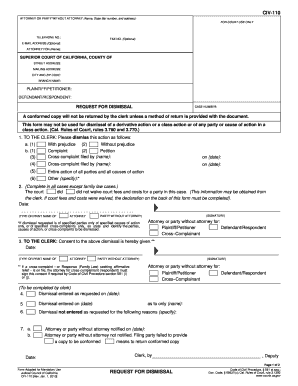
The CA CIV-110 form, also known as the Request for Dismissal, is a crucial document for individuals wishing to dismiss a legal action in California. This guide provides clear and supportive instructions for filling out the form online, ensuring you understand each component.

Follow the steps to fill out the CA CIV-110 form online.

  1. Click ‘Get Form’ button to obtain the form and open it in your preferred editor.
  2. Begin filling out the form by inputting the name, state bar number, and address of the attorney or self-represented party in the provided section. If not applicable, leave this section blank.
  3. Provide the contact information, including telephone number, fax number (optional), and email address (optional), in the respective fields.
  4. Indicate the attorney representing the party, if relevant, by entering their name in the designated area.
  5. Specify the Superior Court of California's location by completing the street address, mailing address, city, and zip code sections accurately.
  6. Enter the names of the plaintiff/petitioner and the defendant/respondent in the appropriate sections.
  7. In the 'Request for Dismissal' section, clearly indicate how you wish to dismiss the action, either 'with prejudice' or 'without prejudice,' and identify the specific complaint, petition, or cross-complaint being dismissed.
  8. If applicable, complete the section regarding waived court fees by checking 'did' or 'did not,' and follow up with the declaration on the back of the form if court fees were waived.
  9. Submit a signature in the appropriate section, ensuring your name is printed above your signature.
  10. If a consent to dismiss is required, this must also be signed in accordance with the guidelines laid out for cross-complaints.
  11. Finally, review all provided information for accuracy. Once confirmed, save your changes, download the form, print it, or share it as necessary.

Complete your CA CIV-110 form online today for efficient document management.

Get form

Experience a faster way to fill out and sign forms on the web. Access the most extensive library of templates available.

Related content

CIV-110 Request for Dismissal - California Courts

This form may not be used for dismissal of a derivative action or a class action or of any...

Learn more
11901516* - CIV-110

This form may not be used for dismissal of a derivative action or a class action or of any...

Learn more
INSTRUCTION MANUAL

The EOS-1D X is the top-of-the-line EOS DIGITAL high-performance digital single-lens...

Learn more
Questions & Answers

Get answers to your most pressing questions about US Legal Forms API.

Contact support

Can you file a motion to dismiss without filing an answer?

Yes, in California, you can file a motion to dismiss without submitting an answer first. This option is beneficial for addressing deficiencies in the complaint prior to engaging in further litigation. When pursuing this route, utilize the CA CIV-110 form to ensure your filing is correct and adhered to court protocols.

In California, the two primary dismissal rules include voluntary and involuntary dismissals. A voluntary dismissal can happen when the plaintiff chooses to withdraw their case, whereas an involuntary dismissal occurs when the court dismisses a case due to failure to timely prosecute. Familiarizing yourself with these rules helps in navigating the CA CIV-110 process effectively.

When writing a motion for dismissal, structure your document with a clear introduction stating your request. Follow it with a detailed argument, using relevant laws and precedents as necessary. Ensure that your motion adheres to the CA CIV-110 requirements, reinforcing your points with concise, factual information.

Filling out the CA CIV-110 involves specific steps to ensure accuracy. Begin with the case caption at the top, then clearly identify the parties and case number. Follow the prompts on the form carefully, providing all necessary details and any grounds for dismissal, to enhance clarity and effectiveness.

Filling out a motion to dismiss form requires attention to detail. Start by clearly stating the legal grounds for your motion, followed by any supporting facts or evidence. Utilize the CA CIV-110 form to ensure all required information is included, making your submission clearer and more effective.

To file a motion to dismiss in California, you must prepare the appropriate documents, including a legal memorandum outlining your reasons for dismissal. The CA CIV-110 form is essential in this process, as it provides the necessary information for the court. Be sure to file your motion with the court clerk and serve it to the other parties involved in the case.

In California, a request for dismissal is typically filed by the plaintiff or the party that initiated the action. This person may choose to dismiss the case voluntarily before the trial. It is important to properly complete the CA CIV-110 form and submit it to the court to finalize the dismissal.

The CA CIV-110 form is a legal document used to request dismissal of a lawsuit in California. It serves as an official declaration from the petitioner, stating their intent to dismiss the case. Understanding its purpose is crucial for anyone involved in legal proceedings. For a comprehensive overview, uslegalforms offers helpful insights and resources.

To write a letter of dismissal for court, begin with the appropriate court’s address and the date. Clearly state that you wish to dismiss the case, referencing the case number and the CA CIV-110 form when applicable. Include your contact information and ensure you sign the letter. This format can aid in preventing misunderstandings.

Filling out the CA CIV-110 form requires clear and precise information. Start by entering your case number, the parties involved, and the court's name. Be sure to sign and date the form at the bottom. For detailed guidance, you can utilize resources from uslegalforms to ensure accuracy.

Get This Form Now!

Use professional pre-built templates to fill in and sign documents online faster. Get access to thousands of forms.

If you believe that this page should be taken down, please follow our DMCA take down process here.

Get CA CIV-110