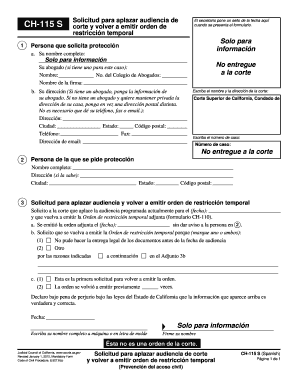
Formaci n Persona que solicita protecci n a. Su nombre completo: Solo para informaci n No entregue a la corte Su abogado (si tiene uno para este caso): Nombre: No. del Colegio de Abogados: Nombre de la firma: b. Su direcci n (Si tiene un abogado, ponga la informaci n de su abogado. Si no tiene un abogado y quiere mantener privada la direcci n de su casa, ponga en vez una direcci n postal distinta. No es necesario que d su tel fono, fax o email.): Direcci n: Estado: C digo postal:.
Open form follow the instructions
Easily sign the form with your finger
Send filled & signed form or save
How to fill out the CA CH-115 S online
The CA CH-115 S form is a request to postpone a court hearing and to reissue a temporary restraining order. This guide will provide comprehensive, step-by-step instructions for filling out the form online, ensuring clarity for all users, regardless of their legal experience.
Follow the steps to successfully complete the form
- Click the ‘Get Form’ button to obtain the CA CH-115 S form and open it in the editor.
- In the first section, enter your full name as the person seeking protection. If you have an attorney, include their name, bar number, and firm name as well.
- Provide your address. If you prefer to keep your home address private, you may use a different mailing address. It is not mandatory to include your phone number, fax, or email.
- Next, fill in the name and address of the court where you will submit the form. Specify the case number associated with your request.
- In the section for the person from whom protection is sought, enter their full name and, if known, their address and city.
- Indicate the date of the currently scheduled hearing, and request a postponement. Specify the reasons for reissuing the temporary restraining order and complete relevant checkboxes.
- Declare that the information provided is true and correct, sign your name, and date the form accordingly.
- Once you have completed all sections, ensure that all information is accurate, and then you can save changes, download, print, or share the form as needed.
Take the next step in your process and complete the CA CH-115 S form online.
Experience a faster way to fill out and sign forms on the web. Access the most extensive library of templates available.
Related content
Instrucciones: Use este formulario para pedir a la corte que cambie la fecha del juicio...
CHS 115 focuses on expository writing, logical thought, clear expression, organizational...
Mar 2, 2025 — Este adaptador CA deve ser usado somente com instrumentos eletrônicos da...
Get answers to your most pressing questions about US Legal Forms API.
Do you have to go to court for a restraining order in California?
Yes, in California, you typically must go to court to obtain a restraining order. The court will assess your request and evidence presented, which can include the CA CH-115 S form. This process allows the judge to make an informed decision on your case. Preparing thoroughly for court and having all necessary documents can be crucial for your success.
What is the standard of proof for a civil restraining order in California?
In California, the standard of proof for a civil restraining order is the preponderance of the evidence, meaning that it is more likely than not that harassment has occurred. You should be prepared to present sufficient evidence to meet this standard. Completing the CA CH-115 S form correctly can help clarify your points and submissions. Ensuring your documentation aligns with this standard can enhance your chances of obtaining an order.
What is the burden of proof for a civil harassment restraining order in California?
The burden of proof for a civil harassment restraining order in California is on the person seeking the order. They must show by a preponderance of the evidence that harassment occurred and poses a threat to their safety. When preparing your case, utilizing the CA CH-115 S form can assist in structuring your evidence and arguments. Being prepared with substantial proof can greatly influence the court's decision.
What proof do you need for a civil restraining order in California?
For a civil restraining order in California, you need to provide evidence of harassment, threats, or violence. This proof can include witness statements, emails, texts, or recorded communications that establish a pattern of behavior. Utilizing the CA CH-115 S form can help organize your evidence and present your case clearly to the court. Gathering strong evidence before filing can significantly increase your chances of success.
How do I overturn a restraining order in California?
To overturn a restraining order in California, you must file the appropriate legal motion with the court. You will need to demonstrate valid grounds for your request, such as changes in circumstances or new evidence. The CA CH-115 S form may be required during this process, allowing you to present your arguments more effectively. Consider seeking legal advice to strengthen your case.
How fast can you get a restraining order in California?
In California, you can often obtain a temporary restraining order quickly, sometimes within a day of filing the necessary paperwork. Once you file your petition using the CA CH-115 S, a court will review your request and schedule a hearing. This process allows for immediate protection until a formal hearing takes place.
What is the standard of proof for a restraining order in California?
The standard of proof for a restraining order in California is 'preponderance of the evidence.' This means you need to present enough evidence to convince the court that it is more likely than not that harassment has occurred. By clearly articulating your situation and providing solid evidence through the CA CH-115 S, you can meet this standard.
What is the burden of proof for a restraining order in California?
The burden of proof for a restraining order in California requires that the petitioner must prove the need for the order through credible evidence. This means you must establish a history of harassment or threats that justifies the need for protection. Using the CA CH-115 S form can guide you in presenting your case effectively.
What are the grounds for a civil harassment restraining order in California?
In California, the grounds for a civil harassment restraining order include specific acts of harassment, such as threats, stalking, persistent unwanted contact, or violence. You need to show that such actions have caused you significant emotional distress. Filing with the CA CH-115 S form helps you detail these grounds clearly.
What is the difference between a protective order and a restraining order in California?
A protective order generally refers to orders issued in criminal cases, while a restraining order is commonly associated with civil cases. Restraining orders typically involve issues like harassment, stalking, or domestic violence. In either case, both orders aim to protect individuals from harm, but they are established through different legal processes.
Use professional pre-built templates to fill in and sign documents online faster. Get access to thousands of forms.
If you believe that this page should be taken down, please follow our DMCA take down process here.