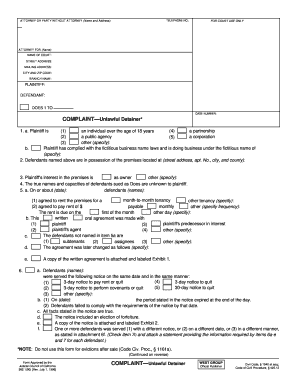
IFF: DEFENDANT: DOES 1 TO CASE NUMBER: COMPLAINT Unlawful Detainer* 1. a. Plaintiff is (4) a partnership (1) an individual over the age of 18 years (2) a public agency a corporation (5) other (specify): (3) Plaintiff has complied with the fictitious business name laws and is doing business under the fictitious name of b. (specify): 2. Defendants named above are in possession of the premises located at (street address, apt. No., city, and county): 3. Plaintiff's interest in the premises is a.
Open form follow the instructions
Easily sign the form with your finger
Send filled & signed form or save
How to fill out the CA 982.1(90) online
Filling out the CA 982.1(90) form online can seem daunting, but this guide will break down the process into simple steps. By following these instructions, users can complete the form accurately and efficiently.
Follow the steps to fill out the CA 982.1(90) online.
- Press the ‘Get Form’ button to obtain the CA 982.1(90) form and open it in your online document editor.
- Input your telephone number in the designated field at the top of the form.
- Provide the name and address of the attorney or the party without an attorney. This information should be placed in the appropriate section labeled 'Attorney or party without attorney.'
- Fill in the fields for 'For court use only,' including the attorney's name, name of the court, and street address.
- Enter the names of the plaintiff and defendant in the respective fields along with the case number.
- Complete the complaint section. Indicate the type of plaintiff and provide details about the defendants' possession of the premises.
- Describe the plaintiff's interest in the premises, including ownership details.
- In the section concerning rental agreements, specify the type of tenancy and rental payment frequency, including due dates.
- If applicable, attach any required documentation as exhibits and specify the details of notice served to the defendants.
- Provide any additional allegations or information regarding service of notice as needed.
- Complete the request for relief, indicating specific demands such as possession, damages, costs, and attorney fees.
- Fill in the information about unlawful detainer assistance, if applicable, and provide the assistant's registration details.
- At the end of the form, make sure to fill in your name, date, and sign where indicated.
- Once all fields are accurately filled, save your changes, and download, print, or share the completed form as needed.
Ensure your documents are completed correctly and efficiently by filling out the CA 982.1(90) form online today.
Experience a faster way to fill out and sign forms on the web. Access the most extensive library of templates available.
Related content
... ca.gov. Parties and counsel may also purchase loose-leaf copies of these rules for...
California Tenants—A Guide to Residential Tenants' and Landlords' Rights and...
Vajag konvertēt Brazīlijas reāls uz Zviedrijas krona? Currency.Wiki piedāvā uzticamu...
Get answers to your most pressing questions about US Legal Forms API.
How to get California climate credit?
To receive California climate credit, you must meet certain eligibility requirements set by the state. You generally need to file a tax return and provide information about your income and household size. The climate credit program aims to assist residents with rising costs associated with climate policies. Stay informed about the CA 982.1(90) provisions to ensure you're aware of any updates related to this program.
Who files a default judgment?
A default judgment is typically filed by the plaintiff in a case when the defendant fails to respond to a complaint. Following the provisions of CA 982.1(90), the plaintiff must provide evidence of proper service and the defendant's failure to respond. If you're unsure about the process, using a service like US Legal Forms can guide you through the necessary steps effectively.
What is the deadline for filing a default judgment in California?
In California, the deadline for filing a default judgment is typically within 10 days after the time for the defendant to respond has expired. However, CA 982.1(90) offers specific guidelines depending on the type of case. It’s essential to keep track of these important timelines to avoid potential dismissal of your request. Consulting resources like US Legal Forms can ensure you understand these deadlines clearly.
How to get California rap sheet?
To obtain a California rap sheet, you need to request a copy from the California Department of Justice. This process involves submitting a Request for Live Scan Service form along with payment. You may also need to provide fingerprints for identification. Knowing CA 982.1(90) regulations can help streamline your request process.
How to request a default judgment in California?
Requesting a default judgment in California involves submitting a specific form to the court as outlined in CA 982.1(90). You need to provide evidence that the defendant was properly served and has not responded within the required time frame. This process also includes a detailed account of your damages. Using platforms like US Legal Forms can simplify your paperwork and ensure compliance with legal requirements.
How to obtain a default judgment in California?
To obtain a default judgment in California, you must first file a request with the court. Ensure you follow CA 982.1(90) guidelines, which require you to provide necessary documentation and proof of service. After the filing, the court will set a hearing date. If you present your case effectively, the judge may grant your default judgment.
What is the cut-off date for discovery in California unlawful detainer?
The cut-off date for discovery in California unlawful detainer cases is generally set by the court after the initial case management conference. Both parties must abide by this timeline to exchange relevant information as required by CA 982.1(90). To streamline your preparations for discovery, consider using resources available through US Legal Forms for accurate forms and deadlines.
What happens after you file an answer to unlawful detainer in California?
Once you file an answer to an unlawful detainer in California, the court will schedule a trial to resolve the dispute. During this process, both the landlord and tenant can present their cases and evidence, including any relevant proof of service as per CA 982.1(90). Being prepared with the right documents can significantly impact the outcome, and US Legal Forms can assist you in gathering everything you need.
How do I legally serve an eviction notice in California?
To legally serve an eviction notice in California, you must deliver the notice personally or through a method allowed by law, such as certified mail. It’s important to follow the specific guidelines outlined in CA 982.1(90) to avoid complications. US Legal Forms can provide the correct formats and instructions to help you navigate serving an eviction notice properly.
What is proof of service for eviction in California?
Proof of service for eviction in California refers to a legal document that confirms the tenant received notice of the eviction action. This document is critical during court proceedings and must be prepared in accordance with CA 982.1(90). By using US Legal Forms, you can access templates that make this task straightforward and compliant with the law.
Use professional pre-built templates to fill in and sign documents online faster. Get access to thousands of forms.
If you believe that this page should be taken down, please follow our DMCA take down process here.