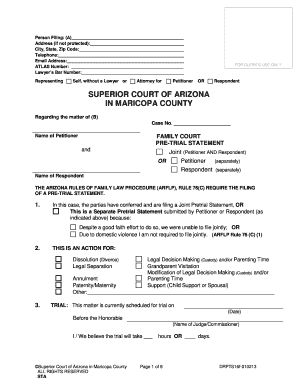
S ATTACHED, or below: 1. 2. 3. 4. 11. DETAILED AND CONCISE STATEMENT OF CONTESTED ISSUES OF FACT AND/OR LAW, below, or ATTACHED. 1. 2. 3. 4. 5. 6. 7. 8. 9. 10. 12. PETITIONER S DETAILED PROPOSAL FOR RESOLUTION OF CONTESTED ISSUES OF FACT AND LAW, below, or ATTACHED. 13. RESPONDENT S DETAILED PROPOSAL FOR RESOLUTION OF CONTESTED ISSUES OF FACT AND LAW, below, or ATTACHED. 14. DISCOVERY AND DISCLOSURE. All pretrial discovery and disclosure has been completed or will be completed by thi.

How it works
  • Open form

    Open form follow the instructions

  • Easily sign form

    Easily sign the form with your finger

  • Share form

    Send filled & signed form or save

How to fill out the AZ DRPTS16f online

This guide provides a step-by-step approach to completing the AZ DRPTS16f online. Designed to support users with various levels of experience, this resource will help you navigate the form with clarity and confidence.

Follow the steps to accurately complete the AZ DRPTS16f online

  1. Click the ‘Get Form’ button to access the AZ DRPTS16f form and open it in your preferred document editing tool.
  2. Begin by filling in the section labeled 'Person Filing.' Enter your name, address (if it is not protected), city, state, zip code, telephone number, and email address.
  3. Provide your ATLAS number and lawyer’s bar number if applicable, noting whether you are representing yourself or have an attorney.
  4. Proceed to the 'Superior Court of Arizona in Maricopa County' section. Enter the case number and the name of the petitioner and respondent as applicable.
  5. Complete the section regarding the nature of the action, selecting the appropriate options such as dissolution, legal separation, or custody.
  6. Fill out the trial details, including the scheduled trial date and the name of the judge or commissioner presiding over the case.
  7. List all parties involved in the action, including their names, addresses, ages, employers, and any relevant marriage details.
  8. If there are minor children involved, enter their names, dates of birth, and ages in the designated areas.
  9. Complete the witness and exhibit sections by checking the appropriate boxes and including details on any involved parties' witness and exhibit lists.
  10. Review the joint stipulations and admissions, contested facts, and proposals for resolutions by both the petitioner and the respondent.
  11. Make sure to finalize any additional discovery and disclosure information as required by the form.
  12. Incorporate your attorney information and signatures if representation is involved, or add your signatures as a self-represented party.
  13. Finally, after reviewing your entries, save your changes, and consider downloading or printing the completed form for your records.

Complete your AZ DRPTS16f online efficiently and ensure all your documentation is accurate.

Get form

Experience a faster way to fill out and sign forms on the web. Access the most extensive library of templates available.

Related content

Family Court Pretrial Statement DRPTS16f

This is a Separate Pretrial Statement submitted by Petitioner or Respondent (as indicated...

Learn more
UNIFIED FAMILY COURT - School of Law

Court forms: Arizona's Maricopa County Superior Court pro- vides pro se litigants with a...

Learn more
Questions & Answers

Get answers to your most pressing questions about US Legal Forms API.

Contact support

How to get temporary custody of a child in Arizona?

To obtain temporary custody in Arizona, you must file a petition with the court, outlining your reasons for seeking temporary custody. Be prepared to provide evidence that supports your request, such as emergencies or significant changes in the child’s current living situation. Using the AZ DRPTS16f can assist you in preparing a comprehensive petition to navigate this process effectively.

Winning full custody in Arizona requires more than just a strong desire for custody; it requires a solid plan. You should present evidence of your nurturing environment and demonstrate consistent involvement in your child’s life. Utilize AZ DRPTS16f to ensure your case is structured properly and addresses all necessary legal requirements for a successful custody petition.

Yes, obtaining full custody in Arizona can be a complex process. The courts emphasize the importance of both parents' roles, and they assess each situation carefully. To simplify your journey, utilize the AZ DRPTS16f to prepare essential documentation and strategies for presenting your case.

Judges in Arizona prioritize the child’s best interests when making custody decisions. They consider factors like the child's relationship with each parent, each parent's ability to provide for the child, and any history of domestic violence or substance abuse. To better understand these criteria and present your case effectively, the AZ DRPTS16f resources can be invaluable.

Getting full custody in Arizona can be challenging, especially if both parents are involved and seeking custody. Courts evaluate many factors, including the child’s needs, parental fitness, and the existing relationship with each parent. With the right preparation and guidance, including tools like AZ DRPTS16f, you can increase your chances of success.

Judges often favor parents who can show they provide a safe and loving home environment. Typically, candidates who demonstrate strong involvement in their child's life, good parenting skills, and a stable lifestyle are more likely to gain full custody. By utilizing the detailed resources of the AZ DRPTS16f as part of your preparation, you can effectively argue your case for full custody.

To build a case for full custody, focus on demonstrating your ability to provide a stable environment for your child. Gather evidence such as school records, witness statements, and documentation of your involvement in your child's life. The AZ DRPTS16f can guide you through this process, ensuring you present a compelling case that prioritizes your child's best interests.

Filling out a pre-trial statement involves collecting essential information about your case and presenting it clearly. You will need to outline your claims, defenses, and any evidence supporting your position. For convenience, consider using the resources available on the US Legal platform, including the AZ DRPTS16f forms, to streamline this process.

During a custody battle, avoid making derogatory statements about the other parent, as this can negatively impact your case. It's also unwise to express emotional volatility or make threats, as this may reflect poorly on your parenting capabilities. Instead, focus on constructive dialogue that emphasizes your commitment to the child’s well-being. AZ DRPTS16f can help you with tips on maintaining a positive approach during these challenging discussions.

In Arizona, child custody is determined after thorough consideration of several factors, including the child's age, needs, and the parents' capacity to meet those needs. The court also evaluates the child's relationship with each parent and any history of family violence. By preparing adequately and understanding these determinants, you can advocate effectively for your desired outcome. AZ DRPTS16f offers advice on how to navigate this process seamlessly.

Get This Form Now!

Use professional pre-built templates to fill in and sign documents online faster. Get access to thousands of forms.

If you believe that this page should be taken down, please follow our DMCA take down process here.

Get AZ DRPTS16f