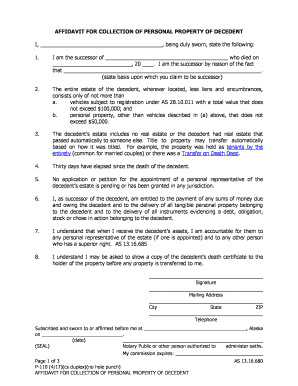
Te basis upon which you claim to be successor) . 2. The entire estate of the decedent, wherever located, less liens and encumbrances, consists only of not more than a. vehicles subject to registration under AS 28.10.011 with a total value that does not exceed $100,000; and b. personal property, other than vehicles described in (a) above, that does not exceed $50,000. 3. The decedent s estate includes no real estate or the decedent had real estate that passed automatically to someone else.

How it works
  • Open form

    Open form follow the instructions

  • Easily sign form

    Easily sign the form with your finger

  • Share form

    Send filled & signed form or save

How to fill out the AK P-110 online

The AK P-110 form, also known as the affidavit for collection of personal property of decedent, is essential for those claiming the assets of a deceased individual. This guide will provide a clear, step-by-step approach to assist users in completing this form accurately online.

Follow the steps to effectively fill out the AK P-110 form online.

  1. Press the ‘Get Form’ button to access the AK P-110 form and open it in your preferred editor.
  2. Begin by entering your name in the designated field, confirming your identity as the successor of the deceased.
  3. Specify the name of the deceased individual who passed away and the date of death.
  4. Indicate your basis for claiming to be the successor, providing sufficient details that justify your status.
  5. Complete the section detailing the entire estate, including the total value of registered vehicles and personal property that you are claiming.
  6. Affirm that no real estate is included in the estate or confirm if it automatically passed to another party.
  7. Acknowledge that 30 days have elapsed since the death of the deceased before submitting the affidavit.
  8. Confirm that no petition for the appointment of a personal representative is pending.
  9. Detail your entitlement to the payment of debts and delivery of personal property belonging to the deceased.
  10. Understand the responsibility of accounting for the assets to any appointed representative or other claimants.
  11. Prepare to show a copy of the deceased’s death certificate to the holder of the property if required.
  12. After filling in all necessary fields, save your changes, and take the opportunity to download, print, or share the completed form.

Get started on completing your AK P-110 form online today!

Get form

Experience a faster way to fill out and sign forms on the web. Access the most extensive library of templates available.

Related content

Affidavit For Collection of Personal Property of...

The P-110 affidavit allows a successor to collect personal property after 30 days, if the...

Learn more
Grammar Note 3

Keeping كان fixed in the masculine singular is very common as well (see AK page 110)...

Learn more
Motores CA

Jul 7, 2017 — 1. Observações gerais. 1.1. Utilização da documentação. Essa...

Learn more
Questions & Answers

Get answers to your most pressing questions about US Legal Forms API.

Contact support

What is an affidavit for collection of personal property in NC?

An affidavit for collection of personal property in North Carolina allows individuals to collect personal assets from the deceased without opening formal probate. This document can often simplify asset recovery. While this pertains specifically to North Carolina, if you find yourself in Alaska, consider the procedures that align with the AK P-110 for more complex situations.

The timeframe for receiving letters of testamentary typically depends on the court’s schedule and the complexity of your petition. Most commonly, you can expect to receive them within a few weeks after filing your probate petition. Being organized and having all required documents ready can expedite this process, particularly when navigating the AK P-110.

In Alaska, you generally have three years to file for probate after the individual passes away. However, it's advisable to file sooner, especially if there are valuable assets to manage. Prompt action can assist in aligning with requirements in the AK P-110 and ensure everything proceeds smoothly.

Probate duration in Alaska can vary greatly, typically ranging from several months to over a year. The complexity of the estate, the number of heirs, and if disputes arise can impact the timeline. Understanding these variables helps you prepare for what to expect when using the AK P-110 process.

An alternative to a letter of testamentary is a small estate affidavit. When the estate's value is below a certain threshold, this document allows heirs to collect assets without going through probate. Using a small estate affidavit can simplify asset management significantly, especially compared to the procedures outlined in the AK P-110.

To get a letter of testamentary in Alaska, begin by filing a petition with the appropriate probate court. Ensure you have the original will, a death certificate, and identification ready. After reviewing your petition, the court will issue the letter of testamentary, which is essential for executing the estate as defined in the AK P-110.

To order a testamentary letter, you need to file a petition for probate in the Alaska probate court. This petition requests the court to recognize the validity of the will, followed by submitting necessary documents. Once the court accepts your petition, it will issue the letter of testamentary, authorizing you to manage the deceased’s estate, including using the AK P-110.

Legal ownership of a Kalashnikov varies by state and local regulations. In many areas, semi-automatic variants are permitted under certain conditions, while others may have more restrictive rules. If you’re exploring ownership of the AK P-110 or similar models, consider consulting USLegalForms for guidance on navigating these legal waters effectively.

The term Kalashnikov refers broadly to the design and family of firearms created by Mikhail Kalashnikov, while the AK-47 is one specific model within that family. AK P-110 represents a more modern variant in this lineage. Understanding the distinctions between these terms is essential for discussions around firearm legislation and ownership.

Owning a full-auto AK is heavily regulated in the United States and generally requires a special federal license under the National Firearms Act. Only a limited number of full-auto weapons are available due to strict production laws from 1986 onward. For those interested in legal ownership of AK variants like the AK P-110, it’s advisable to consult legal resources or platforms like USLegalForms to ensure compliance with local laws.

Get This Form Now!

Use professional pre-built templates to fill in and sign documents online faster. Get access to thousands of forms.

If you believe that this page should be taken down, please follow our DMCA take down process here.

Get AK P-110