Open form follow the instructions
Easily sign the form with your finger
Send filled & signed form or save
How to fill out the Spending Diary online
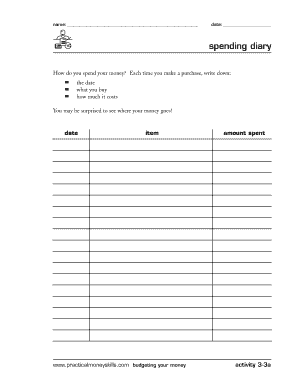
The Spending Diary is a valuable tool for tracking your expenditures and understanding your financial habits. This guide will assist you in completing the Spending Diary online, ensuring that you capture each of your spending activities accurately and efficiently.
Follow the steps to successfully complete your Spending Diary online.
- Click ‘Get Form’ button to retrieve the Spending Diary and open it within the online editor.
- Enter your name in the designated field at the top of the form to personalize your Spending Diary.
- Write the current date in the date field to document when you are completing this diary.
- For each purchase you make, record the date of the transaction in the 'date' section.
- In the 'item' field, specify the product or service that you purchased.
- Document the amount spent in the corresponding field to keep a clear record of your expenditures.
- As you fill out the diary, categorize each expense under the appropriate headings, such as Automobile, Food, Entertainment, etc.
- Once you have listed your expenditures, use the spending summary section to tally the total money spent in each category.
- Review your entries for accuracy.
- After completing your Spending Diary, you can save changes, download, print, or share the completed form as needed.
Start filling out your Spending Diary online today to gain better insight into your spending habits!
Experience a faster way to fill out and sign forms on the web. Access the most extensive library of templates available.
Related content
Use this worksheet to see how much money you spend this month. Also, use the worksheet to...
Directions. For one week, keep track of how you spend your money. At the end of the week...
Completing the hard Desert Diary and hard Fremennik Diary gives a 1/3 chance to reduce the...
Get answers to your most pressing questions about US Legal Forms API.
How to make a spending diary?
Creating a Spending Diary is simple and starts with choosing a format that works for you, whether it’s a physical notebook or a digital app. Record every expense, categorizing each entry to recognize patterns. Regularly review your entries to gain insights into your spending behaviors and adjust your budget accordingly.
How do you calculate the 50/30/20 rule?
To calculate the 50/30/20 rule, first determine your after-tax income. Next, divide this income into three categories: allocate 50% for needs (such as housing and bills), 30% for wants (like entertainment), and 20% for savings or debt repayment. Utilizing a Spending Diary can help you stay accountable and make necessary adjustments as you go.
Is the 50/30/20 rule a good idea?
Yes, the 50/30/20 rule is widely regarded as a practical and flexible budgeting strategy. It provides a clear framework for managing finances without being overly restrictive. Regularly reviewing your Spending Diary can help assess the effectiveness of this rule in your financial life.
What is the 75-15-10 rule?
The 75-15-10 rule directs individuals to spend 75% of their income on needs and wants, set aside 15% for savings, and dedicate 10% for debt repayment. This approach prioritizes living comfortably while not neglecting savings. You can keep track of these percentages in your Spending Diary, making adjustments as necessary.
What is the 70-10-10-10 budget rule?
The 70-10-10-10 budget rule suggests spending 70% of your income on living expenses, while allocating 10% each to savings, debt repayment, and charitable donations. This rules offers a different approach compared to others, focusing on balance and contribution. You can enhance this method by using a Spending Diary to maintain clarity in each category.
How do I track my own spending?
To track your spending, start by creating a Spending Diary where you record all your expenses daily. Note each item, categorize it, and analyze your spending patterns over time. This process not only helps in identifying areas to cut back but also ensures you stick to your budget.
How do you classify your expenses in your spending diary?
Classifying your expenses in a spending diary can be quite straightforward. You can categorize them into fixed, variable, and discretionary expenses. This classification helps you identify trends and make informed adjustments to better align your spending with your financial goals.
How do you write a financial diary?
Writing a financial diary involves documenting your financial goals, expenses, and reflections on your spending habits regularly. You can also include notes on areas where you succeeded or struggled. This approach offers a comprehensive view of your financial journey and can guide you toward better decisions.
What is the 50/30/20 spending rule?
The 50/30/20 spending rule is a simple guideline for budgeting. It suggests allocating 50% of your income to needs, 30% to wants, and 20% to savings and debt repayment. By following this structure, you can effectively manage your finances and ensure that your spending diary reflects a balanced approach.
How to make a spending journal?
To make a spending journal, start by selecting a format that works best for you, whether it's digital or paper. Create categories for different types of expenses, and consistently record every transaction you make, along with the date and purpose. This process will provide valuable insights into your spending patterns over time. You can use tools and templates available on uslegalforms to simplify the creation of your spending journal and enhance your financial organization.
Use professional pre-built templates to fill in and sign documents online faster. Get access to thousands of forms.
If you believe that this page should be taken down, please follow our DMCA take down process here.